Genome sequence of a bovine respiratory syncytial virus strain from a cow in Tennessee
Ola K. Elsakhawy, Ashkan Roozitalab, Mohamed A. Abouelkhair

TL;DR
This paper presents the genome sequence of a bovine respiratory syncytial virus strain found in a cow in Tennessee.
Contribution
The study provides an updated genome sequence of a currently circulating BRSV strain in the U.S.
Findings
The genome sequence of BRSV_23 was identified in a cow in Tennessee.
The sequence offers insights into BRSV evolution and epidemiology.
Abstract
We report the genome sequence of a bovine respiratory syncytial virus strain (hereafter referred to as BRSV_23), identified in a cow in Tennessee. This genome sequence updates the currently circulating BRSV field strains in the United States, providing insights into viral evolution and epidemiology to improve diagnostics and control strategies.
Genes, proteins, chemicals, diseases, species, mutations and cell lines named across the full text — each resolved to its canonical identifier and authoritative record.
Click any figure to enlarge with its caption.
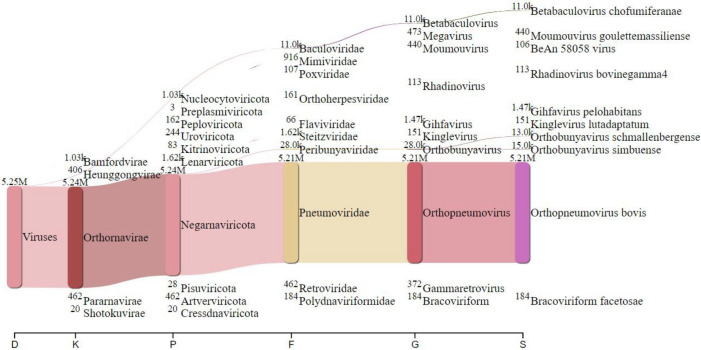 Fig 1
Fig 1| Accession | Strain/isolate | Host | % Identity of BRSV_23 to each strain | Coverage | Length (bp) | Completeness | Country | Collection_ |
|---|---|---|---|---|---|---|---|---|
|
| BRSV/Bovine/Italy/strain 48036/MA/2018 |
| 95 | 100 | 15,139 | Complete | Italy | 2018 |
|
| BO/SWUN-1/21/CH |
| 98 | 100 | 15,150 | Complete | China | 2021 |
|
| BO/SWUN-2/21/CH |
| 98 | 100 | 15,145 | Complete | China | 2021 |
|
| BO/SWUN-3/20/CH |
| 98 | 100 | 15,142 | Complete | China | 2020 |
|
| BO/SWUN-5/22/CH |
| 98 | 100 | 15,145 | Complete | China | 2022 |
|
| YAK/SWUN-1/21/CH |
| 98 | 100 | 15,143 | Complete | China | 2021 |
|
| A_BRSVDKp7 |
| 95 | 96 | 14,561 | Partial | Denmark | 2001 |
|
| C_7088BALd7 |
| 96 | 96 | 14,563 | Partial | Sweden | 2012 |
|
| C_7088NSd6 |
| 96 | 96 | 14,563 | Partial | Sweden | 2012 |
|
| D_3982BALd6 |
| 96 | 96 | 14,625 | Partial | France | 2014 |
|
| D_3996BALd7 |
| 96 | 96 | 14,625 | Partial | France | 2014 |
|
| F_8531BALd5 |
| 95 | 95 | 14,563 | Partial | Sweden | 2018 |
|
| F_8537NSd4 |
| 94 | 60 | 14,563 | Partial | Sweden | 2018 |
|
| F_SnookBAL2018 |
| 96 | 96 | 14,563 | Partial | United Kingdom | 2018 |
|
| G_2035BALd7 |
| 94 | 96 | 14,562 | Partial | Sweden | 2018 |
|
| G_2081BALd7 |
| 94 | 96 | 14,556 | Partial | Sweden | 2018 |
|
| O_AI12U20 |
| 94 | 96 | 14,562 | Partial | Sweden | 2020 |
|
| O_AJ22U20 |
| 94 | 96 | 14,562 | Partial | Sweden | 2020 |
|
| O_BE11J20 |
| 94 | 96 | 14,562 | Partial | Sweden | 2020 |
|
| O_BK11J20 |
| 94 | 96 | 14,562 | Partial | Sweden | 2020 |
|
| BRSV_NSWL4 |
| 86 | 87 | 13,416 | Partial | Australia | 2019 |
|
| BRSV\KS\467\2021 |
| 99 | 100 | 15,122 | Complete | USA | 2021 |
|
| BRSV\KS\090\2021 |
| 98 | 96 | 14,801 | Partial | USA | 2021 |
|
| DQ |
| 96 | 100 | 15,151 | Complete | China | 2018 |
|
| BRSV_Sweden_HPIG-SLU-620-Lovsta_2016 |
| 94 | 100 | 15,140 | Complete | Sweden | 2016 |
|
| USII/S1 |
| 99 | 100 | 15,123 | Complete | USA | 2015 |
Peer Reviews
No public reviews on file for this paper yet. If you reviewed it on a platform where reviews are public (OpenReview, ICLR, NeurIPS, ICML), you can paste yours below so the community can read it here.
Videos
No videos yet. Explain this paper in a talk, walkthrough, or lecture? Add one.
Taxonomy
TopicsRespiratory viral infections research · Bacteriophages and microbial interactions · Plant Virus Research Studies
ANNOUNCEMENT
Bovine respiratory syncytial virus (BRSV) is an enveloped virus with a single-stranded, negative-sense RNA genome that belongs to the Orthopneumovirus genus within the Pneumoviridae family (1). BRSV is a major viral pathogen in cattle, especially in young calves, and is a leading cause of respiratory illness (2). BRSV targets epithelial cells of the respiratory tract, inducing syncytia (fusion of infected cells), which leads to tissue damage, inflammation, and mucus buildup. This damage impedes airflow and creates an environment for secondary bacterial infections, further complicating the disease (2). Metagenomic sequencing improves diagnostic performance for respiratory infections by allowing for the unbiased detection of a wide range of pathogens, including bacteria, viruses, and fungi, in a single test (3, 4).
Lung tissue was obtained from a 4-month-old cow that had been euthanized due to respiratory disease in the summer of 2023 and was immediately analyzed using an in-house respiratory diagnostic quantitative polymerase chain reaction (qPCR) panel on a QuantStudio 3 system at the University of Tennessee College of Veterinary Medicine Diagnostic Laboratory. The panel, which tests for bovine respiratory syncytial virus, bovine viral diarrhea virus (BVDV), and infectious bovine rhinotracheitis (IBR), was positive for BRSV and negative for BVDV and IBR. For sequencing, 1 g of lung tissue was suspended in 0.5 mL of phosphate-buffered saline and thoroughly homogenized using a FastPrep-24 homogenizer (MP Biomedicals, USA). The RNA was extracted and purified using MagMAX Viral/Pathogen Nucleic Acid Isolation Kit (Thermo Fisher Scientific, USA). Samples were DNAse treated with Invitrogen DNAse (RNAse free) at a final concentration of 0.1 U/µL. The RNA quantity and quality were evaluated using a NanoDrop 2000 (Thermo Fisher Scientific, USA) and Qubit flex fluorometer (Fisher, Waltham, MA). Library preparation was performed using Illumina’s Stranded Total RNA Prep Ligation with Ribo-Zero Plus kit and 10 bp unique dual indices. Sequencing was performed using a NovaSeq X Plus platform, generating 150 bp paired-end reads, with a total of 37.8 million reads. Demultiplexing, quality control, and adapter trimming were performed with bcl-convert (v4.2.4). Metagenomics data analysis was performed using the Sunbeam pipeline (version 4.7.0) (5). Taxonomic classification was performed using Kraken2 (version 2.1.3) on Illumina reads (6, 7). The Kraken2 result was subsequently visualized using Pavian (version 1.0) with rank codes representing the taxonomic ranks of domain, kingdom, phylum, family, genus, or species (Fig. 1) (8). Out of the total 5,253,956 viral reads analyzed, a substantial proportion of 5,210,973 reads (99.18%) were classified as bovine respiratory syncytial virus. Then viral reads were assembled into contigs using MEGAHIT (version 1.2.9) (9, 10). The obtained genome of bovine respiratory syncytial virus was 15,146 nucleotides in size (GC content: 33.5%) and was annotated using Viral Annotation Pipeline and iDentification (VAPiD; version 1.2) (11). The final genome read coverage was 99035.2×. BRSV_23 showed identities of 86%–99% to the known bovine respiratory syncytial virus strains from GenBank (Table 1). All the sequence analysis described in this study was conducted utilizing the Jetstream2 cloud computing resource which is supported by the National Science Foundation (12). Default parameters were used except where otherwise noted.
Sankey diagram representing the Kraken2 report. The flow width corresponds to the number of reads, and the number above each node indicates the K-mer hits. A rank code was applied to denote domain (D), kingdom (K), phylum (P), family (F), genus (G), or species (S). Out of the total 5,253,956 viral reads analyzed, a substantial proportion of 5,210,973 reads (99.18%) were classified as BRSV.
This genome sequence provides an essential update on the currently circulating BRSV field strains in the United States, shedding light on viral evolution and epidemiology. This knowledge helps to improve diagnostic tools, vaccine design, and management techniques for more successful BRSV control.
The reference list from the paper itself. Each links out to its DOI / PubMed record.
- 1Rima B, Collins P, Easton A, Fouchier R, Kurath G, Lamb RA, Lee B, Maisner A, Rota P, Wang L Ictv Report Consortium 2017. ICTV virus taxonomy profile: Pneumoviridae. J Gen Virol 98:2912–2913. doi:10.1099/jgv.0.00095929087278 PMC 5775899 · doi ↗ · pubmed ↗
- 2Valarcher JF, Taylor G. 2007. Bovine respiratory syncytial virus infection. Vet Res 38:153–180. doi:10.1051/vetres:200605317257568 · doi ↗ · pubmed ↗
- 3Li Z, et al.. 2024. Diagnostic performance of metagenomic sequencing in patients with suspected infection: a large-scale retrospective study. Front Cell Infect Microbiol 14:1463081.39310785 10.3389/fcimb.2024.1463081 PMC 11412945 · doi ↗ · pubmed ↗
- 4Lin S, Chen Y, Li H, Chen T, Lin Q. 2024. Diagnostic value and clinical use of metagenomic next-generation sequencing for invasive pulmonary aspergillosis. Am J Transl Res 16:4885–4893. doi:10.62347/LDHU 738039398609 PMC 11470307 · doi ↗ · pubmed ↗
- 5Clarke EL, Taylor LJ, Zhao C, Connell A, Lee J-J, Fett B, Bushman FD, Bittinger K. 2019. Sunbeam: an extensible pipeline for analyzing metagenomic sequencing experiments. Microbiome 7:46. doi:10.1186/s 40168-019-0658-x 30902113 PMC 6429786 · doi ↗ · pubmed ↗
- 6Wood DE, Lu J, Langmead B. 2019. Improved metagenomic analysis with Kraken 2. Genome Biol 20:257. doi:10.1186/s 13059-019-1891-031779668 PMC 6883579 · doi ↗ · pubmed ↗
- 7Lu J, Rincon N, Wood DE, Breitwieser FP, Pockrandt C, Langmead B, Salzberg SL, Steinegger M. 2022. Metagenome analysis using the Kraken software suite. Nat Protoc 17:2815–2839. doi:10.1038/s 41596-022-00738-y 36171387 PMC 9725748 · doi ↗ · pubmed ↗
- 8Breitwieser FP, Salzberg SL. 2020. Pavian: interactive analysis of metagenomics data for microbiome studies and pathogen identification. Bioinformatics 36:1303–1304. doi:10.1093/bioinformatics/btz 71531553437 PMC 8215911 · doi ↗ · pubmed ↗