Complete genome sequence of Shigella phage Moonfish isolated from Mid-Michigan
Sundharraman Subramanian, Hazel McGuffin, Rachel Passage, John A. Dover, Kristin N. Parent

TL;DR
This paper reports the full genome sequence of a new Shigella phage, Moonfish, isolated from a cattle ranch in Michigan.
Contribution
The study provides the complete genome sequence and host range analysis of a novel Shigella phage.
Findings
Moonfish has a 69,166-bp genome and is similar to N4-like phages.
It has a narrow host range compared to other similar phages.
Abstract
A Shigella podophage, Moonfish, was isolated from a longhorn cattle ranch in Barry County, MI, USA. The 69,166-bp genome was annotated and places Moonfish in a similar category to N4-like phages. Host range studies show that Moonfish has a narrow host profile relative to similar phages.
Genes, proteins, chemicals, diseases, species, mutations and cell lines named across the full text — each resolved to its canonical identifier and authoritative record.
Click any figure to enlarge with its caption.
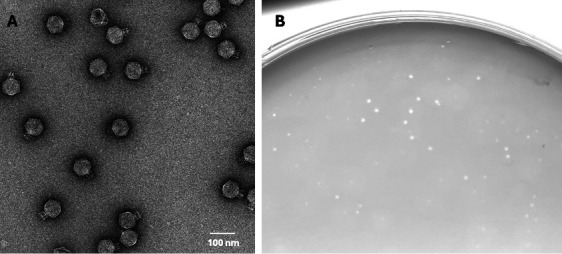 Fig 1
Fig 1| Bacterial host | Strain | Plaque (yes/no) | Strain reference |
|---|---|---|---|
|
| PE577 (serotype Y) | Yes | ( |
| CFS100 (serotype 2a2) | No | ( | |
|
| 14028s | No | ( |
|
| EV36 (K-12/K1 hybrid) | No | ( |
| MG1655 (K-12) | No | ( | |
| REL606 (B strain) | No | ( | |
| C122 (C strain) | No | ( |
- —National Institute of General Medical Scienceshttp://dx.doi.org/10.13039/100000057
- —National Science Foundationhttp://dx.doi.org/10.13039/501100008982
Peer Reviews
No public reviews on file for this paper yet. If you reviewed it on a platform where reviews are public (OpenReview, ICLR, NeurIPS, ICML), you can paste yours below so the community can read it here.
Videos
No videos yet. Explain this paper in a talk, walkthrough, or lecture? Add one.
Taxonomy
TopicsBacteriophages and microbial interactions · Genomics and Phylogenetic Studies · Viral gastroenteritis research and epidemiology
ANNOUNCEMENT
Shigella flexneri is the causative agent of shigellosis and is responsible for human disease worldwide (1). At the time we began our investigations, relatively few Shigella phages had been isolated compared with other enteric bacterial species. For example, there were only 34 known Shigella phages compared with thousands of Escherichia coli phages (2). Recently, we have been involved in Shigella phage-hunting activities to discover diverse species (3). Shigella podophages HRP29, Moo19, and B2 were isolated in Lincoln, NE, USA, as part of a high school phage-hunting exercise (4, 5). By contrast, no Shigella podophages have been isolated to date from our Michigan phage-hunting activities (6). As part of a graduate course in Fall 2018, we expanded our library of samples and found one podophage from Mid-Michigan.
Phage Moonfish was isolated from a water sample that stemmed from longhorn cattle trough water, collected on 4 September 2018 at GPS location: 42°26′50.5″N 85°14′22.0″W. The sample was collected in a sterile 50 mL conical tube and held at room temperature overnight. The sample was then filtered through a 0.22 µm syringe filter, and 500 µL of filtrate was propagated on Shigella flexneri serotype Y strain PE577 (7) using Miller’s LB Broth (Research Products International) in a top agar overlay at 37°C using standard protocols (3). Spot tests to gauge the host range were performed by combining bacterial cells in a double agar overlay method in triplicate, similar to the work previously described (6). Moonfish displayed a narrow host range with small, clear plaques (Table 1; Fig. 1) and is the only podophage we have isolated using serotype Y Shigella, with an unmodified O-antigen on the lipopolysaccharide (8); all others were isolated on and specific to strain CFS100, which is serotype 2a_2_ that has a highly decorated O-antigen (3, 5).
(A) Negatively stained micrograph of Moonfish, showing podophage morphology with short, non-contractile tails. Image was collected at MSU’s Cryo-EM Research Technology Support Facility on a Talos Arctica with a Ceta camera at 57,000× nominal magnification (pixel size 2.5 Å). (B) Plaque morphology of Moonfish.
The Moonfish genome was extracted as described from particles concentrated from clarified lysate (6). Samples were prepared for whole-genome sequencing using the Illumina DNA Prep tagmentation kit and Illumina Unique Dual Indexes. Sequencing was performed on the Illumina NextSeq2000 platform using a 300 cycle flow cell kit to produce 2 × 150 bp paired reads. Read demultiplexing, read trimming, and run analytics were performed using DRAGEN version 4.2.7, an onboard analysis software on the NextSeq2000. The purified genomes were sequenced by SeqCoast Genomics (Portsmouth, NH, USA). In total, we had 347,539,022 input bases with an average input read length of 148 bp. We then trimmed reads using the trim sequences application within Galaxy (15) version 24.1 and assembled using SPAdes version 4.0.0 into one contig with a final genome coverage of 542.07 (15, 16). GeneMarkS (17) was used to identify open reading frames, and both sequences were manually annotated using BLAST (18), InterPro scan (19), and tRNAscan-SE (20) using default parameters.
Moonfish is a 69,166-bp podophage with a 43% GC content, 82 genes, 44 annotated genes, and 1 tRNA. Moonfish is most similar to the N4-like phages, with ~78% nucleotide identity to Shigella phage Moo19 (using BLAST alignments using standard databases, nr, etc.) (18). Negative stain electron microscopy using 1% uranyl acetate reveals that Moonfish has podophage morphology (Fig. 1) and a similar structure to that of phages Moo19 and B2 (21).
The reference list from the paper itself. Each links out to its DOI / PubMed record.
- 1Connor TR, Barker CR, Baker KS, Weill F-X, Talukder KA, Smith AM, Baker S, Gouali M, Pham Thanh D, Jahan Azmi I, Dias da Silveira W, Semmler T, Wieler LH, Jenkins C, Cravioto A, Faruque SM, Parkhill J, Wook Kim D, Keddy KH, Thomson NR. 2015. Species-wide whole genome sequencing reveals historical global spread and recent local persistence in Shigella flexneri. Elife 4:e 07335. doi:10.7554/e Life.0733526238191 PMC 4522646 · doi ↗ · pubmed ↗
- 2S. S, Parent KN, Doore SM. 2020. Ecology, structure, and evolution of Shigella phages. Annu Rev Virol. doi:10.1146/annurev-virology-010320-052547 PMC 767096932392456 · doi ↗ · pubmed ↗
- 3Bittle C, Brittain K, Doore SM, Dover J, Drarvik SMB, Parent KN, Ratnayake R, Stone P, Schrad JR, Schrad K, Subramanian S, Tinney KR. 2023. Phage hunting in the high school classroom: phage isolation and characterization. Am Biol Teach 85:440–447. doi:10.1525/abt.2023.85.8.44039371917 PMC 11452010 · doi ↗ · pubmed ↗
- 4Doore SM, Schrad JR, Perrett HR, Schrad KP, Dean WF, Parent KN. 2019. A cornucopia of Shigella phages from the Cornhusker State. Virology (Auckl) 538:45–52. doi:10.1016/j.virol.2019.09.007PMC 700902131569014 · doi ↗ · pubmed ↗
- 5Subramaniam S, Bergland Drarvik SM, Tinney KR, Doore SM, Parent KN. 2024. Moo 19 and B 2: structures of schitoviridae podophages with T=9 geometry and tailspikes with esterase activity. Sci Adv In Press.10.1126/sciadv.adt 0022 PMC 1165468139693418 · doi ↗ · pubmed ↗
- 6Doore Sarah M., Schrad JR, Dean WF, Dover JA, Parent KN. 2018. Shigella phages isolated during a dysentery outbreak reveal uncommon structures and broad species diversity. J Virol 92. doi:10.1128/JVI.02117-17PMC 587440029437962 · doi ↗ · pubmed ↗
- 7Doore S.M, Subramanian S, Tefft NM, Morona R, Ter Avest MA, Parent KN. 2021. Large metabolic rewiring from small genomic changes between strains of Shigella flexneri J Bacteriol 203:e 00056-21. doi:10.1128/JB.00056-2133753469 PMC 8117524 · doi ↗ · pubmed ↗
- 8Teh MY, Furevi A, Widmalm G, Morona R. 2020. Influence of Shigella flexneri 2a O antigen acetylation on its bacteriophage Sf 6 receptor activity and bacterial interaction with human cells. J Bacteriol 202:e 00363-20. doi:10.1128/JB.00363-2032989087 PMC 7685545 · doi ↗ · pubmed ↗