Draft genome sequences of six Brucella melitensis isolates collected from humans and livestock in Tanzania
Earl A. Middlebrook, Ephrasia Hugho, Beatus Lyimo, Coletha Mathew, Charles Mayenga, Lingling Li, Nelson B. Amani, AbdulHamid Lukambagire, Happiness Kumburu, Lidia Munuo, Samson Lyimo, Gabriel Shirima, Rudovick R. Kazwala, Maurice Byukusenge, Blandina Mmbaga, Zachariah Makondo

TL;DR
This paper reports the genome sequences of six Brucella melitensis strains from Tanzania, offering insights into the spread of this disease in humans and livestock.
Contribution
The study provides new genome sequences of Brucella melitensis from Tanzania, enhancing understanding of local strain diversity.
Findings
Six Brucella melitensis isolates were sequenced from Tanzania’s Kagera region.
The genomes will aid in comparative genomics and brucellosis control strategies in East Africa.
Abstract
We present genome assemblies of six Brucella melitensis strains isolated from goats and humans in Tanzania’s Kagera region. These sequences provide insight into circulating Brucella strains in Tanzania and East Africa. These data will support future comparative genomics, epidemiological investigations, and regional brucellosis control strategies.
Genes, proteins, chemicals, diseases, species, mutations and cell lines named across the full text — each resolved to its canonical identifier and authoritative record.
Click any figure to enlarge with its caption.
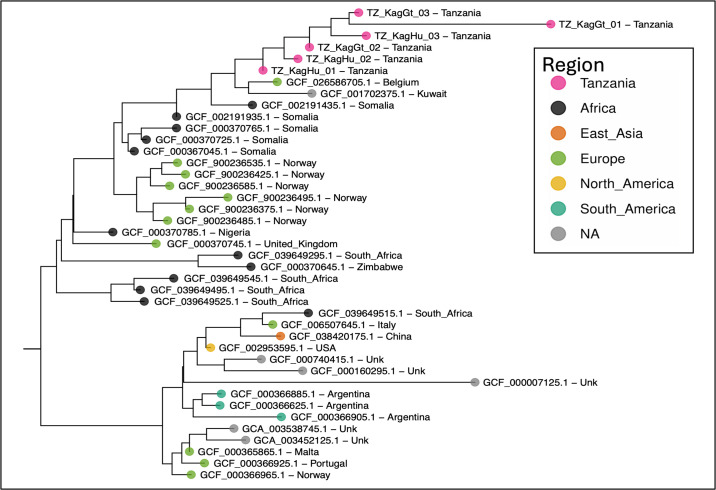 Fig 1
Fig 1| Sample | ||||||
|---|---|---|---|---|---|---|
| TZ_Kagera_H01 | TZ_Kagera_H02 | TZ_Kagera_H03 | TZ_Kagera_G01 | TZ_Kagera_G02 | TZ_Kagera_G03 | |
| Genome size | 3,280,749 | 3,281,053 | 3,281,099 | 3,277,679 | 3,283,154 | 3,283,061 |
| Contigs | 38 | 38 | 37 | 236 | 37 | 37 |
| Longest contig | 609,536 | 609,552 | 609,536 | 80,579 | 609,570 | 609,586 |
| N50 | 143,366 | 174,766 | 174,766 | 23,443 | 174,791 | 174,791 |
| Mean contig length | 86,335.50 | 86,343.50 | 88,678.35 | 13,888.47 | 88,733.89 | 88,731.37 |
| GC_percent | 0.57 | 0.57 | 0.57 | 0.57 | 0.57 | 0.57 |
| CDS | 3,125 | 3,128 | 3,126 | 3,195 | 3,129 | 3,129 |
| rRNA | 3 | 3 | 3 | 4 | 3 | 3 |
| tRNA | 49 | 51 | 50 | 50 | 51 | 51 |
| Coding density | 0.87 | 0.87 | 0.87 | 0.87 | 0.87 | 0.87 |
| Completeness | 99.45 | 99.45 | 99.45 | 99.06 | 99.45 | 99.45 |
| Contamination | 0.67 | 0.67 | 0.67 | 1.79 | 0.67 | 0.67 |
| NCBI BioSample |
|
|
|
|
|
|
| NCBI accessions |
|
|
|
|
|
|
| SRA accession |
|
|
|
|
|
|
| Raw reads | 3,302,222 | 3,294,052 | 3,219,745 | 13,196,957 | 3,211,131 | 3,081,903 |
| Collection GPS | −1.6034498 | −1.6034498 | −1.5346324 | −1.312585 | −1.312585 | −1.312585 |
- —Defense Threat Reduction Agencyhttp://dx.doi.org/10.13039/100000774
Peer Reviews
No public reviews on file for this paper yet. If you reviewed it on a platform where reviews are public (OpenReview, ICLR, NeurIPS, ICML), you can paste yours below so the community can read it here.
Videos
No videos yet. Explain this paper in a talk, walkthrough, or lecture? Add one.
Taxonomy
TopicsBrucella: diagnosis, epidemiology, treatment · Galectins and Cancer Biology · Burkholderia infections and melioidosis
ANNOUNCEMENT
The molecular epidemiology of brucellosis in Tanzania is critical for effective disease control. The country’s heterogeneous agricultural practices create complex multi-host transmission networks for Brucella species. Whole genome sequencing and phylogenetic analyses comparing Tanzanian isolates with global data sets provide insights into strain diversity and regional pathogen dissemination patterns across East Africa (1).
Brucella melitensis, the predominant cause of human brucellosis, poses significant public health challenges on the African continent (2, 3). Here, we present six Brucella melitensis isolates from the Kagera region of Tanzania, providing molecular insights into strain diversity from this important livestock-producing area. Three isolates were obtained from goat milk (TZ_Kagera_G0-) and three from human patients in Karagwe district (TZ_Kagera_H0-). The animals and humans sampled were from a region where goats intermingled with cattle and sheep during grazing. Goat milk was collected (~5 mL) into sterile Falcon tubes, pooled from all four quarters after cleaning the udder and discarding the first few drops. Collected milk was immediately stored at 18°C. For human subjects, 5 mL of blood was aseptically taken by registered nurses from the brachial vein using heparinized tubes and immediately stored at −20°C. Both blood and milk were cultured on Brucella selective medium (Farrell’s medium) under both aerobic and anaerobic conditions (5% CO_2_) at 37°C for about 4 days (4, 5). Suspected Brucella colonies were subcultured to obtain pure isolates. Cultures were incubated at 37°C in 5%–10% CO_2_ and observed for 10 days. Suspected Brucella-positive cultures were confirmed by subculture on Farrell’s medium and MacConkey agar (6).
Isolates were plated on blood agar and incubated at 37°C in 5%–10% CO_2_ for up to 3 days. Two to three colonies were selected, heat-inactivated at 100°C for 10 minutes (7), and DNA was extracted using a DNeasy Blood and Tissue Kit (Qiagen, Hilden, Germany). DNA quality was confirmed via qPCR targeting the Brucella-specific IS711 sequence (8), NanoDrop spectrophotometer, and Qubit 4.0 fluorometer. Genomic libraries were prepared using the Illumina DNA Prep kit. One sample was sequenced with the P1 600-cycle kit (Kagera_G01), and the others with the P1 300-cycle kit (2 × 151 bp reads), all on an Illumina NextSeq 2000 platform.
Sequence analysis was performed within the EDGE bioinformatics UI platform (v2.4.0) (9). Reads were trimmed and filtered using faQC (v2.08) (10) with three bases clipped from each end and removing reads below 20 average quality and/or 50 bp length. Reads were assembled using IDBA (v1.1.1) (11) with options "--pre_correction --mink 31 --maxk 121 --step 20 --min_contig 200.” CheckM (v1.2.2) (12) was used to estimate completeness and contamination, while Prokka (v1.14.5) (13) was used to predict coding sequences (CDSs), tRNAs, and rRNAs (Table 1). Contigs less than 700 bp long were filtered out of the final assemblies.
Phylogenetic relationship between the six new sequences and publicly available Brucella sequences shows the new sequences cluster tightly with the closest relatives being from Belgium, Kuwait, Somalia, and Norway (Fig. 1). These six new sequences increase our understanding of local B. melitensis strain diversity, supporting future comparative genomics, epidemiological studies, and regional brucellosis control efforts.
Phylogenomic tree of newly sequenced Brucella strains from Tanzania along with closely related sequences from NCBI assemblies. Leaves are labeled with NCBI’s accession and country of origin, and the symbol color at leaf tips indicates the broader region of origin, while the new sequences are indicated by pink symbols. Branch lengths are proportional to the inferred number of mutations/site. All splits are supported with 100% of aLRT 1000 replicates. Tree was inferred from all available B. melitensis assemblies in RefSeq/Genbank (accessed 3 Oct 2024) with the OrthoPhyl pipeline (v2.0) (14). OrthoPhyl was run with defaults except only strict single-copy orthologs were concatenated into the final codon supermatrix, and iqtree[] options “--lmap 2000 --symtest -B 1000 -t PARS --ninit 2 -m MFP -p partions.txt” were invoked. Tree was visualized with ggtree in R (15).
The reference list from the paper itself. Each links out to its DOI / PubMed record.
- 1Ducrotoy MJ, Bertu WJ, Ocholi RA, Gusi AM, Bryssinckx W, Welburn S, Moriyón I. 2014. Brucellosis as an emerging threat in developing economies: lessons from Nigeria. P Lo S Negl Trop Dis 8:e 3008. doi:10.1371/journal.pntd.000300825058178 PMC 4109902 · doi ↗ · pubmed ↗
- 2Georgi E, Walter MC, Pfalzgraf M-T, Northoff BH, Holdt LM, Scholz HC, Zoeller L, Zange S, Antwerpen MH. 2017. Whole genome sequencing of Brucella melitensis isolated from 57 patients in Germany reveals high diversity in strains from Middle East. P Lo S One 12:e 0175425. doi:10.1371/journal.pone.017542528388689 PMC 5384748 · doi ↗ · pubmed ↗
- 3Mc Dermott JJ, Arimi SM. 2002. Brucellosis in sub-Saharan Africa: epidemiology, control and impact. Vet Microbiol 90:111–134. doi:10.1016/s 0378-1135(02)00249-312414138 · doi ↗ · pubmed ↗
- 4Farrell ID. 1974. The development of a new selective medium for the isolation of Brucella abortus from contaminated sources. Res Vet Sci 16:280–286. doi:10.1016/S 0034-5288(18)33726-34369280 · doi ↗ · pubmed ↗
- 5Farrell ID, Robertson L. 1972. A comparison of various selective media, including a new selective medium for the isolation of brucellae from milk. J Appl Bacteriol 35:625–630. doi:10.1111/j.1365-2672.1972.tb 03744.x 4631240 · doi ↗ · pubmed ↗
- 6Gopalsamy SN, Ramakrishnan A, Shariff MM, Gabel J, Brennan S, Drenzek C, Farley MM, Gaynes RP, Cartwright EJ. 2021. Brucellosis initially misidentified as Ochrobactrum anthropi bacteremia: a case report and review of the literature. Open Forum Infect Dis 8:ofab 473. doi:10.1093/ofid/ofab 47334660837 PMC 8514177 · doi ↗ · pubmed ↗
- 7Wakjira BS, Jorga E, Lakew M, Olani A, Tadesse B, Tuli G, Belaineh R, Abera S, Kinfe G, Gebre S. 2022. Animal brucellosis: seropositivity rates, isolation and molecular detection in southern and central Ethiopia. Vet Med (Auckl) 13:201–211. doi:10.2147/VMRR.S 37245536060523 PMC 9431773 · doi ↗ · pubmed ↗
- 8Mancilla M, Ulloa M, López-Goñi I, Moriyón I, María Zárraga A. 2011. Identification of new IS 711 insertion sites in Brucella abortus field isolates. BMC Microbiol 11:176. doi:10.1186/1471-2180-11-17621813003 PMC 3163539 · doi ↗ · pubmed ↗