Draft genomic sequences of a rare environmental pathogen, Comamonas kerstersii, from immunocompromised patients with acute gastroenteritis
Mamatha Ballal, Sohan Rodney Bangera, Vignesh Shetty, Shashikiran Umakanth, Lauge Holm Sørensen, Rene S. Hendriksen

TL;DR
This paper reports the genome sequences of a rare bacteria found in patients with weakened immune systems and stomach infections.
Contribution
The study provides new genomic data for Comamonas kerstersii isolated from immunocompromised patients with acute gastroenteritis.
Findings
Genomic sequences of five C. kerstersii isolates were obtained from patients with acute gastroenteritis.
The isolates were from immunocompromised individuals, suggesting a potential pathogenic role of C. kerstersii in such cases.
Abstract
Comamonas kerstersii is a ubiquitous, aerobic, motile gram-negative bacteria considered commensal but has played a significant role as a potential pathogen causing clinical infections. Here, we report the genomic sequences of five C. kerstersii isolated from immunocompromised patients with acute gastroenteritis.
Genes, proteins, chemicals, diseases, species, mutations and cell lines named across the full text — each resolved to its canonical identifier and authoritative record.
Click any figure to enlarge with its caption.
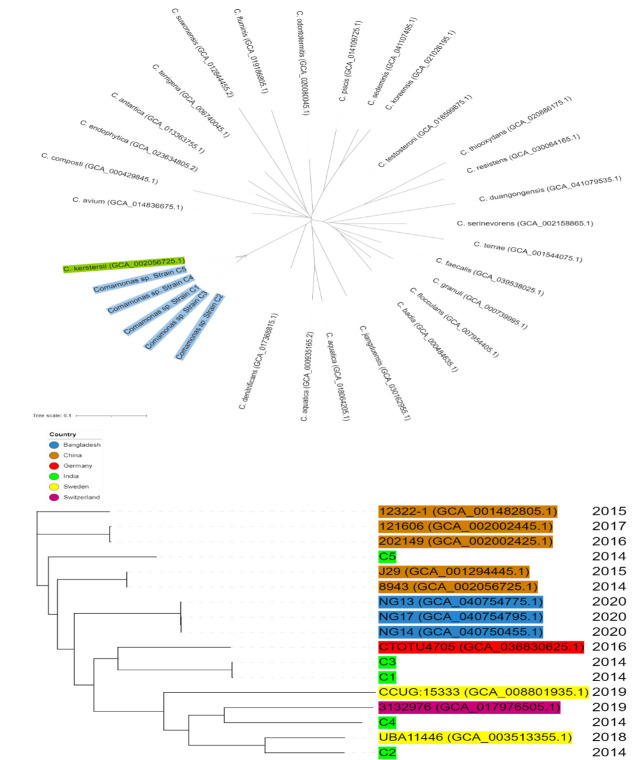 Fig 1
Fig 1Peer Reviews
No public reviews on file for this paper yet. If you reviewed it on a platform where reviews are public (OpenReview, ICLR, NeurIPS, ICML), you can paste yours below so the community can read it here.
Videos
No videos yet. Explain this paper in a talk, walkthrough, or lecture? Add one.
Taxonomy
TopicsInfections and bacterial resistance · Antibiotic Resistance in Bacteria · Bacterial biofilms and quorum sensing
ANNOUNCEMENT
Comamonas kerstersii, a gram-negative bacterium of the Comamonadaceae family, is globally found in water, soil, and gut microbiota (1). It is linked to abdominal and gastrointestinal infections, often in polymicrobial environments. Its role in diarrhea is unclear, typically associated with gastrointestinal perforations (2). We report draft genomic sequences of five C. kerstersii strains from immunocompromised patients with acute gastroenteritis. The study was approved by the Kasturba Medical College and Hospital Ethics Committee under approval number IEC1: 180/2024.
The strains were isolated in 2014 from patients with diarrhea admitted to a tertiary care hospital in India. Stool specimens were collected for routine microbiological investigation. The isolates were non-lactose-fermenting on MacConkey agar. Gram staining identified them as gram-negative bacilli. The isolates were motile by the hanging drop method, catalase positive, oxidase positive, indole negative, urea not hydrolyzed, citrate not utilized, and showed both slant and butt as alkaline on TSI medium without H₂S production. No hemolysis was observed on blood agar. These biochemical reactions may not conclusively identify the bacteria as Comamonas. For definitive identification, MALDI-TOF mass spectrometry confirmed the identification as Comamonas. The strains were subcultured on nutrient agar slopes, stored at 4°C, and then inoculated into brain heart infusion broth for 18–24 hours. Genomic DNA was extracted from the broth using the Invitrogen Easy-DNA Kit, and DNA concentrations were determined with the Qubit dsDNA BR assay kit. Paired-end libraries were prepared using the modified NEB library prep kit and sequenced (2 × 150 bp) on Illumina Hiseq, yielding average insert sizes of 255–259 bp. Bioinformatic tools were run with default settings unless otherwise stated. Trimming was performed with AdapterRemoval v. 1.1 (https://github.com/MikkelSchubert/adapterremoval) and de novo assembled with VelvetOptimiser v. 2.2.5 (https://github.com/tseemann/VelvetOptimiser/tree/2.2.5) with a maximum k-mer length of 99 and Velvet v. 1.2.07 (3). Estimated completeness, contamination, and routine QC metrics were found with CheckM2 v. 1.0.2 (4). Antimicrobial resistance genes and plasmids were predicted using ResFinder v. 4.5.0 (5) and PlasmidFinder v. 2.1 (6) ().
PathogenFinder v. 1.1 (http://cge.food.dtu.dk/services/PathogenFinder) (7) indicated C3 (ERS2626704) and C4 (ERS2626705) of the C. kerstersii as potential pathogens. VirulenceFinder v. 1.5 (https://cge.food.dtu.dk/services/VirulenceFinder/) (8) detected celb- Endonuclease colicin E2 in isolate C3 (ERS2626704). Assemblies were searched against VFDB (21-10-2024) (9) using blastn v. 2.16+ (10) identifying diverse potential virulence genes. All isolates contained analogs for secretion systems IV, VI, and motility proteins (motA, fliAIP). C1–C4 additionally contained system III proteins and fliN.
Single nucleotide polymorphism phylogenetic analysis using CSI Phylogeny v. 1.4 (https://cge.food.dtu.dk/services/CSIPhylogeny/) and FastTree v. 2.1.11 (11) produced maximum-likelihood phylogenies and a Mash v. 2.3 (12) comparison to reference genomes for Comamonas spp. from NCBI Genbank (genomes listed in). A phylogeny of strains C1–C5 with high-quality genomes of C. kerstersii from NCBI (n = 12) shows that C1 and C3 cluster closely together with considerable distance to and between C2, C4, and C5 (Fig. 1). Strains C1–C4 are more related to wastewater and feces isolates from the European countries. Strain C5 appears more related to clinical isolates from China. The diversity of the isolates indicates sporadic community infection.
Phylogenetic tree with SNPs of five strains of C. kerstersii, strains C1–C5, and NCBI reference genomes for each Comamonas spp. Strains C1–C5 are highlighted in blue; closest reference genome [C. kerstersii] is highlighted in green. C1–C5 and 12 high-quality draft genomes of C. kerstersii. Each strain is highlighted by country with year of isolation. NCBI genomes downloaded from the GenBank database. Visualized in Itol v. 6.9.1 [ref]. Genomes for C. testosterone sp. [GCA_016599875.1] and C. kerstersii sp. [GCA_002056725.1] were used as references for the top and bottom phylogenetic trees, respectively. Figure created with BioRender.com.
The reference list from the paper itself. Each links out to its DOI / PubMed record.
- 1Rong K, Delport J, Al Mutawa F. 2022. Comamonas kerstersii bacteremia of unknown origin. Case Rep Infect Dis 2022:1–3. doi:10.1155/2022/1129832 PMC 897732835387092 · doi ↗ · pubmed ↗
- 2Zhang Y, Li K, Zhan Y, Shi L, Zeng Y, Wang H, Lu Z. 2023. Bacteremia caused by Comamonas kerstersii in a patient with acute perforated appendicitis and localized peritonitis: case report and literature review. Front Med 10:1283769. doi:10.3389/fmed.2023.1283769 PMC 1073344538131046 · doi ↗ · pubmed ↗
- 3Zerbino DR, Birney E. 2008. Velvet: algorithms for de novo short read assembly using de Bruijn graphs. Genome Res 18:821–829. doi:10.1101/gr.074492.10718349386 PMC 2336801 · doi ↗ · pubmed ↗
- 4Parks DH, Imelfort M, Skennerton CT, Hugenholtz P, Tyson GW. 2015. Check M: assessing the quality of microbial genomes recovered from isolates, single cells, and metagenomes. Genome Res 25:1043–1055. doi:10.1101/gr.186072.11425977477 PMC 4484387 · doi ↗ · pubmed ↗
- 5Bortolaia V, Kaas RS, Ruppé E, Roberts MC, Schwarz S, Cattoir V, Philippon A, Allesøe RL, Rebelo AR, Florensa AF. 2020. Res Finder 4.0 for predictions of phenotypes from genotypes. J Antimicrob Chemother 75:3491–3500. doi:10.1093/jac/dkaa 34532780112 PMC 7662176 · doi ↗ · pubmed ↗
- 6Carattoli A, Zankari E, García-Fernández A, Voldby Larsen M, Lund O, Villa L, Aarestrup FM, Hasman H. 2014. Plasmid Finder and p MLST: in silico detection and typing of plasmids. Antimicrob Agents Chemother 58:3895–3903. doi:10.1128/AAC.02412-1424777092 PMC 4068535 · doi ↗ · pubmed ↗
- 7Cosentino S, Voldby Larsen M, Møller Aarestrup F, Lund O. 2013. Pathogen Finder--distinguishing friend from foe using bacterial whole genome sequence data. P Lo S ONE 8:e 77302. doi:10.1371/journal.pone.007730224204795 PMC 3810466 · doi ↗ · pubmed ↗
- 8Joensen KG, Scheutz F, Lund O, Hasman H, Kaas RS, Nielsen EM, Aarestrup FM. 2014. Real-time whole-genome sequencing for routine typing, surveillance, and outbreak detection of verotoxigenic Escherichia coli. J Clin Microbiol 52:1501–1510. doi:10.1128/JCM.03617-1324574290 PMC 3993690 · doi ↗ · pubmed ↗