Complete genome sequence of bacteriophage LMC infecting Listeria monocytogenes from fowl droppings
Jiyoon Chung, Yoonjee Chang

TL;DR
This paper reports the complete genome sequence of a phage that infects Listeria monocytogenes, isolated from fowl droppings.
Contribution
The novel contribution is the isolation and full genome characterization of a new bacteriophage targeting Listeria monocytogenes.
Findings
The phage LMC has a genome of 42,151 bp with a GC content of 36.58%.
It contains 59 open reading frames and has an icosahedral capsid with a long tail.
The phage shows strong antibacterial activity against L. monocytogenes ATCC 19115.
Abstract
Listeria monocytogenes-targeting phage (LMC) was isolated from fowl droppings, and its complete genome was analyzed. LMC consists of 42,151 bp with a GC content of 36.58% and contains 59 open reading frames. It has an icosahedral capsid and a long tail. It shows a high antibacterial ability against L. monocytogenes ATCC 19115.
Genes, proteins, chemicals, diseases, species, mutations and cell lines named across the full text — each resolved to its canonical identifier and authoritative record.
Click any figure to enlarge with its caption.
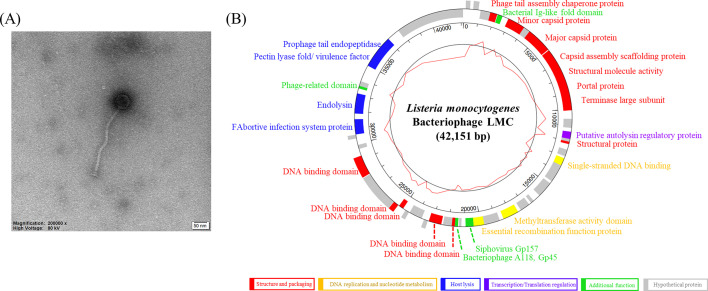 Fig 1
Fig 1| No. | Strains | Efficiency of plating (EOP) | ||
|---|---|---|---|---|
| 1 |
|
| ATCC 19115 | ++ |
| 2 | 20800818 | + | ||
| 3 | ATCC 19111 | − | ||
| 4 | LM-1 12 | − | ||
| 5 | LM-1 16 | − | ||
| 6 | KCCM 40307 | − | ||
| 7 | 20800013 | − | ||
| 8 | 20800014 | − | ||
| 9 | 20800015 | − | ||
| 10 | 20800016 | − | ||
| 11 | 20800018 | − | ||
| 12 | 20800019 | − | ||
| 13 | 20800020 | − | ||
| 14 | 20800021 | − | ||
| 15 | 20800022 | − | ||
| 16 | 20800023 | − | ||
| 17 | 20800024 | − | ||
| 18 | DH-1 | − | ||
| 19 | DH-2 | − | ||
| 20 | DH-3 | − | ||
| 21 | DH-4 | − | ||
| 22 |
| ATCC 33090 | + | |
| 23 | KCTC 3586 | + | ||
| 24 | ATCC 51742 | − | ||
- —National Research Foundation of Korea (NRF)
Peer Reviews
No public reviews on file for this paper yet. If you reviewed it on a platform where reviews are public (OpenReview, ICLR, NeurIPS, ICML), you can paste yours below so the community can read it here.
Videos
No videos yet. Explain this paper in a talk, walkthrough, or lecture? Add one.
Taxonomy
TopicsBacteriophages and microbial interactions · Listeria monocytogenes in Food Safety · Salmonella and Campylobacter epidemiology
ANNOUNCEMENT
Listeria is a Gram-positive genus that causes food poisoning (1). Listeria monocytogenes can adapt effectively to low-temperature, high-salinity environments and has high biofilm-forming ability (2). L. monocytogenes can be preserved in the global food chain with these characteristics. Consequently, Listeria contamination continues to be a problem in food production (3). To control this bacterium, substances such as antibiotics can be used, but it can lead to the development of antibiotic-resistant bacteria (4). Therefore, current studies focus on bacteriophages that can effectively control this bacterium without causing any antibiotic resistance (5).
This study aimed to isolate a new bacteriophage (phage) targeting Listeria and to analyze its characteristics. Phages can be isolated from environments rich in bacteria (6). Considering that L. monocytogenes is frequently associated with poultry, fecal samples from poultry were selected for phage isolation. LMC was isolated from poultry droppings using its host strain, L. monocytogenes ATCC 19115, in Dongtan, South Korea (37.2056°N, 127.0789°E). The host was cultured in brain heart infusion medium under aerobic conditions at 37°C. After purification, LMC produced a single, well-defined plaque on the overlaid host lawn, confirming its identity. Morphology was visualized by transmission electron microscopy (TEM) following negative staining with 2% uranyl acetate. Phage dimensions were measured from six independent replicates. Total genomic DNA was extracted using the phenol–chloroform method. Sequencing was performed on an Illumina HiSeq platform using 151 base pair (bp) paired-end reads, following library preparation with the TruSeq Nano DNA Library Prep Kit (Illumina, USA). Quality control was performed using FastQC version 0.11.5 (7), and trimming was done with Trimmomatic version 0.36 (8) under default settings. The average sequencing depth was 139×. The reads were assembled de novo using SPAdes version 3.15.5. Open reading frames (ORFs) were analyzed using GeneMarks, FgenesV software, and Rast, and annotated via InterProScan (https://www.ebi.ac.uk/interpro) and BLASTP (https://blast.ncbi.nlm.nih.gov/Blast.cgi). The genome map was generated using GeneScene version 0.99.8.0. The host range was confirmed via a spot assay. Phage lysate was dropped onto the lawn containing the host strain, and the extent of host lysis was measured. TEM revealed that LMC has an icosahedral capsid and a long tail, indicating it belongs to the Caudoviricetes class (Fig. 1A). The capsid size of LMC is approximately 57.35 ± 1.98 nm, and the tail width and length are 12.60 ± 1.00 nm and 288.98 ± 0.35 nm, respectively. LMC consists of a linear double-stranded DNA with 42,151 bp. It contains 36.58% GC and 59 ORFs (Fig. 1B). Specifically, 15 ORFs contribute to phage structure and packaging. Next, 3 ORFs are related to DNA replication, and 5 ORFs to host lysis. One ORF is assigned to transcriptional regulation. A total of 31 ORFs are implicated in hypothetical proteins, whereas 4 ORFs showed additional functions. The host lytic ability can be verified by the host range analysis (Table 1). LMC evidently and clearly killed L. monocytogenes ATCC 19115 with significant activity. Thus, the results of this study offer the first full sequencing and characteristics of a phage known as LMC, which can serve as a basis for further phage research.
(A) TEM image of phage LMC (measured from six independent replicates). The scale bar means 50 nm. (B) The genomic map of phage LMC. The outer circle shows the ORFs, and specific colors indicate the group with specific functions. The inner circle indicates the GC content. Each ORF is classified into six types and analyzed: (ⅰ) structure and packaging, (ⅱ) DNA replication and nucleotide metabolism, (ⅲ) host lysis, (ⅳ) transcription/translation regulation, (ⅴ) additional function, and (ⅵ) hypothetical protein.
The reference list from the paper itself. Each links out to its DOI / PubMed record.
- 1Gandhi M, Chikindas ML. 2007. Listeria: a foodborne pathogen that knows how to survive. Int J Food Microbiol 113:1–15. doi:10.1016/j.ijfoodmicro.2006.07.00817010463 · doi ↗ · pubmed ↗
- 2Osek J, Lachtara B, Wieczorek K. 2022. Listeria monocytogenes - how this pathogen survives in food-production environments? Front Microbiol 13:866462. doi:10.3389/fmicb.2022.86646235558128 PMC 9087598 · doi ↗ · pubmed ↗
- 3Ramaswamy V, Cresence VM, Rejitha JS, Lekshmi MU, Dharsana KS, Prasad SP, Vijila HM. 2007. Listeria--review of epidemiology and pathogenesis. J Microbiol Immunol Infect 40:4–13.17332901 · pubmed ↗
- 4Charpentier E, Courvalin P. 1999. Antibiotic resistance in Listeria spp. Antimicrob Agents Chemother 43:2103–2108. doi:10.1128/AAC.43.9.210310471548 PMC 89430 · doi ↗ · pubmed ↗
- 5Golkar Z, Bagasra O, Pace DG. 2014. Bacteriophage therapy: a potential solution for the antibiotic resistance crisis. J Infect Dev Ctries 8:129–136. doi:10.3855/jidc.357324518621 · doi ↗ · pubmed ↗
- 6Koskella B, Meaden S. 2013. Understanding bacteriophage specificity in natural microbial communities. Viruses 5:806–823. doi:10.3390/v 503080623478639 PMC 3705297 · doi ↗ · pubmed ↗
- 7Andrews S. 2010. Fast QC: a quality control tool for high throughput sequence data. Available from: http://www.bioinformatics.babraham.ac.uk/projects/fastqc/
- 8Bolger AM, Lohse M, Usadel B. 2014. Trimmomatic: a flexible trimmer for Illumina sequence data. Bioinformatics 30:2114–2120. doi:10.1093/bioinformatics/btu 17024695404 PMC 4103590 · doi ↗ · pubmed ↗