Near-complete genome sequencing of the feline coronavirus serotype I strain FIPV-Aqua from a cat with feline infectious peritonitis in Japan
Yoshikazu Tanaka, Eri Tanabe, Takashi Sasaki

TL;DR
This paper reports the near-complete genome sequence of a feline coronavirus strain from a cat in Japan with a fatal disease called feline infectious peritonitis.
Contribution
The study provides a new near-complete genome sequence of the feline coronavirus strain FIPV-Aqua.
Findings
The near-complete genome sequence of FIPV-Aqua was successfully determined.
This strain was isolated from a cat in Japan with feline infectious peritonitis.
Abstract
Feline coronavirus causes the fatal disease feline infectious peritonitis (FIP), for which no effective vaccine is currently available. Here, we present the near-complete genome sequence of the Japanese strain FIPV-Aqua.
Genes, proteins, chemicals, diseases, species, mutations and cell lines named across the full text — each resolved to its canonical identifier and authoritative record.
Click any figure to enlarge with its caption.
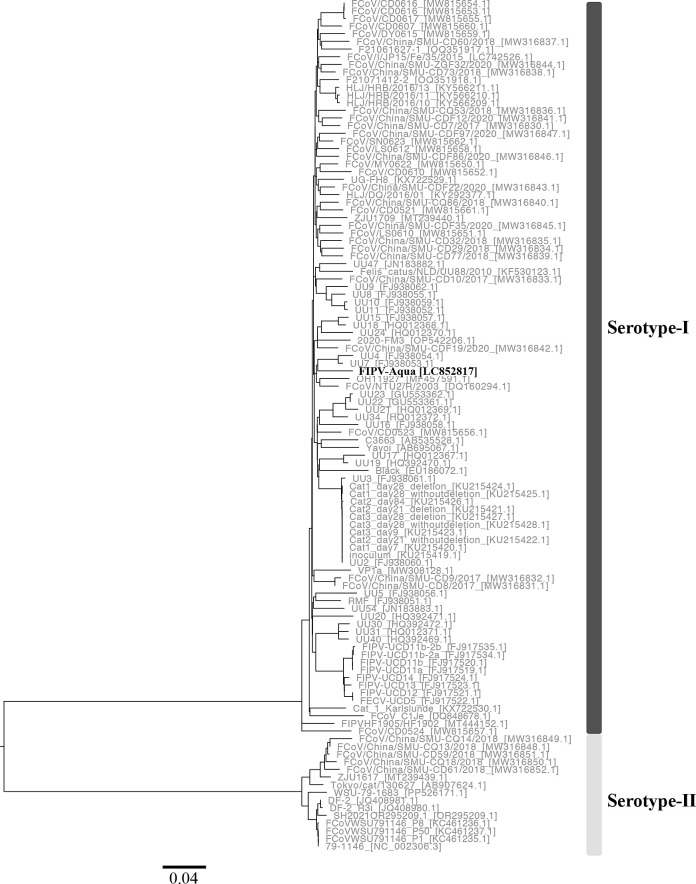 Fig 1
Fig 1- —Japan Society for the Promotion of Sciencehttp://dx.doi.org/10.13039/501100001691
Peer Reviews
No public reviews on file for this paper yet. If you reviewed it on a platform where reviews are public (OpenReview, ICLR, NeurIPS, ICML), you can paste yours below so the community can read it here.
Videos
No videos yet. Explain this paper in a talk, walkthrough, or lecture? Add one.
Taxonomy
TopicsAnimal Virus Infections Studies · Viral gastroenteritis research and epidemiology · Virus-based gene therapy research
ANNOUNCEMENT
Feline infectious peritonitis (FIP) is a fatal systemic granulomatous disease caused by feline coronavirus (FCoV), among the genus Alphacoronavirus in the family Coronaviridae (1). FCoVs are classified into serotypes I and II based on virus-neutralizing antibodies (2), with serotype I predominating in Japan (3). Understanding FCoV genetic diversity is key to vaccine developments for FIP; however, few studies have applied whole-genome sequencing to molecular epidemiology. We report the genome sequence of FCoV strain FIPV-Aqua from a cat with FIP in Japan.
The FCoV strain, FIPV-Aqua, was isolated from the pleural fluid of a 5-month-old male American shorthair cat. The patient presented with clinical signs suggestive of FIP. The FCoV gene was identified in the pleural effusion by reverse transcription quantitative PCR (4). Based on the observed symptoms and clinical biochemical findings, the cat was diagnosed with FIP. Samples were collected for clinical diagnosis of FIP, and institutional ethics approvals were not required for this work.
FCoV particles were isolated from fcwf-4 CU cells (5) infected with the pleural fluid of the cat. Total RNA was extracted from the cells using Isogen (Nippon Gene, Japan). The library was prepared using the Illumina Stranded mRNA Prep Ligation Kit (Illumina, USA). Sequencing was performed using a paired-end 2 × 151 bp cycle run on an Illumina NovaSeq 6000 system. We obtained a total of 162,760,371 reads; quality control and adapter trimming were performed by bcl-convert v3.9.3 (https://emea.support.illumina.com/sequencing/sequencing_software/bcl-convert.html). Using CLC Genomics Workbench v11 (Qiagen, Netherlands), after mapping to the genome sequence of Felis catus strain Fca126 (JAFEKA000000000.1) using 10% of trimmed reads, de novo assembly of the viral genome was performed using unmapped reads. To obtain the 5′ and 3′ terminal sequences of the viral genome, consensus sequences were generated by mapping analysis against the genome sequence of FCoV strain UU9 (FJ938062.1). Consequently, we generated a near-complete FCoV sequence without gaps. Gene annotation was performed based on the results of BLASTN analysis (https://blast.ncbi.nlm.nih.gov/Blast.cgi) against the reference FCoV serotype-I strains UU9 and C1Je (DQ848678) (6). Default parameters were used for all software unless otherwise specified.
The FIPV-Aqua strain was phylogenetically identified as serotype I based on amino acid sequences of spike protein using MEGA v7 (Fig. 1) (7), with a genome size and G+C content of 28,522 bp and 38.39%, respectively. This genome contains 11 open reading frames encoding seven nonstructural proteins (polyprotein 1ab, polyprotein 1a, and nonstructural proteins 3a, 3b, 3c, 7a, and 7b) and four structural proteins (spike, envelope, membrane, and nucleocapsid). The polyprotein 1ab and 1a genes encode 16 nonstructural proteins (nsp1 to nsp16). Overlapping regions between these two genes, as well as a slip-site sequence (5′-UUUAAAC-3′) within them, were identified, consistent with typical coronavirus strains (6). The spike gene of this strain exhibited a deletion at the 5′ end, resembling those observed in FCoV strains such as UU16 (FJ938058.1), UU21 (HQ012369.1), Cat_1_Karlslunde (KX722530.1), and HF1902 (MT444152.1).
Phylogenetic tree based on 111 full-length amino acid sequences of FCoV spike protein was constructed by the neighbor-joining method. Strain FIPV-Aqua in the present study and those obtained from the NCBI database were indicated by black and grey letters, respectively. GenBank accession numbers were shown within square brackets. FIPV-Aqua was clustered into the clade containing serotype I strains, but was not closely related to any strains.
This entry of FCoV strain FIPV-Aqua genome into GenBank will contribute to various studies, including genomics, ecology, and epidemiology of FIP and FCoV.
The reference list from the paper itself. Each links out to its DOI / PubMed record.
- 1Addie D, Belák S, Boucraut-Baralon C, Egberink H, Frymus T, Gruffydd-Jones T, Hartmann K, Hosie MJ, Lloret A, Lutz H, Marsilio F, Pennisi MG, Radford AD, Thiry E, Truyen U, Horzinek MC. 2009. Feline infectious peritonitis. ABCD guidelines on prevention and management. J Feline Med Surg 11:594–604. doi:10.1016/j.jfms.2009.05.00819481039 PMC 7129471 · doi ↗ · pubmed ↗
- 2Agostini ML, Andres EL, Sims AC, Graham RL, Sheahan TP, Lu X, Smith EC, Case JB, Feng JY, Jordan R, Ray AS, Cihlar T, Siegel D, Mackman RL, Clarke MO, Baric RS, Denison MR. 2018. Coronavirus susceptibility to the antiviral remdesivir (GS-5734) is mediated by the viral polymerase and the proofreading exoribonuclease. M Bio 9:e 00221-18. doi:10.1128/m Bio.00221-1829511076 PMC 5844999 · doi ↗ · pubmed ↗
- 3Tanaka Y, Sasaki T, Matsuda R, Uematsu Y, Yamaguchi T. 2015. Molecular epidemiological study of feline coronavirus strains in Japan using RT-PCR targeting nsp 14 gene. BMC Vet Res 11:57. doi:10.1186/s 12917-015-0372-225889235 PMC 4359392 · doi ↗ · pubmed ↗
- 4Tanaka Y, Tanabe E, Nonaka Y, Uemura M, Tajima T, Ochiai K. 2022. Ionophore antibiotics inhibit type II feline coronavirus proliferation in vitro. Viruses 14:1734. doi:10.3390/v 1408173436016355 PMC 9415497 · doi ↗ · pubmed ↗
- 5O’Brien A, Mettelman RC, Volk A, André NM, Whittaker GR, Baker SC. 2018. Characterizing replication kinetics and plaque production of type I feline infectious peritonitis virus in three feline cell lines. Virology (Auckl) 525:1–9. doi:10.1016/j.virol.2018.08.022PMC 648308730205273 · doi ↗ · pubmed ↗
- 6Dye C, Siddell SG. 2007. Genomic RNA sequence of feline coronavirus strain F Co V C 1Je. J Feline Med Surg 9:202–213. doi:10.1016/j.jfms.2006.12.00217363313 PMC 2582377 · doi ↗ · pubmed ↗
- 7Kumar S, Stecher G, Tamura K. 2016. MEGA 7: molecular evolutionary genetics analysis version 7.0 for bigger datasets. Mol Biol Evol 33:1870–1874. doi:10.1093/molbev/msw 05427004904 PMC 8210823 · doi ↗ · pubmed ↗