FUBP3: A new player in HIV-1 transcriptional activation and immune regulation
Manukumar Honnayakanahalli Marichannegowda, Mohamed S. Bouzidi, Satish K. Pillai

Abstract
Genes, proteins, chemicals, diseases, species, mutations and cell lines named across the full text — each resolved to its canonical identifier and authoritative record.
Click any figure to enlarge with its caption.
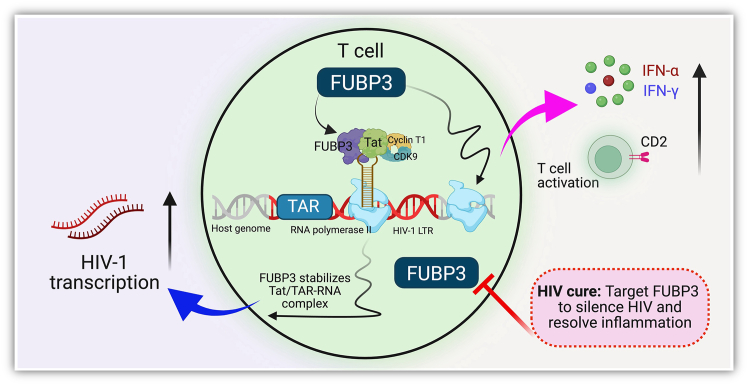 Figure 1
Peer Reviews
No public reviews on file for this paper yet. If you reviewed it on a platform where reviews are public (OpenReview, ICLR, NeurIPS, ICML), you can paste yours below so the community can read it here.
Videos
No videos yet. Explain this paper in a talk, walkthrough, or lecture? Add one.
Taxonomy
TopicsHIV Research and Treatment · HIV/AIDS drug development and treatment · Hepatitis C virus research
Main text
Despite effective antiretroviral therapy (ART), HIV-1 infection is not cured due to the persistence of a latent viral reservoir during treatment.1^,^2 HIV-1 cure strategies therefore focus on eliminating the HIV reservoir to prevent future viral rebound. Alternatively, a recently developed cure framework known as the “block-and-lock” strategy aims to permanently silence latent reservoirs, thereby preventing viral rebound and eventual immunodeficiency.3^,^4 Identifying host factors that regulate HIV-1 transcription and latency will be critical to the development of effective block-and-lock approaches. A recent detailed investigation published in Molecular Therapy Nucleic Acids by Gibaut et al. identifies the far upstream element-binding protein 3 (FUBP3) as a novel enhancer of HIV-1 transcriptional activity and a regulator of immune response pathways in T cells (Figure 1).5 This discovery of FUBP3 regulation of HIV-1 transcription may offer a promising new approach to reinforce viral silencing and advance the block-and-lock HIV cure strategy.Figure 1FUBP3 as a dual regulator of HIV-1 transcription and immune response in T cells
The Gibaut et al. investigation uses an innovative chromatin immunoprecipitation combined with mass spectrometry (ChAP-MS) technique, an unbiased approach, to discover FUBP3 as a significant player in HIV transcription. The interaction of FUBP3 with the HIV-1 trans-activator of transcription (Tat) protein was found to enhance viral transcription. Furthermore, the direct binding of FUBP3 to trans-activation response (TAR)-RNA and stabilization based on the presence of Tat were revealed, suggesting a cooperative mechanism for HIV-1 transcription.6 Interestingly, the FUBP3-TAR-Tat complex binds to promoters upstream of the transcription start site in the HIV long terminal repeat, which helps RNA polymerase II recruitment and elongation, thereby enhancing transcription.
The authors demonstrate that FUBP3 is a novel host factor that HIV-1 exploits to favor its replication using multiple mechanisms. Transcriptomic analysis showed that FUBP3 depletion could affect the expression of numerous host immune-related genes linked to T cell activation and inflammation. Genes such as CDK1 and KLHL8 and T cell receptor components such as CD2, CCR4, and IL7R were significantly downregulated. Also, the depletion of FUBP3 downregulates the pathways related to tumor necrosis factor alpha signaling via nuclear factor κB, interferon (IFN)-α, and IFN-λ suppression. The finding suggests a dual role of FUBP3 as an enhancer of HIV-1 transcription and an inhibitor of immune response pathways that indirectly suppress HIV transcription.
The Search Tool for the Retrieval of Interacting Genes/Proteins (STRING) protein-protein interaction analysis showed that the genes upregulated by FUBP3 are associated with cancer, cell migration, and nervous system development. Also, quantitative reverse-transcription PCR validated FUBP3-mediated induction of CCR4 and IL7R gene expression, suggesting that FUBP3 regulates the expression of T cell receptors, which influence T cell activation. The analyses of FUBP3 depletion effects on the host transcriptome yielded three key observations: (1) FUBP3 depletion downregulates several genes that are known to be involved in HIV transcription and replication, including CCR1, CCR2, CCR5, CD2, CD28, CD38, CD69, ITGAL, CDK1, and ribonucleotide reductase subunit M2, which plays a vital role in hepatitis B virus and cancer biology by maintaining the deoxyribonucleotide triphosphate pool for DNA biosynthesis and replication7^,^8; (2) FUBP3 depletion downregulates the transmembrane glycoprotein CD2 at both mRNA and protein levels in all investigated cell lines in the study. CD2 is a commonly found receptor on T cells, natural killer cells, thymocytes, and dendritic cells, which was identified as a cell surface biomarker of HIV latently infected resting CD4^+^ T cells in people living with HIV (PLWHs)9; and (3) FUBP3 depletion downregulates the nuclear receptors retinoic-acid-receptor-related orphan receptor β and γ, which are established cellular co-factors that support HIV-1 transcription in lymphoid tissue-resident Th17 cells. Taken together, the study’s findings suggest that FUBP3 directly facilitates HIV transcription and also has a broader impact on a range of host genes responsible for immune response, inflammation, and T cell activation, contributing multifactorially to viral persistence.
Despite promising results, the study also has limitations worth considering: (1) the study was primarily conducted in specific cell lines such as Jurkat and Jurkat-dervied latency (J-Lat) cells, which do not fully represent the complex scenario of HIV infection in primary human CD4^+^ T cells in vivo in the presence of multi-lineage cellular interactions; (2) the experiments focus solely on direct and indirect interactions of FUBP3 with HIV transcriptional machinery, but impacts on other aspects of the viral life cycle (e.g., translation of viral proteins or viral budding) are not extensively investigated; and (3) although the study reports that FUBP3 knockdown does not alter HIV-1 integration efficiency, the possibility exists that FUBP3 impacts the distribution of HIV integration sites in the host genome which may exert downstream effects on viral expression and reactivation. Future studies could leverage integration site analysis to reveal whether FUBP3 depletion may shift the integration site toward less transcriptionally active chromatin, which will clarify the observed reduction in HIV-1 gene expression.10 Delving deeper into the impacts of FUBP3 on HIV persistence in more physiologically relevant infection models will support a better understanding of the true therapeutic potential of FUBP3 as a pharmacological target, laying a strong foundation for future innovative HIV cure strategies.
In summary, the study by Gibaut et al. demonstrates that inhibiting FUBP3 may represent a novel strategy to suppress HIV-1 transcription, which could provide additional therapeutic value by simultaneously restoring normal immune function in PLWHs. Additional studies are needed to explore the relevance of these findings in vivo to determine if targeting of FUBP3 can complement ART and contribute to HIV cure strategies. Importantly, FUBP3 appears to be a broadly active transcriptional regulator and therefore may prove to be a valuable therapeutic target extending beyond HIV into other areas of virology and immunology.
Acknowledgments
M.H.M. and S.K.P. are supported by National Institutes of Health grants R01AI172754 and R01MH112457, and M.S.B. is supported by the University of California, California HIV/AIDS Research Program (H24BD7806).
Author contributions
M.H.M., S.K.P., and M.S.B. wrote the manuscript. M.H.M. and S.K.P. created the artwork.
Declaration of interests
The authors declare no competing interests.
The reference list from the paper itself. Each links out to its DOI / PubMed record.
- 1Finzi D.Hermankova M.Pierson T.Carruth L.M.Buck C.Chaisson R.E.Quinn T.C.Chadwick K.Margolick J.Brookmeyer R.Identification of a Reservoir for HIV-1 in Patients on Highly Active Antiretroviral Therapy Science 278199712951300936092710.1126/science.278.5341.1295 · doi ↗ · pubmed ↗
- 2Wong J.K.Hezareh M.Günthard H.F.Havlir D.V.Ignacio C.C.Spina C.A.Richman D.D.Recovery of Replication-Competent HIV Despite Prolonged Suppression of Plasma Viremia Science 278199712911295936092610.1126/science.278.5341.1291 · doi ↗ · pubmed ↗
- 3Ahlenstiel C.Mendez C.Lim S.T.H.Marks K.Turville S.Cooper D.A.Kelleher A.D.Suzuki K.Novel RNA Duplex Locks HIV-1 in a Latent State via Chromatin-mediated Transcriptional Silencing Mol. Ther. Nucleic Acids 42015 e 26110.1038/mtna.2015.31PMC 488175926506039 · doi ↗ · pubmed ↗
- 4Delviks-Frankenberry K.A.Ojha C.R.Hermann K.J.Hu W.S.Torbett B.E.Pathak V.K.Potent dual block to HIV-1 infection using lentiviral vectors expressing fusion inhibitor peptide m C 46- and Vif-resistant APOBEC 3G Mol. Ther. Nucleic Acids 3320237948093766296510.1016/j.omtn.2023.08.007PMC 10470399 · doi ↗ · pubmed ↗
- 5Gibaut Q.M.R.Li C.Cheng A.Moranguinho I.Mori L.P.Valente S.T.FUBP 3 enhances HIV-1 transcriptional activity and regulates immune response pathways in T cells Mol. Ther. Nucleic Acids 36202510252510.1016/j.omtn.2025.102525 PMC 1200592840248217 · doi ↗ · pubmed ↗
- 6Schulze-Gahmen U.Echeverria I.Stjepanovic G.Bai Y.Lu H.Schneidman-Duhovny D.Doudna J.A.Zhou Q.Sali A.Hurley J.H.Insights into HIV-1 proviral transcription from integrative structure and dynamics of the Tat:AFF 4:P-TE Fb:TAR complexe Life 52016 e 1591010.7554/e Life.15910 PMC 507284127731797 · doi ↗ · pubmed ↗
- 7Mazzu Y.Z.Armenia J.Chakraborty G.Yoshikawa Y.Coggins S.A.Nandakumar S.Gerke T.A.Pomerantz M.M.Qiu X.Zhao H.A Novel Mechanism Driving Poor-Prognosis Prostate Cancer: Overexpression of the DNA Repair Gene, Ribonucleotide Reductase Small Subunit M 2 (RRM 2)Clin. Cancer Res.252019448044923099607310.1158/1078-0432.CCR-18-4046 PMC 6820162 · doi ↗ · pubmed ↗
- 8Liu X.Xu Z.Hou C.Wang M.Chen X.Lin Q.Song R.Lou M.Zhu L.Qiu Y.Inhibition of hepatitis B virus replication by targeting ribonucleotide reductase M 2 protein Biochem. Pharmacol.10320161181282677445810.1016/j.bcp.2016.01.003 · doi ↗ · pubmed ↗