Correction: Hannotier et al. A CFO-Assisted Algorithm for Wireless Time-Difference-of-Arrival Localization Networks: Analytical Study and Experimental Results. Sensors 2024, 24, 737
Cédric Hannotier, François Horlin, François Quitin

Abstract
Genes, proteins, chemicals, diseases, species, mutations and cell lines named across the full text — each resolved to its canonical identifier and authoritative record.
Click any figure to enlarge with its caption.
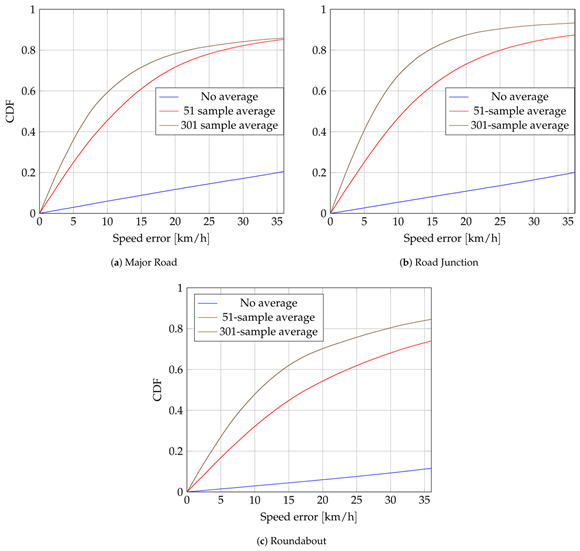 Figure 1
Peer Reviews
No public reviews on file for this paper yet. If you reviewed it on a platform where reviews are public (OpenReview, ICLR, NeurIPS, ICML), you can paste yours below so the community can read it here.
Videos
No videos yet. Explain this paper in a talk, walkthrough, or lecture? Add one.
Taxonomy
TopicsIndoor and Outdoor Localization Technologies · Energy Efficient Wireless Sensor Networks · Target Tracking and Data Fusion in Sensor Networks
Figure Correction
In the original publication [1], there was a mistake in Figure 10 as published. The corrected Figure 10 appears below.
Text Correction
-
In the original Section 3.3, the sentence “Figure 10 shows the eCDFs of the speed error for each scenario” has been updated to read “Figure 10 shows the eCDFs of the speed error for each scenario, defined as , where is the true velocity, the estimated one”.
-
In Section 3.3, Paragraphs 2–3 have been updated as follows:
Lowering increases the accuracy of the speed estimation. However, targets are not moving faster than 55 km/h and, 95% of the time, they do not reach 30 km/h. Hence, getting accurate speed estimations—relative to the target’s low speed—is challenging. eCDFs of the errors of direction, defined as the angle between actual and estimated velocities, are shown in Figure 11. This illustrates that the coarse estimation of the direction of the target is possible. It performs worse in roundabout scenarios. Apart from the higher , averaging over several measurements is less effective since it averages measurements with different directions.
The authors apologize for any inconvenience caused and state that the scientific conclusions are unaffected. The original article has been updated. This correction was approved by the Academic Editor. The original publication has also been updated.
The reference list from the paper itself. Each links out to its DOI / PubMed record.