OsEDS1 and OsPAD4 Are Involved in Brown Planthopper Resistance in Rice
Linzhi Fang, Rong Su, Cunyan Li, Xiaodong Liu, Yuanyuan Song, Rensen Zeng, Qiongli Wang, Haitao Cui, Daoqian Chen

TL;DR
This study identifies two genes, OsEDS1 and OsPAD4, that help rice resist brown planthoppers, a major rice pest.
Contribution
The study reveals the role of OsEDS1 and OsPAD4 in rice resistance to brown planthoppers through their regulation of defense-related hormones and genes.
Findings
Mutation in OsPAD4 or OsEDS1 increases rice susceptibility to brown planthoppers.
OsPAD4 and OsEDS1 regulate salicylic acid and jasmonic acid levels and defense gene expression in rice.
BPH infestation effects on hormone levels and gene expression are altered in OsPAD4 and OsEDS1 mutants.
Abstract
The crucial roles of the lipase-like protein enhanced disease susceptibility 1 (EDS1) and phytoalexin deficient 4 (PAD4) in disease resistance in Arabidopsis have been identified. However, their function in rice (Oryza sativa L.) resistance to brown planthopper (BPH, Nilaparvata lugens Stål), the most notorious pest of rice, remains unknown. In this study, the transcript levels of OsEDS1 and OsPAD4 were rapidly altered by BPH infestation. Mutation in either OsPAD4 or OsEDS1 resulted in increased rice susceptibility to BPH, which was associated with increased honeydew excretion and an increased host preference of BPH. Furthermore, mutation in either OsPAD4 or OsEDS1 led to decreased basal levels of salicylic acid (SA) and jasmonic acid (JA) in the absence of BPH, along with the depressed expression of the defense-responsive genes OsPAL, OsICS1, OsPR1a, OsLOX1, OsAOS1 and OsJAZ11 involved…
Genes, proteins, chemicals, diseases, species, mutations and cell lines named across the full text — each resolved to its canonical identifier and authoritative record.
Click any figure to enlarge with its caption.
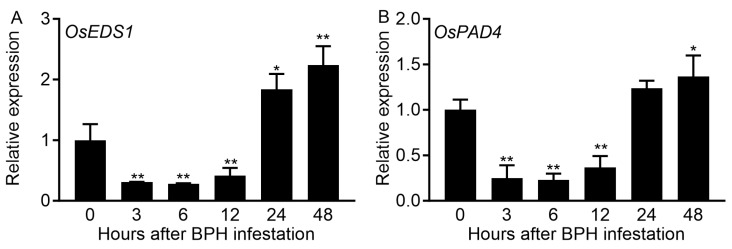 Figure 1
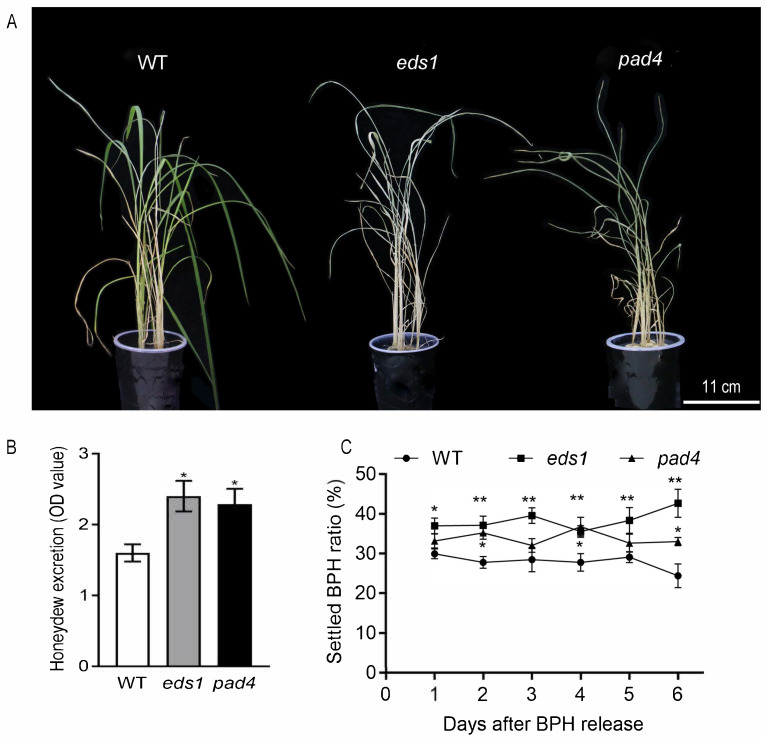 Figure 2
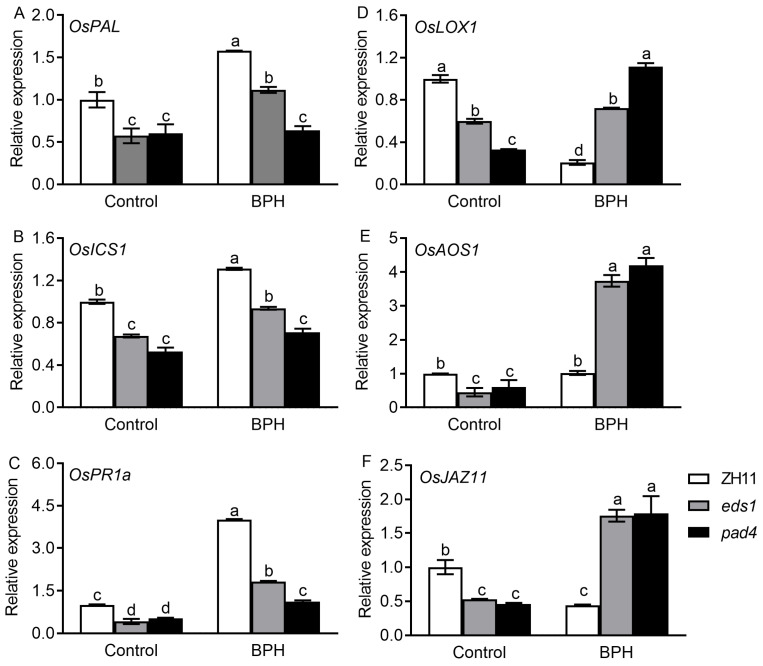 Figure 3
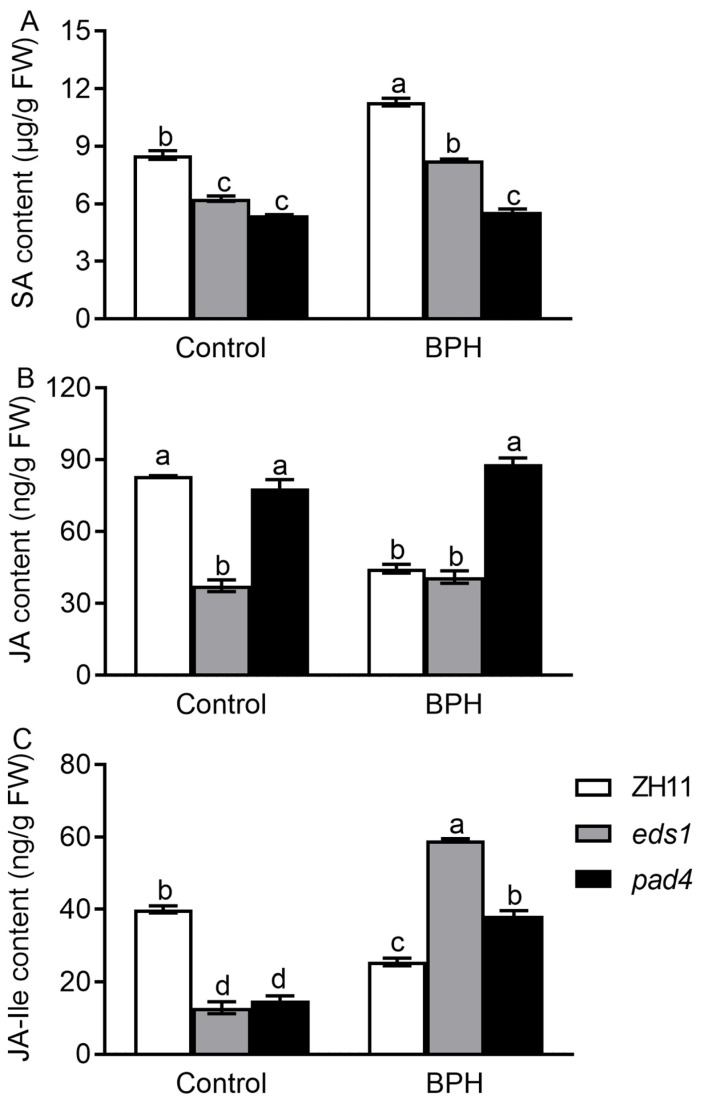 Figure 4
- —National Natural Science Foundation of China
- —Distinguished Young Scholars of Fujian Agriculture and Forestry University
Peer Reviews
No public reviews on file for this paper yet. If you reviewed it on a platform where reviews are public (OpenReview, ICLR, NeurIPS, ICML), you can paste yours below so the community can read it here.
Videos
No videos yet. Explain this paper in a talk, walkthrough, or lecture? Add one.
Taxonomy
TopicsInsect-Plant Interactions and Control · Plant Parasitism and Resistance · Plant Virus Research Studies
1. Introduction
Insect pests impost serious impacts on the production of rice (Oryza sativa L.) [1,2], a primarily staple food crop for half of the world’s population. The brown planthopper (BPH) (Nilaparvata lugens Stål) is the main insect pest in rice production throughout Asia [1]. As BPH is a rice-specific piercing-and-sucking herbivore, BPH attack not only results in severe damage, ‘hopperburn’, but also transmits rice viruses [3,4]. To date, the mainstay for crop protection against BPH remains chemical insecticides, which has resulted in insecticide resistance, environmental toxicity and concerns for human health [5]. Hence, it is particularly urgent to elucidate the mechanisms underlying rice–BPH interactions and develop resistant rice varieties to this notorious pest.
During millions of years of plant and insect co-evolution, plants have developed intricate defense systems against insect herbivores mediated by multiple signaling pathways, including the plant hormone jasmonic acid (JA) and salicylic acid (SA) signaling pathways [5]. JA is generally considered to play a major role in response to chewing herbivores, while SA is a critical mediator of plant defense responses against sucking herbivores [6,7,8]. In the case of rice–BPH interactions, SA is widely recognized as the key component of rice defenses against BPH. BPH infestation elevates SA levels and gene expression related to SA biosynthesis, particularly in resistant varieties [9,10,11,12]. The expression of NahG, which encodes the bacterial salicylate hydroxylase eliminating SA accumulation, decreases rice resistance to BPH [13]. The knockdown of SA biosynthesis genes encoding phenylalanine ammonia lyase (PAL) leads to sensitivity to BPH, while the overexpression of OsPAL6 and OsPAL8 enhances rice resistance to BPH [13]. Moreover, the SA pathway is activated after BPH infestation in BPH14-, BPH29- and BPH9-mediated resistance [14,15,16]. On the other hand, several studies indicate that the JA pathway also plays an important role in rice defenses against BPH, particularly in susceptible varieties [17,18]. These observations suggest that the roles of these defense hormones in rice defense against BPH are complicated and depend on the rice genotype.
The functions of the lipase-like protein enhanced disease susceptibility 1 (EDS1) and phytoalexin deficient 4 (PAD4) as key immune activators in plant immunity have been extensively studied [19,20,21,22,23,24,25,26]. In Arabidopsis thaliana, AtEDS1 and AtPAD4 function together to confer both basal immunity and effector-triggered immunity (ETI) by stimulating the production of SA and antimicrobial molecules during plant–pathogen interaction [24,27]. It is recognized that activated TNL receptors (intracellular nucleotide-binding leucine-rich repeat receptors with N-terminal Toll–interleukin 1 receptor domains) stimulate AtEDS1-PAD4 basal immunity activity to transcriptionally boost SA levels and repress JA pathways in Arabidopsis [24,26]. Moreover, AtPAD4, independently of AtEDS1, functions in resistance to the phloem sap-feeding green peach aphid (Myzus persicae Sülzer) [28,29]. Further studies reveal that AtPAD4-mediated defense against green peach aphids is independent of SA or camalexin production [30]. The AtPAD4 lipase-like domain is sufficient for Arabidopsis aphid resistance but not for the AtEDS1-dependent activation of basal and effector-triggered pathogen immunity [31]. These results suggest that AtEDS1-PAD4 appears to regulate Arabidopsis resistance against pathogens and aphids in a distinct manner. Notably, both OsEDS1 and OsPAD4 also play positive roles in rice resistance to pathogens, whereas they mediate rice resistance against Xanthomonas oryzae in a JA-dependent, but not SA-dependent, manner compared with their orthologs in Arabidopsis [22,23]. Recently, it was unveiled that the OsEDS1-OsPAD4-OsADR1 immune complex controls rice immune homeostasis and multipathogen resistance with a fundamentally conserved immune-triggering and signaling mechanism in Arabidopsis and rice [32,33]. However, whether and how OsEDS1 and OsPAD4 are involved in the rice–BPH interaction remain unknown.
Previous studies indicate that the expression patterns of OsEDS1 and OsPAD4 are altered by BPH infestation and that they display differential expression in resistant and susceptible rice varieties during BPH attack, implying the potential involvement of OsPAD4 and OsEDS1 in rice resistance against BPH [9,10,11,12]. Here, OsPAD4- and OsEDS1- knockout plants were generated to examine the roles of these immune proteins in rice–BPH interactions. Our results reveal that both OsPAD4 and OsEDS1 positively regulate rice defense response against BPH, possibly by modulating the SA and JA signaling pathways.
2. Results
2.1. BPH Infestation Influences Expression Levels of OsEDS1 and OsPAD4
To determine whether OsEDS1 and OsPAD4 are involved in rice response to BPH infestation, the transcript levels of these two genes in leaf sheaths infested by BPH were monitored by qRT-PCR. The expression levels of both OsEDS1 and OsPAD4 decreased at 3–12 h, then slightly increased at 24 and 48 h after BPH infestation (Figure 1).
2.2. Mutations in OsPAD4 and OsEDS1 Decrease Rice Resistance to BPH
To further investigate the roles of OsEDS1 and OsPAD4 in rice–BPH interactions, OsEDS1 and OsPAD4 knockout rice lines were generated by CRISPR-Cas9 technology inducing a 32 bp deletion at the 2 site from ‘ATG’ (eds1) and a ‘T’ insertion at the 452 site from ‘ATG’ (pad4), respectively, in the ZH11 background (Figure S1A). Both eds1 and pad4 plants did not exhibit abnormal growth phenotypes except for a slight decrease in plant height under normal conditions (Figure S1B,C). Both eds1 and pad4 plants showed significant increased susceptibility to BPH infestation. After 7 days of BPH feeding, both eds1 and pad4 plants were more severely damaged than ZH11 plants (Figure 2A). Honeydew excretion, a solid indicator of BPH feeding and hence host suitability, was 50.00% and 43.12% higher for the insects feeding on eds1 and pad4 plants, respectively, relative to those on ZH11 plants (Figure 2B). Moreover, a host choice behavior test showed that BPH preferred to feed on eds1 and pad4 plants compared with ZH11 plants. Among the three genotypes, the settled ratio of BPH nymphs was the highest on the eds1 plant, the lowest on ZH11 plants and intermediate on the pad4 plant at almost all time points tested (Figure 2C). However, there was no difference between the three genotypes for the survival rate of BPH after 7 days of infestation (Figure S2).
2.3. Mutations in OsEDS1 and OsPAD4 Alter the Expression of Defense-Responsive Genes
To investigate how OsEDS1 and OsPAD4 affect rice resistance to BPH, we analyzed the expression levels of defense-responsive genes in ZH11 plants and OsEDS1 and OsPAD4 knockout rice lines by qRT-PCR analysis. The transcript of SA biosynthesis genes OsPAL (phenylalanine ammonia-lyase) and OsICS1 (isochorismate synthase 1) and SA signaling downstream defense-related gene OsPR1a (basic pathogenesis-related gene 1a) was induced by BPH infestation. However, their transcript levels were all significantly lower in eds1 and pad4 plants compared with ZH11 plants under both uninfested (control) and BPH-infested conditions (Figure 3A–C). The transcript levels of JA biosynthesis and signaling genes OsLOX1 (lipoxygenase 1), OsAOS1 (allene oxide synthase 1) and OsJAZ11 (jasmonate-zim domain 11) were significantly depressed in eds1 and pad4 plants in the absence of BPH. Their transcript levels were repressed by BPH infestation in ZH11 plants, whereas they were elevated by BPH infestation in eds1 and pad4 plants. After BPH infestation, the expression levels of OsLOX1, OsAOS1 and OsJAZ11 were all significantly higher in eds1 and pad4 plants compared with ZH11 plants (Figure 3D,E).
2.4. Mutations of OsEDS1 and OsPAD4 Impair BPH-Induced SA and JA Modulation
To further confirm the roles of OsEDS1 and OsPAD4 in modulating the SA and JA pathways, we determined the endogenous SA and JA levels in ZH11 plants and OsEDS1 and OsPAD4 knockout rice lines after BPH infestation. In line with the expression of defense-responsive genes, SA levels were elevated by BPH infestation, but they were significantly lower in eds1 and pad4 plants compared with ZH11 plants under both control and BPH infestation conditions (Figure 4A). In the absence of BPH, eds1 plants had significantly lower contents of both JA and JA-Ile than ZH11 plants, while pad4 plants had comparable JA levels but less JA-Ile than ZH11 plants. Both JA and JA-Ile levels were reduced by BPH infestation in ZH11 plants. JA levels remained unchanged in both eds1 and pad4 plants after BPH infestation, yet JA-Ile levels were increased by BPH infestation in both eds1 and pad4 plants.
3. Discussion
EDS1 and PAD4, a pair of sequence-related partners originally characterized in Arabidopsis, are two well-known positive regulators in plant immunity. Arabidopsis AtEDS1 and AtPAD4 form EDS1-PAD4 complexes to transduce immune signals and promote both pattern-triggered immunity (PTI) and effector-triggered immunity (ETI). Recent studies found that OsEDS1 and OsPAD4, the sequence homologs of AtEDS1 and AtPAD4, respectively, also play crucial positive roles in rice immune homeostasis and multipathogen resistance [33]. It has been frequently reported that BPH infestation also influences the expression levels of OsEDS1 and OsPAD4 [9,10,11,12]. However, the roles of OsEDS1 and OsPAD4 in the rice–BPH interaction remain unknown. In this study, the transcript levels of OsEDS1 and OsPAD4 in rice sheaths were rapidly responsive to BPH infestation (Figure 1). Mutations in either OsPAD4 or OsEDS1 resulted in increased rice susceptibility to BPH, along with increased honeydew excretion and an increased host preference of BPH (Figure 2). These results indicated that OsPAD4 and OsEDS1 are also important positive regulators in rice resistance against BPH, which causes the most serious damage to rice crops among all rice insect pests globally. Further analyses illustrated that impaired BPH resistance was associated with repressed SA signaling and boosted JA signaling in eds1 and pad4 mutants (Figure 3 and Figure 4). Therefore, our findings suggested that OsPAD4 and OsEDS1 might regulate rice defense response against BPH by modulating SA and JA signaling.
In Arabidopsis, EDS1-PAD4 heterodimer-mediated PTI and ETI defenses involve the transcriptional boosting of the SA pathway and the depression of the JA pathway [20,24,26,34,35]. EDS1-PAD4 not only enhances the expression of the SA biosynthesis gene of ICS1, but it also promotes a large number of SA-responsive genes in parallel with SA accumulation [24]. Moreover, EDS1-PAD4 could dampen the JA signaling pathway by suppressing the master transcription factor MYC2, which in turn boosts SA signaling [20]. In rice, OsEDS1 and OsPAD4 are also found to be positive regulators in rice–pathogen interactions, and cryo-electron microscopy structure analysis unveiled the fact that the OsEDS1-OsPAD4-OsADR1 (activated disease resistance 1) immune complex controls rice immune homeostasis and multipathogen resistance, which is a fundamentally conserved immune-triggering and signaling mechanism in Arabidopsis and rice [32,33]. In the present study, mutation in either OsPAD4 or OsEDS1 dampened BPH infestation-boosted SA signaling, but it reversed BPH infestation-depressed JA signaling (Figure 3 and Figure 4). These findings suggested that OsEDS1 and OsPAD4 might confer rice resistance against BPH in a conserved manner by boosting the SA pathway and dampening the JA pathway in rice–BPH interactions. In addition, it is reported that OsEDS1 and OsPAD4 positively regulate rice immunity against X. oryzae in a JA-dependent manner [22,23]. In this study, the depression of the JA signaling pathway in eds1 and pad4 mutants was also observed in the absence of BPH, but the JA signaling pathway was fundamentally enhanced by a mutation in either OsPAD4 or OsEDS1 after BPH infestation (Figure 3 and Figure 4). Therefore, it is possible that OsEDS1 and OsPAD4 share both similarities and differences with their Arabidopsis orthologs in a way to regulate pathogen resistance, and they might function in rice–pathogen interactions and rice–BPH interactions in a distinct manner.
Phytohormones SA and JA are essential for controlling defense signaling in plant resistance against insect pests [5]. It is generally considered that SA and JA play distinct roles in mediating plant antiherbivore defenses against chewing and phloem-feeding insects [8]. However, in the case of rice–BPH interactions, the roles of these defense hormones in rice defense response are complicated and depend on the rice genotype. SA is widely recognized as the key component of rice defenses against BPH, particularly in resistant varieties. It has been found that the SA pathway is boosted in BPH14-, BPH29- and BPH9-mediated defense following BPH feeding [14,15,16]. In contrast, BPH infestation induces the defense associated with the JA pathway in susceptible varieties [17,18]. In the present study, we also found that the SA pathway was activated by BPH infestation in resistant ZH11 plants, whereas the JA pathway was boosted by BPH infestation in susceptible eds1 and pad4 mutants (Figure 3 and Figure 4). These results are in accordance with an observation made in the BPH-resistant introgression line RBPH54 possessing a recessive allele of BPH29 and BPH-susceptible transgenic lines overexpressing a BPH29 dominant allele [16]. Moreover, higher basal JA contents were observed in susceptible wild-type plants compared with the resistant oseil1 mutant [36]. And the enhanced JA levels observed are associated with increased susceptibility in the hpl3-1 mutant [37]. One possible explanation for this might be the classic binary model of JA and SA defense mechanisms, which indicates that these phytohormones play opposing roles in mediating defense responses against chewing and sucking insects [9]. It has been reported that silencing JA biosynthesis or signal transduction genes reduced the levels of JA and TrypPI, thus improving rice leaffolder and striped stem borer larval performance while simultaneously increasing the levels of SA and H_2_O_2_ to enhance (or at least not adversely affect) BPH resistance [17,36,37,38].
4. Materials and Methods
4.1. Plant Materials and Growth Conditions
The wild-type rice variety ZH11 (Oryza sativa L. cv. Zhonghua No. 11) was used in this study. OsEDS1 and OsPAD4 knockout mutants were created by CRISPR-Cas9 technology inducing a 32 bp deletion at the 2 site from ‘ATG’ (eds1) and a ‘T’ insertion at the 452 site from ‘ATG’ (pad4) in the ZH11 background, respectively (Figure S1A). All the rice materials used in this study were propagated for at least 3 generations in disease- and pest-controlled propagation fields under strict phytosanitary management.
4.2. Plant Growth Conditions
Seeds of rice were subjected to surface sterilization using 2.5% (v/v) sodium hypochlorite (NaClO) for 30 min, rinsed five times and then soaked in tap water for two days for germination. After 7 days, uniform healthy seedlings were transplanted into a plastic box (L × W × H: 35 cm × 25 cm × 12 cm) containing 5 L full-strength modified Kimura B nutrient solution (pH: 5.6, renewed every 3 d) as previously described by Chen et al. [39]. Rice plants were cultivated for an additional 21 days in a growth chamber under a 12 h/12 h day–night cycle, with the temperature regime at 27 °C/23 °C and a light intensity of 300 μmol m^−2^ s^−1^.
4.3. BPH Rearing and Infestation
BPH colonies were originally collected from rice fields in the campus of Fujian Agriculture and Forestry University in Fuzhou, China, and maintained on plants of Taichung Native 1 (a variety susceptible to BPH) under controlled conditions (as for plants).
For plant sampling, 30-day-old rice seedlings were individually infested with 10 third-instar BPH nymphs, and leaf sheaths were harvested after 0 and 2 days. Sampled leaf sheaths from three rice seedlings were pooled together as a replicate, immediately frozen in liquid nitrogen and stored at −80 °C for further analysis.
For a BPH tolerance bioassay, 30-day-old rice seedlings were transplanted to plastic pots (D × H: 11 cm × 15 cm) containing 1 L nutrient solution (four plants per pot). Rice plants were infested with BPH nymphs (30 third-instar nymphs per plant) and confined in ventilated plastic cylinders (D H: 11 cm, 50 cm) to prevent BPH from escaping. Plant status was observed every day, and plants were photographed after 7 days of infestation.
Honeydew production was measured to determine feeding rates. Rice seedlings were transplanted to plastic pots (one plant per pot). A piece of filter paper (9 cm in diameter) was laid flat on the cup lid, and the rice seedling leaf sheaths were allowed to pass through the filter paper. Each rice plant was inoculated with 10 third-instar female BPH nymphs starved for 2 h in advance and confined in ventilated plastic cylinders. Two days later, filter papers were collected and stained with 0.25% (w/v) ninhydrin solution. Stained filter paper was eluted with a mixture of 0.8 mL 1.2% copper sulfate and 4.2 mL 85% ethanol. The OD value of the eluent was determined at 570 nm to represent the amino acid content in BPH honeydew, as previously described by Friedman [39]. Each treatment included 10 replicates.
For BPH host choice behavior analysis, each pair of oseds1, ospad4 and ZH11 seedlings was transplanted to plastic pots, inoculated with 40 third-instar BPH nymphs and confined in ventilated plastic cylinders. The number of BPH on each rice seedling was recorded 1, 2, 3, 4, 5 and 6 d after inoculation, and the settled ratio was calculated. Each pair included 10 replicates.
For BPH survival rate analysis, rice seedlings were transplanted to plastic pots (one plant per pot). Each rice plant was inoculated with 15 second-instar nymphs and confined in ventilated plastic cylinders. The number of nymphs alive on each plant was counted daily for 7 days, and the survival rate was calculated. Each treatment included 15 replicates.
4.4. Gene Expression Analysis
For gene expression analysis, frozen leaf sheath samples (approximately 0.1 g) were used for RNA extraction following the Eastep® Super Total RNA Extraction kit manual (Shanghai Promega, Shanghai, China). RNA was reverse-transcribed into cDNA using the ReverTra Ace@ qPCR RT master Mix with gDNA remover (TOYOBO, Shanghai, China). RT-qPCR was performed using the 2 × Taq Pro Universal SYBR qPCR Master Mix (Vazyme, Nanjing, China) on an Applied Biosystems Step One Plus system (Applied Biosystems, Foster City, USA) with OsActin as the internal reference gene. Primer specificity was validated through primer-BLAST and verified by a melt curve analysis. The 2^−∆∆Ct^ method was used for calculating the relative expression of genes. All experiments were performed in triplicate using three biological replicates per treatment. Gene-specific primers are listed in Table S1.
4.5. Quantification of JA, JA-Ile and SA
Frozen leaves were used for the quantification of JA, JA-Ile and SA by UPLC-MS/MS as described by Lu et al. [40]. In brief, a fine powder of leaf sheaths (approximately 150 mg for each sample) was dissolved in 1 mL of ice-cold ethyl acetate spiked with internal standards (20 ng of D_6_-JA, 5 ng of D_5_-JA-Ile, 5 ng of D_4_-SA), and it was vortexed for 10 min. After centrifugation at 16,100× g for 10 min at 4 °C, supernatants were transferred to 2 mL tubes for subsequent vacuum evaporation. The residue was resuspended in 0.5 mL of 70% (v/v) methanol and centrifuged at 16,100× g for 10 min at 4 °C. The resulting supernatant was transferred to glass vials and then subjected to HPLC-MS/MS analysis (LCMS-8040, Shimadzu, Kyoto, Japan). The SA, JA and JA-Ile contents were calculated according to a ‘concentration–peak area’ curve of standard samples. Each treatment included three replicates.
4.6. Statistical Analysis
Data analyses were carried out by SPSS 22.0 (SPSS Inc., Chicago, IL, USA). For all data, we performed an analysis of variance (ANOVA) followed by a least significant difference (LSD) post hoc test.
5. Conclusions
In summary, the present study reveals that OsPAD4 and OsEDS1, two well-known crucial immune activators, are responsive to BPH infestation and involved in rice defense response to BPH by modulating SA and JA signaling. Further studies on the functional characterization of the key components and underlying mechanisms in the EDS1-PAD4 module mediating rice BPH resistance are required for the future development of resistant varieties to control this devastating insect.
The reference list from the paper itself. Each links out to its DOI / PubMed record.
- 1Cheng X. Zhu L. He G. Towards understanding of molecular interactions between rice and the brown planthopper Mol. Plant 2013662163410.1093/mp/sst 03023396040 · doi ↗ · pubmed ↗
- 2Du B. Chen R. Guo J. He G. Current understanding of the genomic, genetic, and molecular control of insect resistance in rice Mol. Breed.2020402410.1007/s 11032-020-1103-3 · doi ↗
- 3Lu H. Zhu J. Yu J. Li Q. Luo L. Cui F. Key role of exportin 6 in exosome-mediated viral transmission from insect vectors to plants Proc. Natl. Acad. Sci. USA 2022119 e 220784811910.1073/pnas.220784811936037368 PMC 9457540 · doi ↗ · pubmed ↗
- 4Sogawa K. The rice brown planthopper: Feeding physiology and host plant interactions Annu. Rev. Entomol.198227497310.1146/annurev.en.27.010182.000405 · doi ↗
- 5Erb M. Reymond P. Molecular interactions between plants and insect herbivores Annu. Rev. Plant Biol.20197052755710.1146/annurev-arplant-050718-09591030786233 · doi ↗ · pubmed ↗
- 6Bigeard J. Colcombet J. Hirt H. Signaling mechanisms in pattern-triggered immunity (PTI)Mol. Plant 2015852153910.1016/j.molp.2014.12.02225744358 · doi ↗ · pubmed ↗
- 7Pieterse C. Van der Does D. Zamioudis C. Leon-Reyes A. Van Wees S. Hormonal modulation of plant immunity Annu. Rev. Cell Dev. Biol.20122848952110.1146/annurev-cellbio-092910-15405522559264 · doi ↗ · pubmed ↗
- 8Li Y. Dicke M. Kroes A. Liu W. Gols R. Interactive effects of cabbage aphid and caterpillar herbivory on transcription of plant genes associated with phytohormonal signalling in wild cabbage J. Chem. Ecol.20164279380510.1007/s 10886-016-0738-327530535 PMC 5045842 · doi ↗ · pubmed ↗