To Taste or Not to Taste: A Narrative Review of the Effectiveness of Taste and Non-Taste Exposures on the Dietary Intake of Head Start Children
Anna R. Johnson, Nathaniel Richard Johnson

TL;DR
This paper reviews how taste and non-taste food exposures affect the dietary habits of Head Start children, finding that combining both methods is most effective.
Contribution
The paper provides a narrative review comparing taste and non-taste food exposures in Head Start children, emphasizing the effectiveness of combining both methods.
Findings
Taste and non-taste exposures together improve children's willingness to try, consume, and like food.
Using taste or non-taste exposures alone yields inconsistent results in improving dietary intake.
Head Start programs should implement combined food exposure activities to enhance nutrition outcomes.
Abstract
Objectives: Limited variety in children’s diets impairs lifelong nutrition and health. Head Start is a federal program serving expectant families and children in the United States living at or below the poverty line to the age of five. Head Start children face barriers to nutrient intake. Many nutrition education curricula are implemented in Head Start settings; however, few have addressed whether taste or non-taste food exposures are more effective and appropriate for improving dietary intake in this population. This review evaluates if taste or non-taste exposures are more effective at increasing willingness to try, consume, and like food in children participating in Head Start. Methods: PubMed was searched for studies published in the last 10 years with children aged 2 to 12 years. Included studies had an intervention with exposure to food or its likeness, focusing on those studying…
Genes, proteins, chemicals, diseases, species, mutations and cell lines named across the full text — each resolved to its canonical identifier and authoritative record.
Click any figure to enlarge with its caption.
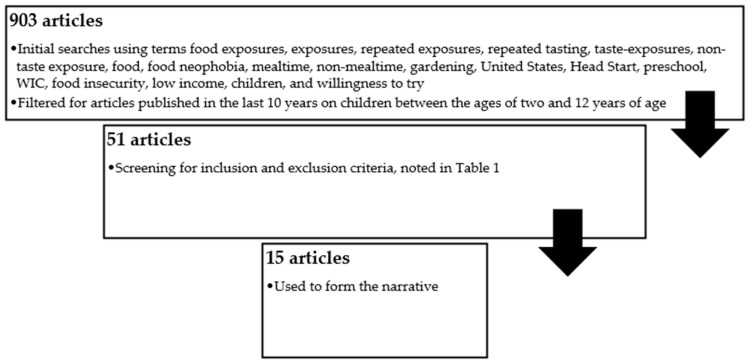 Figure 1
- —funding from the University of North Dakota’s Nutrition and Dietetics Department
Peer Reviews
No public reviews on file for this paper yet. If you reviewed it on a platform where reviews are public (OpenReview, ICLR, NeurIPS, ICML), you can paste yours below so the community can read it here.
Videos
No videos yet. Explain this paper in a talk, walkthrough, or lecture? Add one.
Taxonomy
TopicsChild Nutrition and Water Access · Obesity, Physical Activity, Diet · Early Childhood Education and Development
1. Introduction
A nutritious diet for infants and children is critical for proper growth and development while setting the trajectory for lifelong eating habits and health [1]. The 2020–2025 version of the Dietary Guidelines for Americans recommends a healthy dietary pattern including fruits, vegetables, whole grains, dairy, and protein at all ages and stages [1]. Despite recommendations, many children do not consume fruits and vegetables daily, which is exacerbated by income, with children living below the federal poverty level consuming less fruit and a decreased variety of vegetables, specifically dark green vegetables [2]. Limited intake in children may have lasting impacts on nutrition and development [3,4].
Head Start, a federal program serving expectant families and children to the age of five, supports families in overcoming barriers and improving their child’s nutrition [5]. More specifically, this no-cost, nationwide program promotes development and school readiness for children and families living below the federal poverty line. Head Start programs must follow the Head Start Act and Head Start Program Performance Standards (HSPPS), designated in part 1302 of the Code of Federal Regulations [6]. Parts 1302.44 and 1302.46 of the HSPPS include requirements for nutrition. Programs must provide culturally and developmentally appropriate nutrition services that follow the Child and Adult Care Food Program, a child nutrition program of the United States Department of Agriculture. Additionally, programs must assess each child’s nutrition status and work with caregivers to support children’s nutrition. With these requirements, Head Start programs provide an appropriate environment for implementing nutrition education.
Children experience dietary intake changes as they grow and develop; some of these changes are considered normal, whereas others concern parents [7]. This is especially true for intakes of vegetables and new foods due to food fussiness, leading to the rejection of new and familiar foods [7,8,9]. For instance, Brown and colleagues reported similar food fussiness scores across Head Start children of various races, ethnicities, body mass indexes, and food security levels [9]. Despite expert recommendations, many children do not eat a variety of nutritious foods, as children experience barriers to intake, including food fussiness [1,2]. Children are exposed to food and flavors in various ways, beginning in utero, creating a sense of familiarity. Over 50 years ago, Zajonc coined the term, mere exposure, stating, “mere repeated exposure of the individual to a stimulus is a sufficient condition for the enhancement of his attitude toward it” [10] (p. 1). Although Zajonc’s mere exposure initially applied to word frequency, the concept applies to dietary intake as well, with examples ranging from research on the effects of exposure on portion size, vegetable flavor exposure in early feeding, and optimal service frequency of vegetables to children [11,12,13]. Thus, mere exposure can be applied to children’s diets in an effort to address food fussiness and improve dietary intake.
Applying mere exposure in children’s diets can involve interactions with food or its likeness, referred to as taste or non-taste exposure in this manuscript. In this review, taste exposures are repeated opportunities to put food into the mouth. Non-taste exposures include tactile, olfactory, and visual sensory interactions with food or likeness without the pressure to taste, such as a picture, story, game, craft, gardening, or cooking. Taste and non-taste exposures can also be offered in a mixed methods approach.
In fact, due to the HSPPS requirements, Head Start is an ideal environment to implement food exposures to improve dietary intake [6]. With the many nutrition education curricula implemented in Head Start settings, few address the effectiveness of the exposure methods often incorporated in the program. This narrative review aims to compare and evaluate research on food exposures on children’s dietary intake. More specifically, this review evaluates whether taste or non-taste exposures are more effective at improving dietary intake by increasing willingness to try, consume, and like food in Head Start preschool children.
2. Methods
Search terms included combinations of the following: food exposures, exposures, repeated exposures, repeated tasting, taste-exposures, non-taste exposure, food, food neophobia, mealtime, non-mealtime, gardening, United States, Head Start, preschool, WIC, food insecurity, low income, children, and willingness to try. Searches were completed in the PubMed database between October 2024 and February 2025, filtering for articles published in the last 10 years on children between the ages of two and 12 years of age. In addition, the reference lists of relevant articles were used to review related studies.
Articles were screened for inclusion and exclusion criteria, included in Table 1. Included studies focused on a sample of low-income families and children between 12 months and 5 years of age in the United States, such as those enrolled in Head Start or other assistance programs. However, wider economic and geographic samples were included if research within Head Start centers was limited. Included articles provided an intervention that involved an interaction with food or its likeness and presented results regarding willingness to try foods, amounts of foods consumed, and/or the likability of foods. Studies referencing exposure to marketing, disease, or foodborne illness were excluded.
3. Results
Interacting with food in educational settings provides opportunities to learn about eating and culture while connecting school to home life [14]. Interactions with food or its likeness can involve exposing children to food with or without the pressure to taste, referred to as taste or non-taste exposure in this work. Taste exposures are repeated opportunities to put food into the mouth. Non-taste exposures include interactions with a food likeness, such as a picture, story, game, or craft; additionally, non-taste exposures include activities with real food without the pressure to eat, such as when gardening or cooking. Non-taste exposures can be visual, tactile, or olfactory [15]. Many nutrition education programs in preschool settings implement a mixed methods approach using both taste and non-taste exposures. Research on this topic was completed using the previously described methods, depicted in Figure 1, resulting in a total of 903 articles. Of these, 51 articles were reviewed, and 15 were used to form the narrative. A synopsis of the 15 studies is presented in Table 2.
3.1. Taste Exposures
Regular taste exposures are often provided through meal services in preschool settings. A study by Izumi and associates implemented an eight-month intervention adding targeted fruits and vegetables to Head Start menus twice weekly [18]. A center not receiving repeated exposures was compared using a multilevel logistics model for nested data. Repeated taste exposures created a significant effect on willingness to try three of nine target foods (turnip OR = 3.5, 95% CI [1.5–9.2], rutabaga OR = 3.9, 95% CI [1.7–9.1], and beet OR = 2.4, 95% CI [1.1–5.4]) compared to the control group; no significant difference was found in liking any of the vegetables compared to the control. A study by Nekitsing and colleagues also assessed the effects of taste exposure in preschool children [22]. This United Kingdom-based intervention served mooli, a daikon variety, as a weekly snack. After the 10-week intervention, mooli intake increased, which continued through two follow-up test points at 24 and 36 weeks (intake of eaters F(1, 135) = 11.21, p = 0.001). The intake of those not receiving the repeated taste intervention increased at smaller intervals at each data collection point. Additionally, the percentage of children willing to taste mooli increased in the taste exposure group, albeit insignificantly, whereas the comparison group remained steady throughout the intervention. Taste exposure can increase preschool children’s willingness to try food and consumption levels [18,22].
3.2. Non-Taste Exposures
Studies focusing on non-taste sensory experiences in preschool-aged populations improve their willingness to interact with food. Roberts and colleagues compared south-east England nursery children’s exposures to six vegetables (broccoli, fennel, leek, parsnip, radish, and swede) using a variety of visual, tactile, and olfactory sensory experiences [15]. Non-taste exposures were provided using colored posters, fabric, and lids to control the sensory experience. Exposures targeting multiple senses have the greatest positive effects on willingness to try (U = 171.0, p < 0.001, η^2^ = 0.26) and increase liking (U = 193.0, p = 0.001, η^2^ = 0.19). Dazeley and Houston-Price assessed willingness to try in a non-taste exposure study targeting visual, olfactory, tactile, and auditory sensory experiences in United Kingdom nurseries [17]. This study found an increase in children’s willingness to engage with food; while the increase in willingness to taste was not significant, a significant increase was experienced in children’s willingness to touch (t(53) = 2.05, p = 0.046), leading to promising possibilities of future tasting. Sensory play with food or its likeness improves children’s willingness to engage with foods.
Nutrition education programs can contain non-taste exposure experiences, such as the Phunky Foods program, used in the study by Nekitsing and colleagues referenced in the taste exposure section [22]. Phunky Foods combined visual, auditory, and tactile activities with education on nutritious eating, but did not explicitly include the target vegetable, mooli. This program was implemented independently in an intervention group, with increased mooli intake throughout the study, although the increase was smaller than the taste exposure intervention. The number of children unwilling to try the mooli decreased from pre-intervention to post-intervention, with a small increase by the 36-week follow-up. Non-taste sensory exploration benefits children’s diets when included with nutrition education, although this study and the generalization of effects are limited by minimal data analysis.
Research on visual food exposures suggests minor dietary improvements. Caputi and researchers developed a set of e-books focusing on vegetables from farm to fork, aiming to provide a positive interaction between adults and children while reading about food [8]. This two-week study focused on Italian children aged 18–48 months. Despite increases in target and control vegetables, as well as significant main effects for willingness to try (F(1, 48) = 15.06, p < 0.001, ηp^2^ = 0.239), portion size (F(1, 48) = 23.80, p < 0.001, ηp^2^ = 0.332), consumption frequency (F(1, 46) = 8.47, p = 0.006, ηp^2^ = 0.156), and liking (F(1, 48) = 22.04, p < 0.001, ηp^2^ = 0.315), no significant interaction was found between vegetable and time for any variable. Masento and team completed a similar study using “See and Eat” e-books in the United Kingdom [20]. With identical procedures, this study did find significant interaction effects between the condition and time for portion size (F(1,29) = 15.55, p < 0.001, ηp^2^ = 0.349), consumption frequency (F(1,30) = 13.49, p = 0.001, ηp^2^ = 0.31), and liking (F(1, 29) = 8.69, p < 0.05, ηp^2^ = 0.231). While small in both studies, intake of the control vegetable did increase, indicating general dietary benefits. Masento and colleagues found no significant associations between any demographic indicator and measures of change in the target vegetable, indicating non-taste, visual food exposure benefited children regardless of background [20]. Visual exposures can positively influence children’s dietary choices.
Emerging research on gardening as a nutrition intervention for preschool-aged children also shows promise. A study by Monsur and colleagues assessed food liking after a gardening intervention at eight centers in Texas [21]. The garden was implemented and an instructional book guided 12 classroom activities on produce preparation, maintenance, and harvest. The children rated 12 fruits and vegetables on a five-point scale, with a significant increase from pre- to post-intervention in combined fruit and vegetable rating (est. effect = 1.20, p = 0.01) and vegetable scores (est. effect = 2.05, p = 0.04) when controlling for gender, age, and ethnicity; however, this study had limited participant data and significant differences in group age and ethnicity. Although studies are limited on preschool-aged children, gardening, like visual exposures, has potential as a powerful non-taste exposure tool.
3.3. Mixed Method Exposures
Various preschool nutrition education programs utilize mixed-method exposures. Combining taste and non-taste exposures creates well-rounded opportunities for children to interact with food without the expectation of eating, coupled with opportunities to taste food. The Harvest for Healthy Kids curriculum includes books, tasting activities, sensory table ideas, crafts, picture cards, and newsletters [18,24]. Izumi and colleagues combined the program with additional exposures discussed in the taste exposure section of this paper [18]. The Food Friends-Fun with New Foods^®^ program introduced foods with characters and activities over a 12-week program in the Colorado LEAP study [19]. Non-taste exposure activities in this program included puppet shows, activity cards, books, songs, art projects, sorting, and games, while taste exposures were included as snacks. The Together, We Inspire Smart Eating (WISE) program uses a barn owl mascot, Windy Wise, a barn owl, to engage children in food and nutrition [25,26]. The curriculum incorporates food preparation experiences, integration of food into educational activities, family handouts, and interactions via social media. Lastly, the Phunky Foods program, mentioned in the non-taste exposure section, implements hands-on activities from two components, Eat Well and Strive for 5! [22]. Many preschool nutrition education curriculums combine exposure experiences to enhance children’s nutrition.
Combining exposures offers a successful strategy for increasing children’s willingness to try food. The combined intervention completed by Izumi and colleagues boosted willingness to try, creating a significant increase in six foods (carrot OR = 5.7, CI [1.4–23.0], butternut squash OR = 2.9, CI [1.1–7.4], sweet potato OR = 4.3, CI [1.8–10.7], turnip OR = 7.2, CI [2.7–10.5], rutabaga OR = 9.6, CI [3.8–24.5], beet OR = 6.1, CI [2.3–16.3]) compared to three in the foodservice intervention group discussed in the taste exposure section of this paper [18]. While a significant difference developed between the comparison and the combined intervention, no significant difference existed between the combined intervention and the foodservice-only intervention; however, this lack of significance may be due to the limited sample size [18]. The study referenced in the taste and non-taste sections by Nekitsing and researchers measured the number of children who did not eat the mooli at four data collection points, although provided minimal data analysis in reporting [22]. In the mixed-method intervention, the number of children who did not eat the vegetable decreased from pre-intervention to post-intervention, with a slight increase at a 24-week follow-up, it returned to post-intervention levels by 36 weeks. Combining exposure methods can strengthen effects on children’s willingness to try.
Mixed method exposures can increase children’s positive feelings toward food. While the foodservice intervention by Izumi and researchers discussed in the taste exposure section did not significantly impact liking, the combined intervention did result in a significantly higher score for sweet potato (OR = 3.4, 95% CI [1.2–9.5]), turnip (OR = 3.7, 95% CI [1.2–11.2]), and berries (OR = 21.2, 95% CI [2.4–187.3]) when compared to the control group with a multilevel logistics model [18]. A pilot study in Head Start Centers by Schmitt and colleagues showed mixed method exposure lessons and play led to a statistically significant increase in vegetable liking (M change = 1.1, p = 0.02), while the comparison group did not experience a significant change [23]. In the Colorado LEAP study, the percentage of positive ratings increased at each data collection point; however, the intervention and control group increased at consistent rates and the difference between groups did not reach statistical significance [19]. Data suggests combined exposure methods can increase liking, although liking of food may increase naturally with development.
Consumption increases when children receive mixed-method exposures. In the Colorado LEAP study, the intake of the target vegetable jicama in the intervention group increased significantly from baseline to post-intervention (M = 34.1 g, CI [28.2–40.0], p < 0.0001) and remained elevated at the two-year follow-up (M = 37.3 g, CI [30.8–43.8], p < 0.0001) [19]. The comparison group did not experience a significant change post-intervention but increased significantly at follow-up (M = 20.3 g, CI [12.6–28], p = 0.0008). The assessment included a second food without exposure, edamame, with similar average intakes for both groups at baseline. By the two-year follow-up, both groups reported significantly increased edamame intake (intervention M = 20.8 g, CI [12.6–29.1], p < 0.0001; comparison M = 28.9 g, CI [19.9–37], p < 0.0001) despite the comparison group not experiencing a significant change post-intervention. Differences in intake between jicama and edamame at two years illustrate the importance of exposures on increasing intake, and the role development plays in dietary intake. Nekitsing and colleagues, previously mentioned in the taste and non-taste sections, combined exposures using the Phunky Foods program and compared mean intakes with limited data analysis [22]. Intake increased at post-intervention and the 24-week follow-up but decreased slightly at the 36-week follow-up, compared to peak consumption at 24 weeks. Without consistent and frequent exposures throughout development, effects may plateau, leading to consumption similar to children without exposure; however, children will benefit from the nutrients consumed during the increase.
4. Discussion
This narrative review aims to evaluate whether taste or non-taste exposures are more effective at improving dietary intake in Head Start children by increasing their willingness to try, the amount consumed, and the likability of food. Implementing food exposures into Head Start environments benefits children’s diets, as evidenced by the overview of exposures in Table 3. Foodservice and teaching staff can establish a cohesive approach to provide consistent taste and non-taste exposures. As there is flexibility in nutrition standards from the Head Start Program Performance Standards (HSPPS), programs can tailor their approach to their community’s needs. The HSPPS encourage community partnerships, and programs could work with local nutrition experts, such as Extension, to implement a researched curriculum [6]. Additionally, programs must employ or consult a registered dietitian or nutritionist to support the nutritional aspects of the program, which could include designing or implementing food exposure activities [6]. When executing exposure efforts, programs should consider how to include caregivers and the unique needs faced by the population.
Including caregivers is pivotal to success with dietary changes, as they control children’s diets at home. In a focus group of parents with children in daycare centers in French cities, children’s picky eating concerned and frustrated parents [7]. All but one of the 38 parents reported changes in their child’s diet, with a majority experiencing this around age two. “He used to eat everything and overnight he started to be difficult”, was a common theme in focus groups [7] (p. 407), highlighting that children’s liking of foods changes as they develop. Some parents understood the importance of taste exposures for improving dietary intake, but more could be done to reinforce food exposures. On that note, one parent stated, “Clearly if there is something she doesn’t like, I have to offer it again over the following weeks until she eats it” [7] (p. 409). Parents understand the importance of creating positive exposures to increase familiarity, with some creating characters or serving condiments with new foods. Studies addressing food exposures highlight the causal effect of increased familiarity with food, a critical intervention as growing children learn to assert their independence [7,8,15,17,20,22]. With Head Start serving children at the age when dietary changes are commonly reported, an exposure intervention could be implemented during programming and made more effective by providing support for caregivers at home.
The effects of a school-based intervention can be seen in the home diet and could be explained by children’s pester power. Studies by Whiteside-Mansell and Swindle and Swindle and colleagues assessed the at-home effects of the Together, We Inspire Smart Eating (WISE) nutrition program, using a character, Windy Wise, and sensory experiences to expose children to foods in a Head Start classroom [25,26]. The intervention group experienced an increased home intake of all food categories, except sugary sweets, which decreased [26]. The comparison experienced smaller increases, including an increase in the sugary sweets category, and a decrease in consumption of three WISE fruits targeted in the program: apples, strawberries, and blueberries. A regression analysis controlling for demographics and pre-intervention consumption showed a statistically significant positive effect in the dark green, orange, and yellow vegetable category (SE = 0.050, t = 2.12, p < 0.05) and WISE fruits (SE = 0.050, t = 2.12, p < 0.05), while sugary sweets intake experienced a significant negative effect (SE = 0.050, t = −3.27, p < 0.01). Fruits in general and the targeted WISE vegetables (tomatoes, sweet potatoes, carrots, bell peppers, spinach, greens, and green beans) did not have a significant effect. These at-home effects may be explained through the power of children’s pestering. Swindle and colleagues used hierarchical regression analysis to demonstrate the effect children’s pester power can have on the home diet after a nutrition education program [25]. Controlling for pretest values, willingness to try, and location effects, pester power was a significant predictor of targeted WISE fruit and vegetable consumption (B = 0.16, β = 0.29, p < 0.01), but not of nutrient-poor food intake. Overall, positive changes to the home diet occur after a classroom-based nutrition education program and efforts should be made in supporting positive pester power to amplify effects.
Considerations, such as food waste and accessibility, must be made when working with populations living below the federal poverty line, including Head Start enrollees. Taste exposure effects may take weeks to develop, as demonstrated by the eight-month intervention by Izumi and associates and the 10-week intervention by Nekitsing and colleagues, leading to food waste when repeated exposures are served despite children’s unwillingness to try [18,22]. E-books, gardening, and non-taste sensory experiences revealed positive effects on willingness to try, showing promise as a budget- and environmentally friendly alternative to food wasted from repeated taste exposures [8,15,20,21,22]. With proper attention to the technical challenges of users, device accessibility, and storage space, technology can be leveraged to increase access with a simple and cost-effective electronic distribution process [8,20].
Considerations of nutrition programs for Head Start families extend to food access. A study of rural Head Start children assessed blood carotenoid levels in three groups with the control receiving regular Head Start services, treatment A receiving high-carotenoid fruits and vegetables weekly, and treatment B receiving weekly food and the previously discussed Harvest for Healthy Kids program, including both taste and non-taste exposures [24]. Blood carotenoid levels were assessed using a Pharmanex Biophotonic S3 Scanner using Resonance Ramen Spectroscopy. All three groups experienced an increase in mean carotenoid scores, led by treatment B, with statistically significant differences between treatments (F(2, 206) = 12.967, p < 0.001, Cohen D = 71), demonstrating the causal effects of access and exposures. Considerations for decreasing waste, program delivery, and access to nutritious food can create a more inclusive and effective exposure program.
Various factors limit the ability to draw conclusions from research on food exposures. Differences in study design, small sample sizes, and self-reported measures limit validity and reliability. Moreover, the implementation of nutrition education curricula is limited by staff and the environment. The studies on e-book exposures provide examples of small sample sizes used in exposure studies, with the Italian sample reporting an underpowered sample for evaluating intake [8,20]. Many studies were non-randomized, using a quasi-experimental design, such as the non-randomization of the comparison group in the Harvest for Healthy Kids pilot study [18]. The long-term effects of the Colorado LEAP study were obscured by unclear longitudinal data collection [19]. Additional limitations include recency bias, demographic differences, limited statistical analysis, and high attrition; the Harvest for Healthy Kids study by Izumi and researchers included only 49% of the sample in the analysis due to Head Start enrollment changes, and the study by Monsur and colleagues faced statistical differences in age and race in the control and experimental groups [18,21]. Dixon and colleagues reported fluctuations in liking and eating, with one teacher stating children “will eat carrots one day but not the next” demonstrating the variability and challenges of consistently measuring child data [14] (p. 12). Despite this bias, many studies utilized child- or parent-reported values. Overall, studies on food exposures had factors limiting validity and reliability.
Future research could improve study designs and measurement techniques, while controlling potential environmental influences. While six studies utilized trained observation or weight to measure willingness to try and intake levels, Smith and Colleagues provide a gold standard for measuring consumption [15,16,17,18,19,22,24]. By using spectroscopy to measure blood carotenoid levels, dietary intake was objectively assessed using unintrusive technology, providing more effective measures of program success than child- or parent-reported intake or observation, where errors may occur [24]. Additionally, this study could be used as a design model as there are limited experimental studies on food exposures, and it boasted 0% attrition [24].
Positive initial experiences may lead to more immediate exposure benefits. In the Colorado LEAP study, children rating jicama more positively at baseline had larger increases in consumption during follow-up [19]. Those in the intervention group who initially rated jicama as yummy or just OK experienced the most significant increase in grams consumed, with the increase continuing to the two-year follow-up for those rating jicama as yummy (mean change = 21.4 g CI [13.4–29.5], p < 0.0001). Children rating jicama as yummy or just ok in the control group approached a significant increase in grams consumed during the two-year follow-up. Immediate reactions influence exposure effectiveness, making the first interaction critical to success.
The intervention environment is vital to positive first impressions; however, exposure studies did not reference or control for staff or environmental influences. A cross-sectional study by Anundson and colleagues observed the effects of staff behaviors on children’s eating habits, demonstrating the causal impact of adults on children’s diets [16]. When staff sat with children and ate the same food, vegetable tasting increased significantly (mean difference = 1.02, p < 0.05) while tasting of high-fat/high-sugar foods decreased at a rate approaching significance. Adults sitting at the table without eating the same food significantly decreased fruit tasting (mean difference = −1.24, p < 0.05), with smaller impacts on other food groups. When children were exposed to healthy food talk, tasting fruits increased significantly (mean difference = 0.92, p < 0.05), and tasting high-fat/high-sugar foods decreased at the highest rate (mean difference = −0.65, p < 0.001). Lastly, staff checking in with children before finishing a meal demonstrated significant increases in fruit tasting (mean difference = 1.31, p < 0.001), while decreasing tasting fried vegetables, fried meat, and high-fat meat, and the most significant decrease in high-fat/high-sugar foods (mean difference = −0.69, p < 0.001). Staff behaviors, as part of the classroom environment, influence children’s nutrition-related behaviors.
Despite influencing children’s diets, educators may not possess the ability to execute nutrition-based learning or interventions. This was demonstrated in the taste exposure study completed in the United Kingdom where staff did not follow the taste exposure protocol, decreasing the reliability and validity of the results [22]. In a qualitative study by Dixon and colleagues, teachers reported discomfort in implementing food-based learning, or incorporating learning with food into meals, science, and other educational concepts; education at meals comes more naturally to teachers than implementing food-based learning during other class times [14]. Teachers often misunderstand the intention of using food in learning, choosing foods children are comfortable with or calorie-dense items. Additionally, many Head Start programs, with supportive intentions, write policies prohibiting or limiting the use of real food; Head Start families may experience food insecurity, and programs feel it is inappropriate to use food in lessons without a plan to consume [14]. Short training sessions were provided before implementing many nutrition curricula, but the limitation of overcoming prior values, beliefs, and knowledge still exists.
Future studies on food exposure effectiveness could measure or control for staff and environmental impact. Teachers reported being uncomfortable with nutrition concepts and may not understand what pressure, reward, or withholding food looks like in practice, negatively affecting the intentions of a food exposure intervention [14]. Lack of control or measurement of these variances may skew an exposure intervention. Teachers may also be uncomfortable or unaware of other concerns regarding food-based learning, including proper sanitation, safe preparation, and special dietary needs [14]. Due to teachers’ unfamiliarity with nutrition education, measuring or controlling for adult behaviors in an exposure study will provide data on intervention fidelity.
5. Conclusions
Despite recommendations to consume a variety of foods, children’s diets often fall short, impacting long-term health and nutrition habits. Children living below the federal poverty line experience barriers to intake, further limiting diet variety. However, this narrative review demonstrates the positive influence of mere exposure to food, or its likeness, on children’s diets. Taste and non-taste exposures, when used independently, inconsistently affect children’s willingness to try, consume, and like food; exposures are most effective when combined, although research on the topic faces limitations of study design and environmental controls. This review found that mixed food exposures, often provided in preschool nutrition education curriculums, significantly improve children’s willingness to try, consume, and like food. Head Start programs can include food in learning with considerations to program access and food insecurity; for example, when using food, programs can ensure a plan is in place for consumption or programs can include non-taste exposures with taste exposures from regular meal services. Combining the knowledge of the positive effects found in this review with Head Start standards for meal service and nutrition education, the authors conclude that Head Start classrooms provide an ideal setting for implementing and collaborating with caregivers on food exposure activities; however, due to limitations, this review proposes the need for food exposure studies on Head Start samples with increased validity and reliability, including using new technology to measure impact, implementing an experimental design, and controlling influences from the environment. Although findings were limited, children in Head Start may benefit from programs implementing exposure activities, and expanded research focusing singularly on food exposures could lead to stronger recommendations for widespread implementation.
The reference list from the paper itself. Each links out to its DOI / PubMed record.
- 1U.S. Department of Agriculture and U.S. Department of Health and Human Services Dietary Guidelines for Americans, 2020–20259 th ed.2020 Available online: https://www.dietaryguidelines.gov/(accessed on 29 March 2025)
- 2Wambogo E.A. Ansai N. Ahluwalia N. Ogden C.L. Fruit and Vegetable Consumption Among Children and Adolescents in the United States, 2015–2018 Key Findings Data from the National Health and Nutrition Examination Survey 2015 Available online: https://www.cdc.gov/nchs/products/index.htm(accessed on 29 March 2025)
- 3Samuel T.M. Musa-Veloso K. Ho M. Venditti C. Shahkhalili-Dulloo Y.A. Narrative Review of Childhood Picky Eating and Its Relationship to Food Intakes, Nutritional Status, and Growth Nutrients 201810199210.3390/nu 1012199230558328 PMC 6316224 · doi ↗ · pubmed ↗
- 4Tenenbaum A. Lakhan R. Thianthai C. Chao H.C. Association of Picky Eating with Growth, Nutritional Status, Development, Physical Activity, and Health in Preschool Children Front. Pediatr.201862210.3389/FPED.2018.0002229484290 PMC 5816267 · doi ↗ · pubmed ↗
- 5Office of Head Start Available online: https://acf.gov/ohs/about/head-start(accessed on 29 March 2025)
- 6Code of Federal Regulations Available online: https://www.ecfr.gov/current/title-45/subtitle-B/chapter-XIII/subchapter-B/part-1302(accessed on 29 March 2025)
- 7Rubio B. Rigal N. Parental concerns and attributions of food pickiness and its consequences for the parent–child relationship: A qualitative analysis J. Child Health Care 20172140441410.1177/136749351772583229110520 · doi ↗ · pubmed ↗
- 8Caputi M. Dulay K.M. Bulgarelli D. Houston-Price C. Cerrato G. Fanelli M. Masento N. Molina P. See & Eat! Using E-books to Promote Vegetable Eating Among Preschoolers: Findings From an Italian Sample Front. Psychol.20211271241610.3389/FPSYG.2021.71241634512470 PMC 8430236 · doi ↗ · pubmed ↗