Iodine-Substituted Dithiocarbamic Flavanones—A Structure–Activity Relationship Study of Their Antioxidant Properties
Mihail Lucian Birsa, Laura Gabriela Sarbu

TL;DR
This study explores how different chemical substitutions affect the antioxidant power of flavanones, finding that halogen and morpholine groups enhance their performance.
Contribution
The study introduces new iodine-substituted flavanones and identifies morpholine carbodithioates as having superior antioxidant activity.
Findings
Halogen substituents improve antioxidant properties compared to ascorbic acid and BHT.
Morpholine carbodithioates show the highest radical scavenging activity.
All tested flavanones outperform BHT in the ABTS+• assay.
Abstract
The antioxidant properties of novel diiodo-substituted 3-dithiocarbamic flavanones were investigated. The three frameworks that proved to be the most active ones in our previous studies were selected. By varying the nature of the substituent at the para position of flavanone ring B, a structure–activity relationship study on radical scavenging properties was performed. The influence of these substituents (F, Cl, Br and H) was investigated against DPPH and ABTS+•. The results indicate that the presence of the halogen substituents induces better antioxidant properties than ascorbic acid and BHT. The highest radical scavenging activity was found in the case of morpholine carbodithioates. Regarding the ABTS+• assay, all investigated flavanones exhibited better antioxidant properties than BHT.
Genes, proteins, chemicals, diseases, species, mutations and cell lines named across the full text — each resolved to its canonical identifier and authoritative record.
Click any figure to enlarge with its caption.
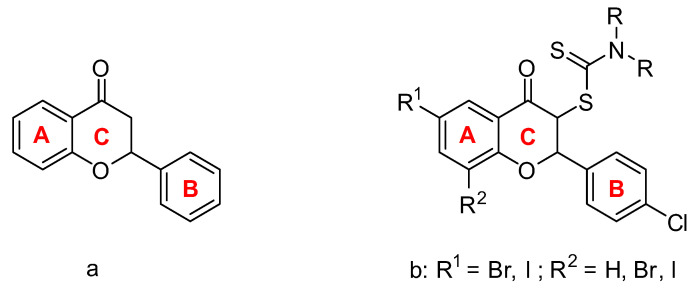 Figure 1
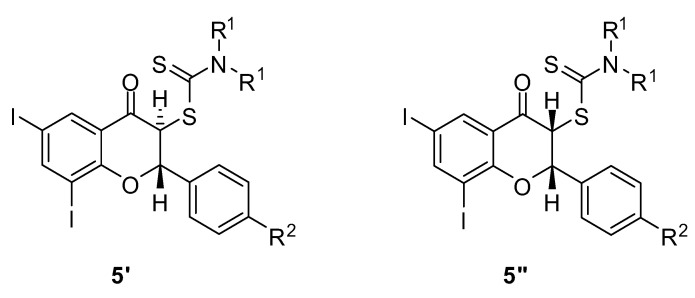 Figure 2
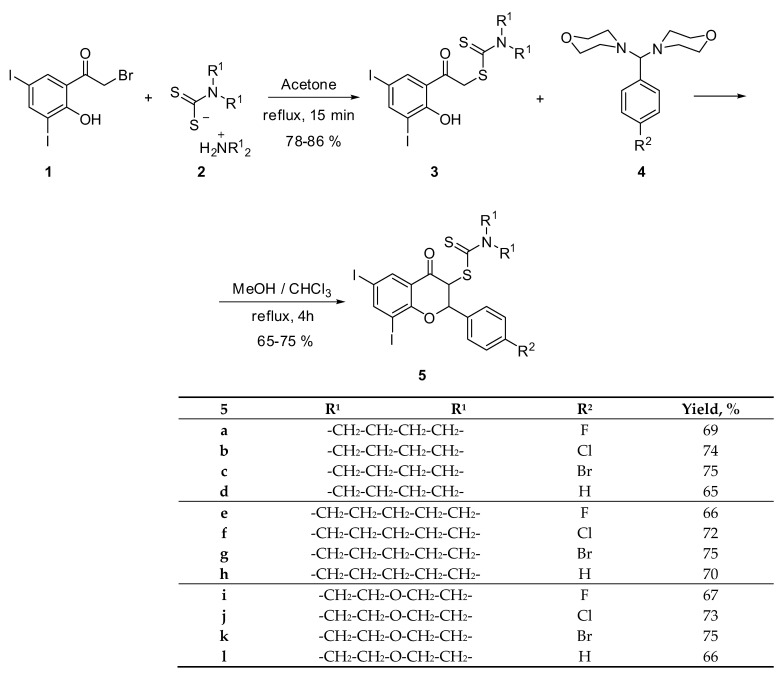 Figure 3
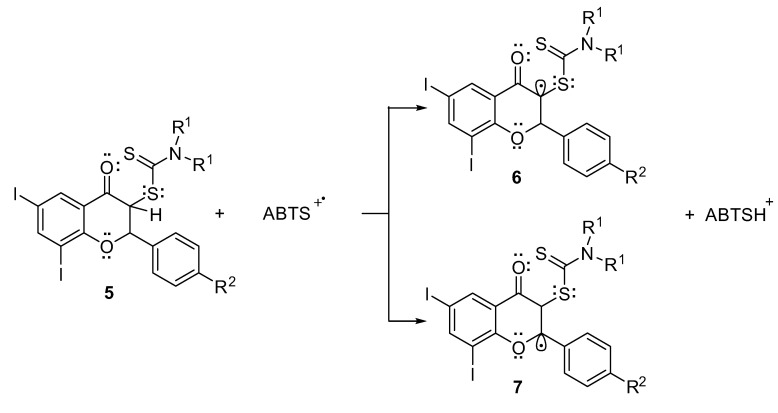 Figure 4
Peer Reviews
No public reviews on file for this paper yet. If you reviewed it on a platform where reviews are public (OpenReview, ICLR, NeurIPS, ICML), you can paste yours below so the community can read it here.
Videos
No videos yet. Explain this paper in a talk, walkthrough, or lecture? Add one.
Taxonomy
TopicsSynthesis of Organic Compounds · Free Radicals and Antioxidants · Synthesis and biological activity