Incidence, Impact, and Complications of Short Cephalomedullary Nail Toggling in Patients with Wide Femoral Medullary Canal
Ahmed Nageeb Mahmoud, Maria F. Echeverry-Martinez, Catherine Mary Doyle, Juan David Bernate, Michael Suk, Daniel Scott Horwitz

TL;DR
This study finds that short cephalomedullary nails can shift in patients with wide femoral canals, leading to potential complications like varus malunion.
Contribution
The study identifies the incidence and causes of nail toggling in wide femoral canals and suggests alternative nail lengths to mitigate complications.
Findings
15.8% of cases with wide femoral canals experienced significant nail toggling and varus displacement.
Deficient proximal nail fixation, such as lag device disengagement or lateral wall fractures, was linked to toggling.
Using long or intermediate nails may be better for patients with wide canals or cortical fractures.
Abstract
Background: Toggling of the short cephalomedullary nail is an understudied phenomenon characterized by a change in the longitudinal axis of the nail in relation to the longitudinal axis of the femoral medullary canal, with subsequent potential loss of reduction. This retrospective study aims to examine the incidence and impact of toggling of short cephalomedullary nails in cases with wide femoral canals. Methods: One thousand two hundred fifty-six (1256) cases that received short proximal femoral nails for intertrochanteric fractures were reviewed. Of them, 101 cases that had wide femoral canals (≥15 mm) and a minimum radiographic follow-up of 6 weeks were included in this study. Outcome measures included nail toggling, varus malunion and revision surgery. Results: After a mean radiographic follow-up of 53.5 weeks, sixteen cases (15.8%) showed significant nail toggling of more than 4…
Genes, proteins, chemicals, diseases, species, mutations and cell lines named across the full text — each resolved to its canonical identifier and authoritative record.
Click any figure to enlarge with its caption.
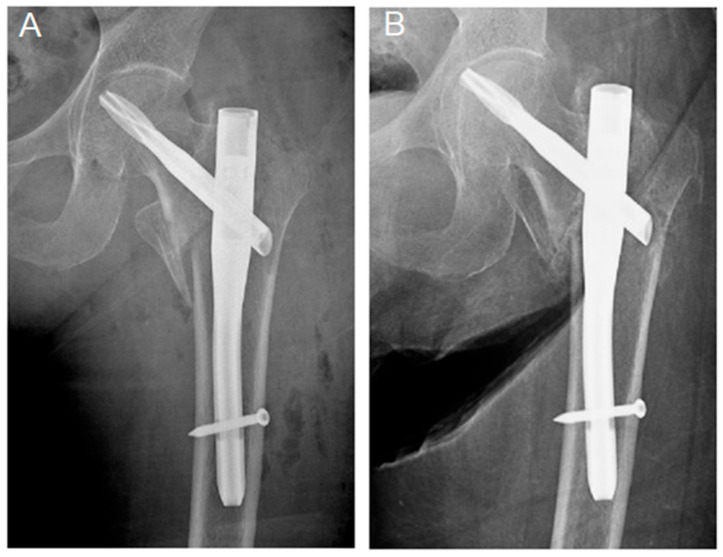 Figure 1
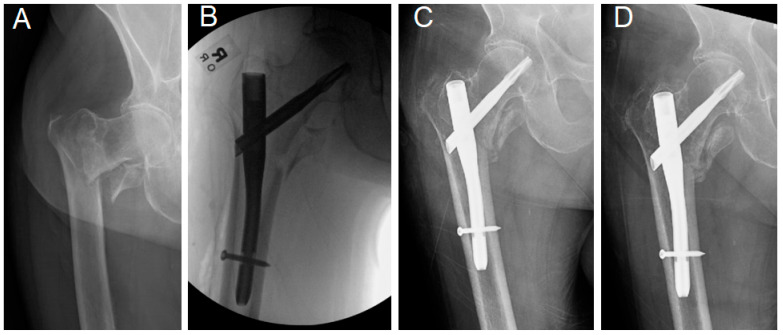 Figure 2
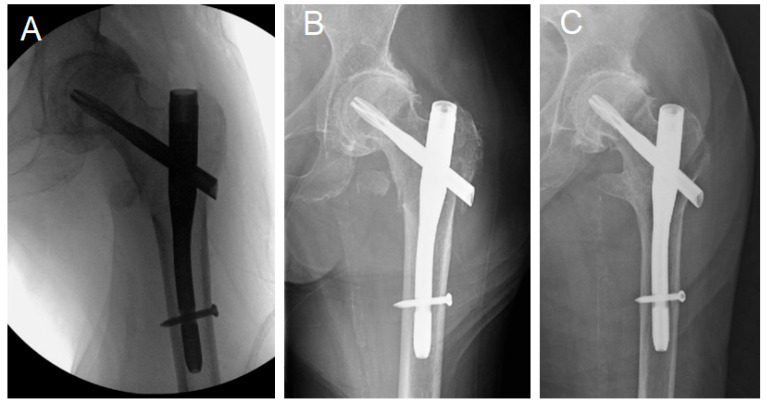 Figure 3
Peer Reviews
No public reviews on file for this paper yet. If you reviewed it on a platform where reviews are public (OpenReview, ICLR, NeurIPS, ICML), you can paste yours below so the community can read it here.
Videos
No videos yet. Explain this paper in a talk, walkthrough, or lecture? Add one.
Taxonomy
TopicsHip and Femur Fractures · Pelvic and Acetabular Injuries · Bone fractures and treatments