Incidence and Predictors of Urethral Stricture Following Transurethral Resection of the Prostate and Open Simple Prostatectomy: A 21-Year Retrospective Cohort Study
Dor Golomb, Meitar Atias, Hanan Goldberg, Asaf Shvero, Yuval Kozlov, Yishai H. Rappaport, Orit Raz

TL;DR
This study found that transurethral resection of the prostate leads to a higher risk of urethral stricture compared to open surgery, with older age and health issues increasing the risk.
Contribution
The study provides new insights into the comparative risk of urethral stricture after two prostate procedures and identifies key predictors of stricture development.
Findings
Urethral stricture incidence was 1.15% after mTURP and 0.538% after OSP.
Older age and higher comorbidity scores were linked to increased stricture risk.
mTURP was associated with a 2.35 times higher risk of stricture compared to OSP.
Abstract
Background/Objectives: To assess the incidence and factors associated with urethral stricture following monopolar transurethral resection of the prostate (mTURP) and open simple prostatectomy (OSP) over a 21-year period. Methods: We conducted a retrospective cohort study of adult male patients insured by Clalit Health Services in Israel, who underwent either mTURP or OSP at multiple centers. Key baseline characteristics, including age, body mass index (BMI), socioeconomic status, Charlson comorbidity index score, and the incidence of urethral stricture, were collected. Postoperative urethral strictures were identified using the ICD-10 code N35.9 (urethral stricture, unspecified). Results: Between January 2000 and December 2021, 54,872 patients underwent simple prostatectomy across 29 hospitals, with 43,525 (79%) undergoing mTURP and 11,347 (21%) undergoing OSP. The median age of…
Genes, proteins, chemicals, diseases, species, mutations and cell lines named across the full text — each resolved to its canonical identifier and authoritative record.
Click any figure to enlarge with its caption.
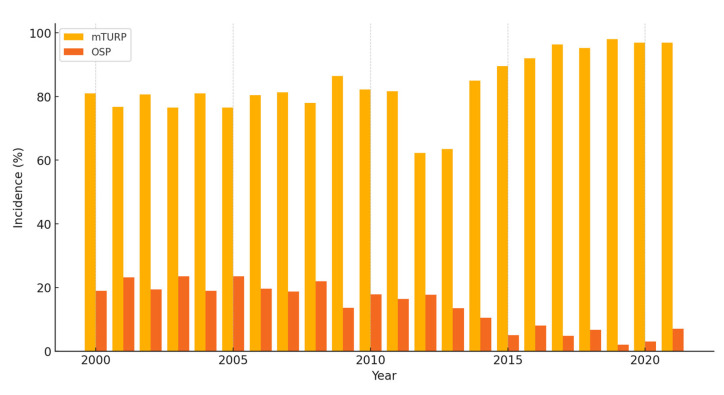 Figure 1
Peer Reviews
No public reviews on file for this paper yet. If you reviewed it on a platform where reviews are public (OpenReview, ICLR, NeurIPS, ICML), you can paste yours below so the community can read it here.
Videos
No videos yet. Explain this paper in a talk, walkthrough, or lecture? Add one.
Taxonomy
TopicsUrinary Bladder and Prostate Research · Urological Disorders and Treatments · Pelvic floor disorders treatments