Comparison of Methods to Assess Discretionary Salt Intake among Nonpregnant Women of Reproductive Age in Punjab, India
Yvonne E Goh, Mari S Manger, Mona Duggal, Reena Das, Surbhi Agarwal, Shipra Saklani, Deepmala Budhija, Manu Jamwal, Bidhi L Singh, Julie M Long, Jamie Westcott, Charles D Arnold, Nancy F Krebs, Rosalind S Gibson, Kenneth H Brown, Christine M McDonald

TL;DR
This study compares four methods to estimate discretionary salt intake among women in Punjab, India, to help improve salt-related public health programs.
Contribution
The study evaluates the precision and agreement of four methods for measuring discretionary salt intake in a specific demographic in India.
Findings
The RD method showed the strongest correlation and best agreement with the WFR method for estimating discretionary salt intake.
The HHSD method was moderately correlated with WFR but had lower precision.
Repeated measurements could improve the precision of the HHSD method for large surveys.
Abstract
Accurate and precise estimates of discretionary salt intake are critical for the design of salt fortification programs and salt reduction interventions. This study aimed to compare 4 methods of estimating discretionary salt intake among nonpregnant females of reproductive age in Punjab, India. One-day, observer-recorded, weighed food records (WFRs), household salt disappearance (HHSD) data, duplicate diet composites, and samples of household salt and milk were collected from 100 females and repeated in a subset of 40 to adjust for intraperson variation and estimate usual discretionary salt intake. Diet composites were also replicated from 40 randomly selected WFR but prepared without the addition of discretionary salt. The duplicate diet composites’ sodium and iodine contents were analyzed using inductively coupled plasma (ICP)-optical emission spectrometry and ICP-mass spectrometry,…
Genes, proteins, chemicals, diseases, species, mutations and cell lines named across the full text — each resolved to its canonical identifier and authoritative record.
Click any figure to enlarge with its caption.
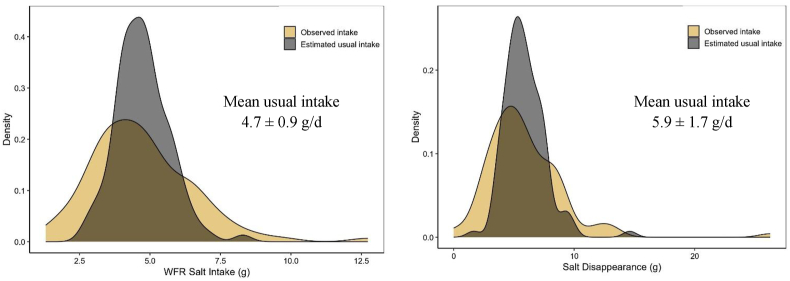 Figure 1
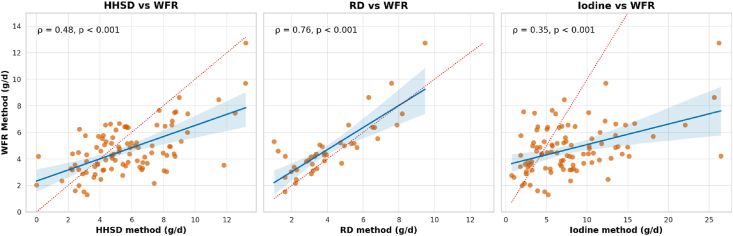 Figure 2
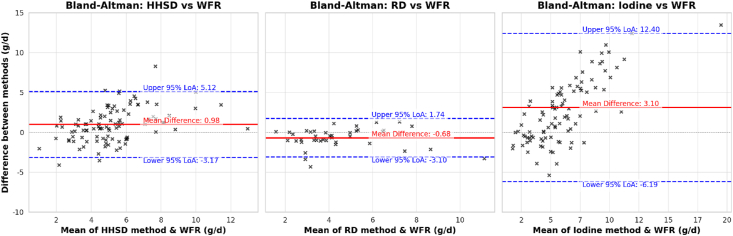 Figure 3
Peer Reviews
No public reviews on file for this paper yet. If you reviewed it on a platform where reviews are public (OpenReview, ICLR, NeurIPS, ICML), you can paste yours below so the community can read it here.
Videos
No videos yet. Explain this paper in a talk, walkthrough, or lecture? Add one.
Taxonomy
TopicsSodium Intake and Health · Nutritional Studies and Diet · Birth, Development, and Health