Exercise Hemodynamics and Sex-Specific Data in Asymptomatic Adults: An Exploratory Pilot Study
Mi-Hyang Jung, So-Young Lee, Woo-Baek Chung, Jong-Chan Youn, Hae Ok Jung

TL;DR
This pilot study explores exercise hemodynamics in asymptomatic adults, finding that females show higher increases in pulmonary artery pressure during exercise.
Contribution
The study provides new sex-specific insights into exercise hemodynamics in asymptomatic middle-aged to older adults.
Findings
The average E/e’ ratio increased significantly during exercise, but remained below 10.
Systolic pulmonary artery pressure rose significantly during exercise, with females showing a more pronounced increase.
Sex-specific differences in hemodynamic responses were observed during exercise.
Abstract
Background: Understanding normal exercise hemodynamics is essential for assessing individuals with exertional dyspnea. This study utilized exercise echocardiography to gain insights into exercise hemodynamics in asymptomatic middle-aged to older adults without overt cardiovascular disease. Methods: We prospectively enrolled 30 individuals aged 45–75 years without dyspnea, excluding those with left ventricular ejection fraction (LVEF) < 50% or significant heart/lung diseases. All participants underwent symptom-limited bicycle exercise echocardiography. Results: Two individuals exhibited early-stage dyspnea, leading to the inclusion of 28 individuals (mean age 61 ± 8 years, 50% female) in the final analysis. Throughout the exercise, the average E/e’ ratio increased from 8.3 ± 1.6 at rest to 9.7 ± 1.8 at 75 W (p = 0.001), while systolic pulmonary artery pressure (SPAP) rose from 23.0 ± 3.9…
Genes, proteins, chemicals, diseases, species, mutations and cell lines named across the full text — each resolved to its canonical identifier and authoritative record.
Click any figure to enlarge with its caption.
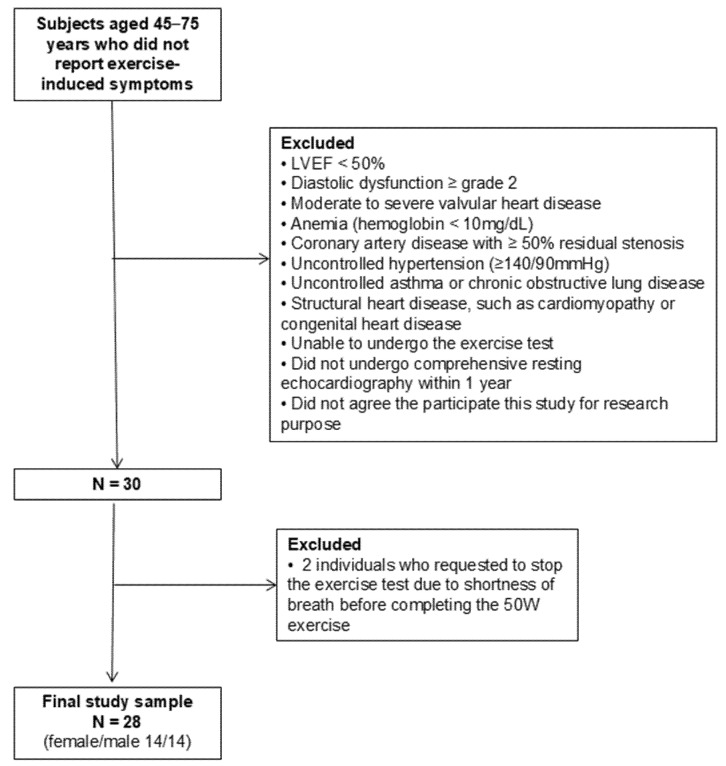 Figure 1
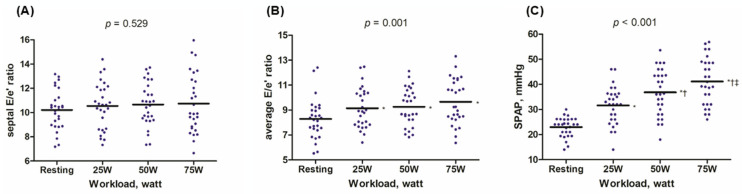 Figure 2
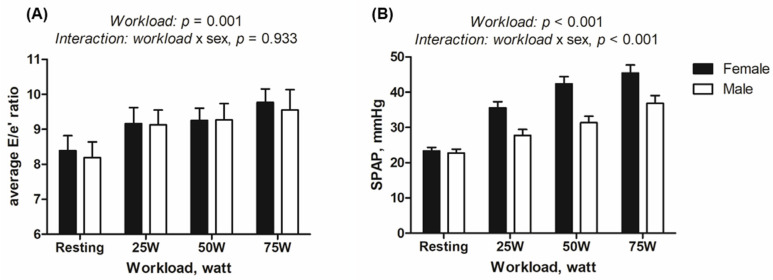 Figure 3
Peer Reviews
No public reviews on file for this paper yet. If you reviewed it on a platform where reviews are public (OpenReview, ICLR, NeurIPS, ICML), you can paste yours below so the community can read it here.
Videos
No videos yet. Explain this paper in a talk, walkthrough, or lecture? Add one.
Taxonomy
TopicsPulmonary Hypertension Research and Treatments · Cardiovascular Function and Risk Factors · Cardiovascular Effects of Exercise