Enhanced Risk Stratification of Smoldering Multiple Myeloma with Dynamic Biomarkers: A Multinational, Multicenter Study including 2,270 Participants (PANGEA 2.0)
Floris Chabrun, Daniel Schwartz, Susanna Gentile, Elias Mai, Tulika Gupta, Jacqueline Perry, David Cordas Dos Santos, Thomas Hielscher, Annika Werly, Sophia Schmidt, Foteini Theodorakakou, Despina Fotiou, Christine Liacos, Nikolaos Kanellias, Noelia Gisbert

TL;DR
A new model called PANGEA 2.0 improves the prediction of when smoldering multiple myeloma will progress to active disease using dynamic biomarkers.
Contribution
PANGEA 2.0 is the first model to use evolving biomarker trajectories for risk stratification in smoldering multiple myeloma.
Findings
Four dynamic biomarkers were found to be significantly associated with progression from smoldering to active multiple myeloma.
PANGEA 2.0 outperforms existing models in predicting progression with higher accuracy.
The model is available as an open-access tool for clinical use and comparison with other models.
Abstract
Accurate prediction of risk of progression from smoldering (SMM) to active multiple myeloma (MM) is paramount to individualized early therapeutic strategies with minimum risk of overtreatment. Current risk stratification models do not account for evolving biomarker trajectories. We assembled the largest cohort to date of 2,270 SMM patients from six international centers with longitudinal clinical and biological data to train and validate the PANGEA 2.0 risk models. Four evolving biomarkers were significantly associated with shorter time-to-progression: M-protein increase ≥0.2g/dL, involved:uninvolved serum free light chain ratio increase ≥20, creatinine increase >25%, and hemoglobin decrease ≥1.5g/dL. PANGEA 2.0 outperforms established models including the 20/2/20 and IMWG models by more accurately predicting progression (C-statistics=0.69–0.84), even without biomarker history…
Genes, proteins, chemicals, diseases, species, mutations and cell lines named across the full text — each resolved to its canonical identifier and authoritative record.
Click any figure to enlarge with its caption.
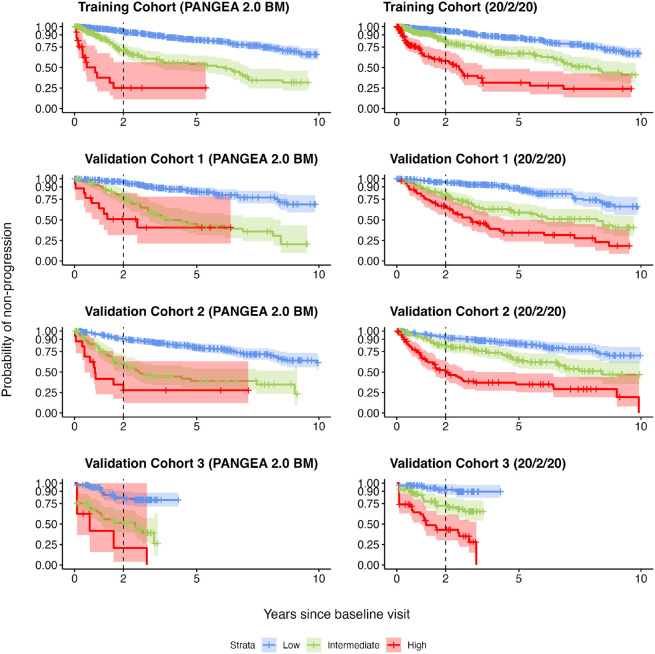 Figure 1
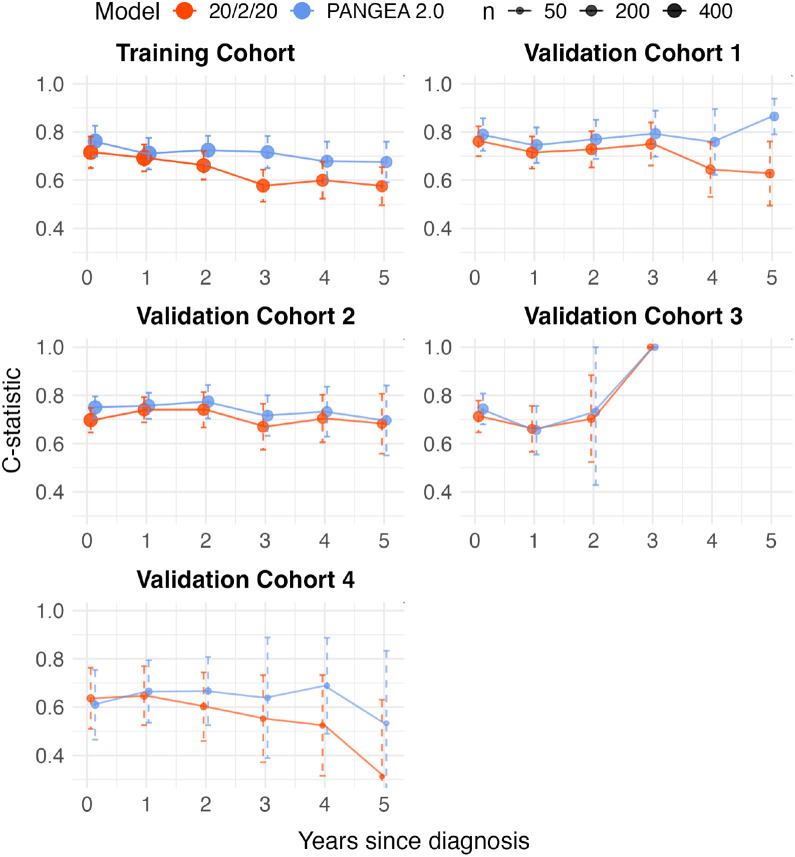 Figure 2
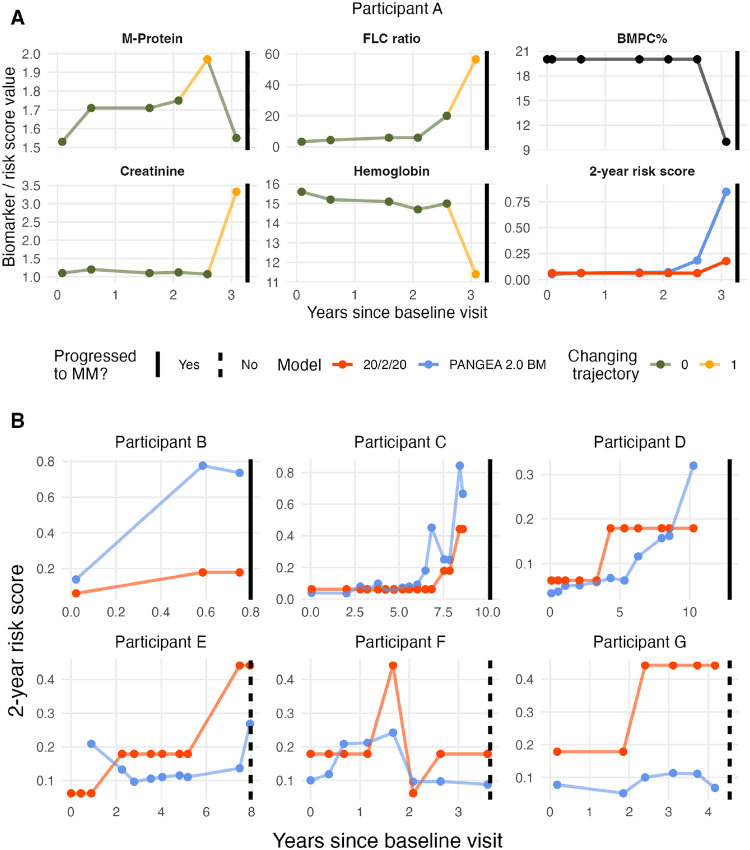 Figure 3
Peer Reviews
No public reviews on file for this paper yet. If you reviewed it on a platform where reviews are public (OpenReview, ICLR, NeurIPS, ICML), you can paste yours below so the community can read it here.
Videos
No videos yet. Explain this paper in a talk, walkthrough, or lecture? Add one.
Taxonomy
TopicsMultiple Myeloma Research and Treatments · Protein Degradation and Inhibitors · Myeloproliferative Neoplasms: Diagnosis and Treatment