Non-invasive Resonance Raman Spectroscopy provides an early estimation of depth in a pig model of multi-depth burns
Rohil Jain, Yanis Berkane, Emmanuella O. Ajenu, Khanh T. Nguyen, Austin Alana Shamlou, Alona Muzikansky, Jonathan Cornacchini, Alexandre G. Lellouch, Basak E. Uygun, Curtis L. Cetrulo, Mark A. Randolph, Korkut Uygun, Padraic Romfh, Shannon N. Tessier

TL;DR
A new non-invasive method using Resonance Raman Spectroscopy can accurately estimate burn depth early after injury in a pig model.
Contribution
A novel Hemoglobin Index based on Resonance Raman Spectroscopy is introduced for early burn depth assessment.
Findings
The Hemoglobin Index achieved 85% AUC accuracy in classifying partial-thickness burn depths on day 3 post-burn.
The method showed nearly perfect classification for other burn categories in the multi-depth model.
Raman-associated fluorescence could track fluorophore deposition for healing management in later phases.
Abstract
Accurate burn depth diagnosis in the early post-burn phase is critical for treatment; however, current assessment methods are subjective, resulting in reduced diagnostic accuracy. Using a compact and portable benchtop setup, we propose a Resonance Raman Spectroscopy protocol to assess burn depth in this phase. By developing a Hemoglobin Index for wounds, we measure hemoglobin in the wound as a marker for wound perfusion, which is altered in burn injuries due to vascular damage. We tested the Hemoglobin Index for wound categorization in a clinically relevant multi-depth burns model in Yucatan pigs. We found a high accuracy of diagnosis on post-burn day 3, an 85% AUC in a binary classifier model for superficial partial-thickness and deep-partial thickness burns, with nearly perfect classification in other categories. Simultaneously, we discuss the potential use of Raman-associated…
Genes, proteins, chemicals, diseases, species, mutations and cell lines named across the full text — each resolved to its canonical identifier and authoritative record.
Click any figure to enlarge with its caption.
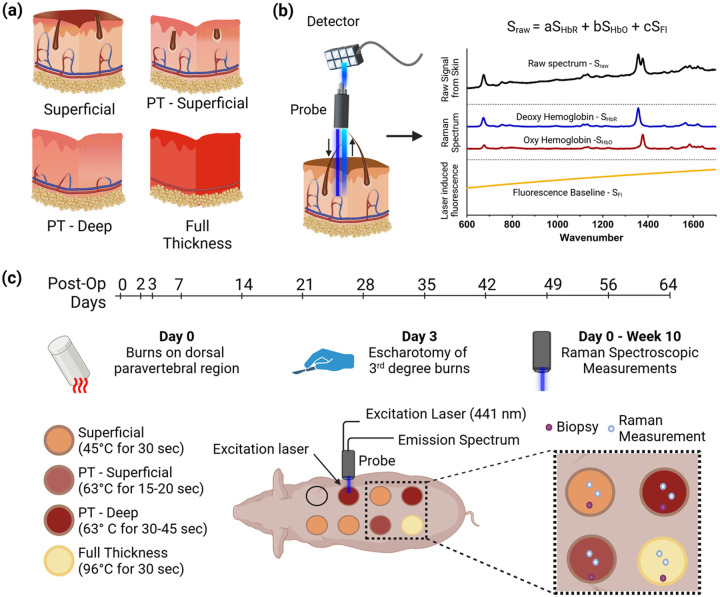 Figure 1
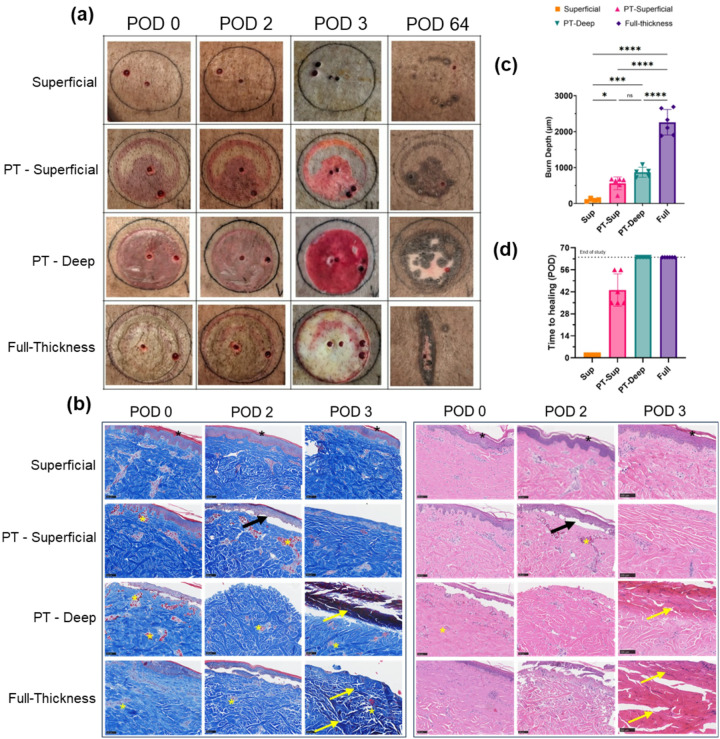 Figure 2
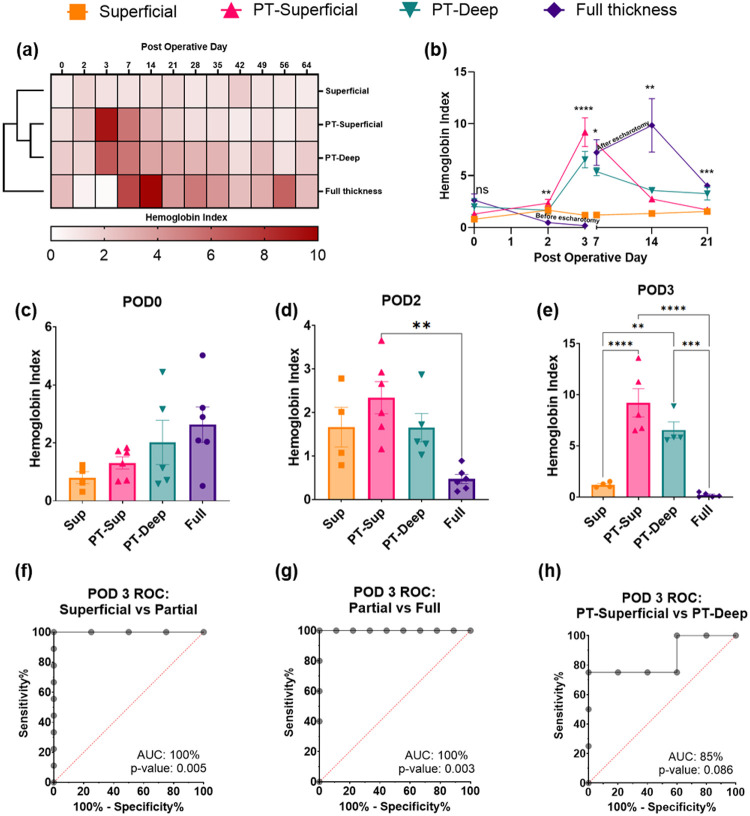 Figure 3
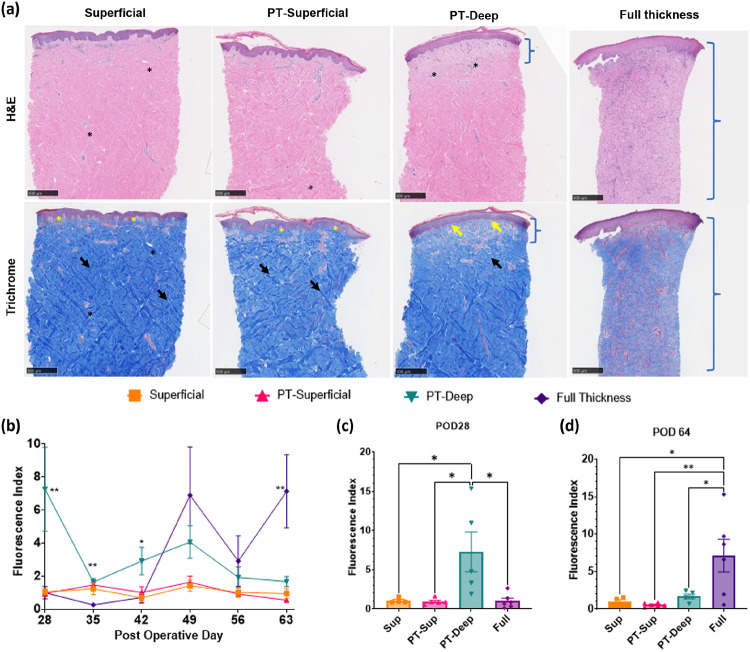 Figure 4
Peer Reviews
No public reviews on file for this paper yet. If you reviewed it on a platform where reviews are public (OpenReview, ICLR, NeurIPS, ICML), you can paste yours below so the community can read it here.
Videos
No videos yet. Explain this paper in a talk, walkthrough, or lecture? Add one.
Taxonomy
TopicsWound Healing and Treatments · Burn Injury Management and Outcomes · Dermatologic Treatments and Research