Structure–Property Relationships in Zwitterionic Pyridinium–Triazole Ligands: Insights from Crystal Engineering and Hirshfeld Surface Analysis
Gerzon E. Delgado, Jonathan Cisterna, Jaime Llanos, Ruth Pulido, Nelson Naveas, Pilar Narea, Pilar Amo-Ochoa, Félix Zamora, Yasna León, Iván Brito

TL;DR
This paper explores how the structure of zwitterionic ligands affects their properties, using crystal engineering and surface analysis to guide material design.
Contribution
The study introduces new zwitterionic ligands and reveals how their structural variations influence supramolecular arrangements and proton conductivity.
Findings
Positional isomerism and methylene spacers significantly affect supramolecular packing and hydrogen bonding.
Hirshfeld surface analysis confirms O···H/H···O and N···H/H···N interactions dominate crystal structures.
Electronic variability among ligands is linked to structural flexibility and isomerism.
Abstract
This article discloses the synthesis of four new positional isomeric zwitterionic ligands exhibiting semi-flexible and flexible characteristics—n-pyridinium-1,2,3-triazole-4-carboxy-5-Acetate (n-PTCA), and n-methylpyridinium-1,2,3-triazole-4-carboxy-5-Acetate (n-MPTCA; where n = 3, 4)—which were derived from an aqueous solution of the corresponding sodium salts in an acidic medium (HCl). These compounds are successfully synthesized and characterized with FT-IR and multinuclear NMR spectroscopy; likewise, proper single crystals are obtained for each compound. All compounds adopt zwitterionic forms in the solid state, which are stabilized via intermolecular proton transfer processes involving HCl and solvent molecules. A single-crystal X-ray analysis revealed how positional isomerism and molecular flexibility influence the supramolecular topology. Specifically, 3-PTCA and 4-PTCA exhibit…
Genes, proteins, chemicals, diseases, species, mutations and cell lines named across the full text — each resolved to its canonical identifier and authoritative record.
Click any figure to enlarge with its caption.
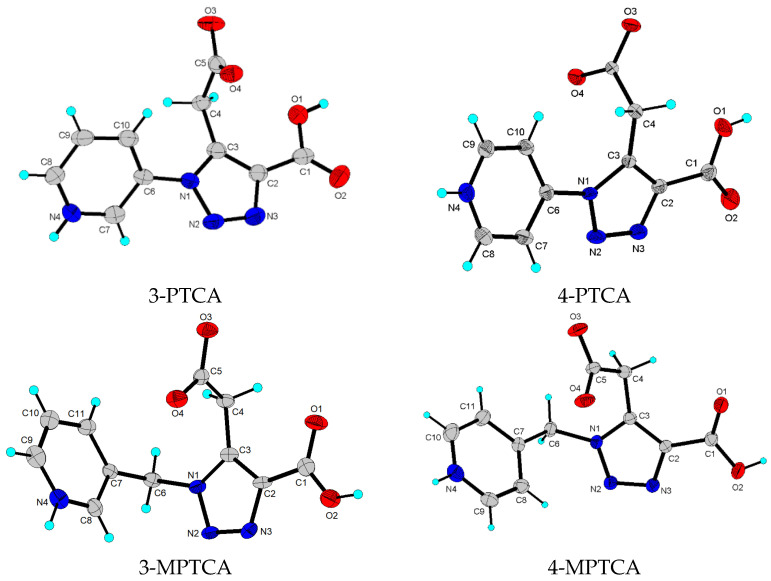 Figure 1
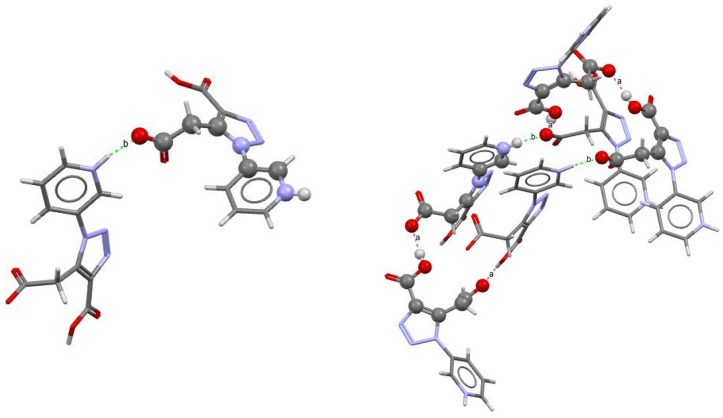 Figure 2
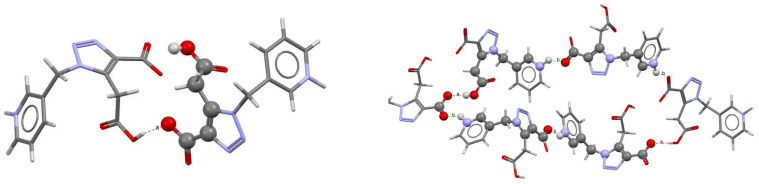 Figure 3
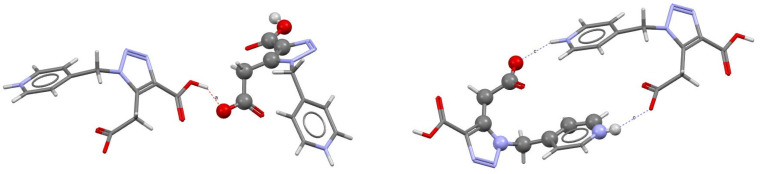 Figure 4
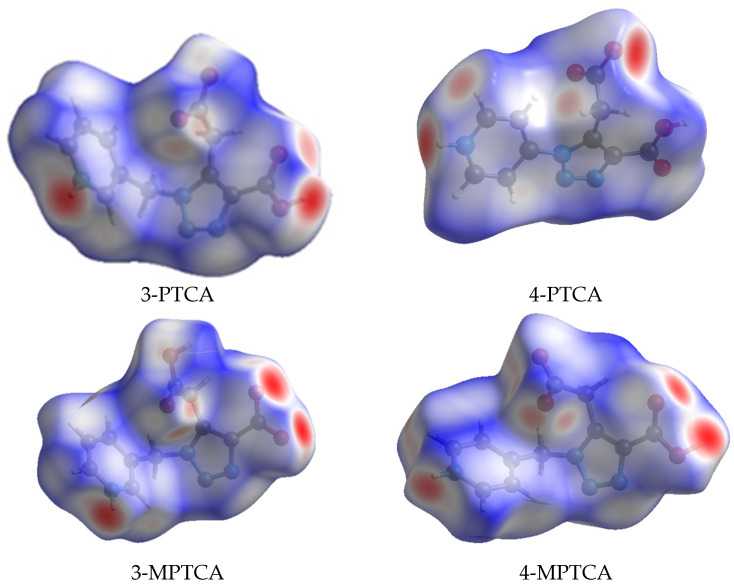 Figure 5
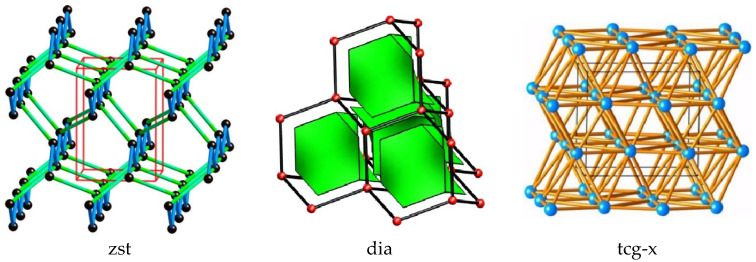 Figure 6
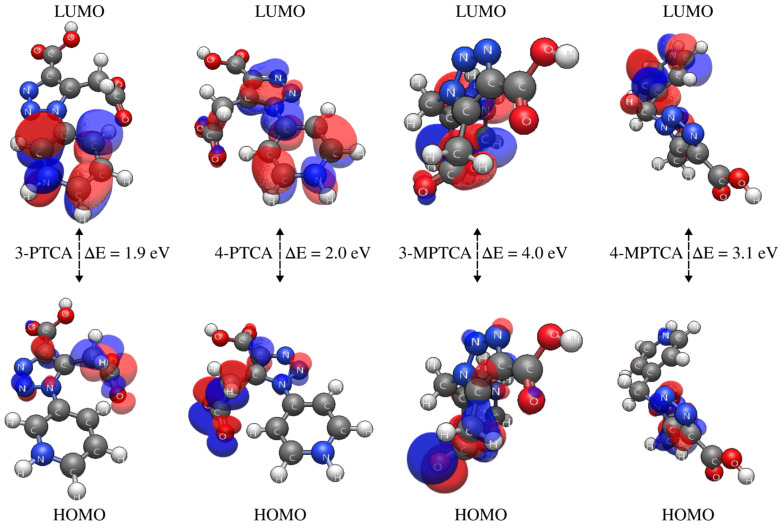 Figure 7
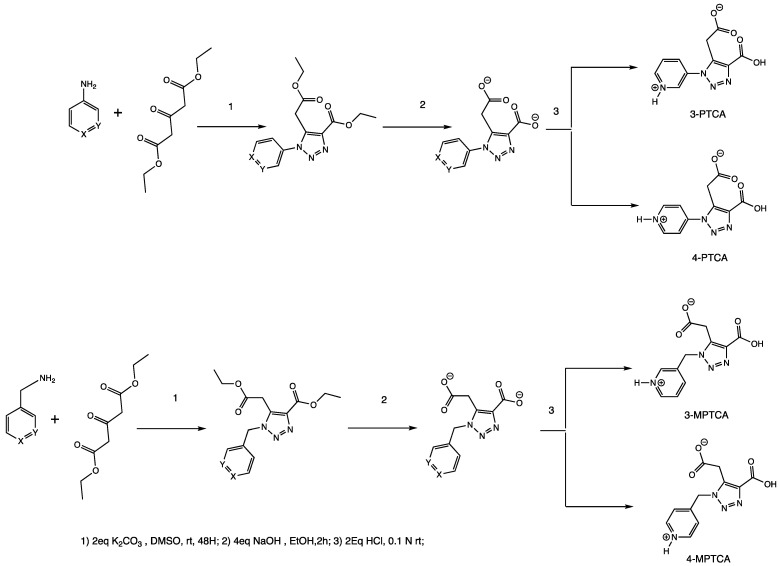 Figure 8
Peer Reviews
No public reviews on file for this paper yet. If you reviewed it on a platform where reviews are public (OpenReview, ICLR, NeurIPS, ICML), you can paste yours below so the community can read it here.
Videos
No videos yet. Explain this paper in a talk, walkthrough, or lecture? Add one.
Taxonomy
TopicsSynthesis and Reactivity of Heterocycles · Crystallography and molecular interactions · Surface Chemistry and Catalysis