Capturing Information About Multiple Sclerosis Comorbidity Using Clinical Interviews and Administrative Records: Do the Data Sources Agree?
Michela Ponzio, Maria Cristina Monti, Paola Borrelli, Giulia Mallucci, Daniela Amicizia, Filippo Ansaldi, Giampaolo Brichetto, Marco Salivetto, Andrea Tacchino, Pietro Perotti, Simona Dalle Carbonare, Roberto Bergamaschi, Cristina Montomoli

TL;DR
This study compares clinical interviews and administrative records to identify comorbidities in people with multiple sclerosis, finding strong agreement for diabetes and hypertension but weaker agreement for other conditions.
Contribution
The study evaluates the agreement between clinical interviews and administrative records for MS comorbidities, highlighting discrepancies in data sources.
Findings
Administrative data showed high agreement for diabetes and hypertension but underreported other conditions like anxiety and autoimmune diseases.
Sensitivity for diabetes was 80%, and for hypertension was 62%, indicating reliable detection in administrative records.
Psychiatric and autoimmune comorbidities were often under-reported or misclassified in administrative data.
Abstract
Background/Objectives: Multiple sclerosis (MS) is often associated with comorbidities that affect clinical outcomes. Data on comorbidities can be sourced from self-reports, medical records, and administrative databases. The gold standard for collecting such data is prospective clinical collection, as in clinical trials, but this is not feasible in large epidemiological studies. This study aimed to assess the agreement between two data sources, clinical interviews and administrative records, identifying major comorbidities in people with MS (pwMS). Methods: We evaluated the agreement between clinical interview data and administrative records in pwMS enrolled at two sites (2021–2022). Seven comorbidities were investigated: depression, anxiety, diabetes, hypertension, autoimmune disease, chronic lung disease, and hyperlipidemia. We used kappa (κ), sensitivity, specificity, and predictive…
Genes, proteins, chemicals, diseases, species, mutations and cell lines named across the full text — each resolved to its canonical identifier and authoritative record.
Click any figure to enlarge with its caption.
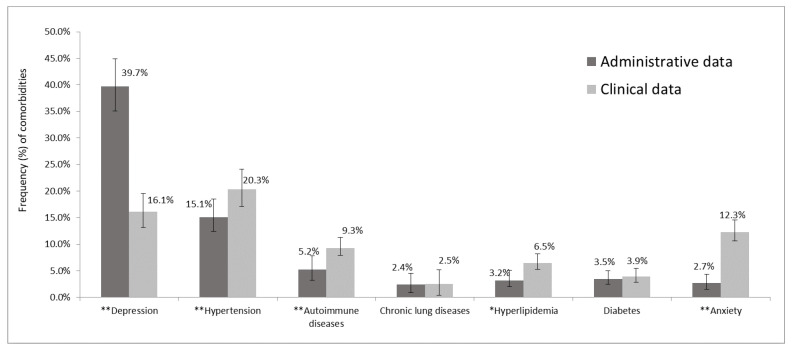 Figure 1
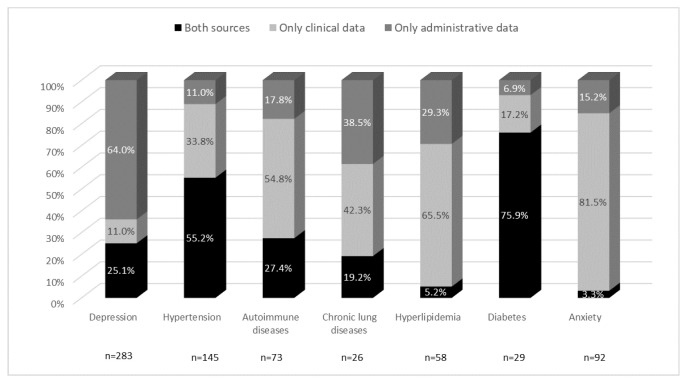 Figure 2
Peer Reviews
No public reviews on file for this paper yet. If you reviewed it on a platform where reviews are public (OpenReview, ICLR, NeurIPS, ICML), you can paste yours below so the community can read it here.
Videos
No videos yet. Explain this paper in a talk, walkthrough, or lecture? Add one.
Taxonomy
TopicsMedical Coding and Health Information · Chronic Disease Management Strategies · Reliability and Agreement in Measurement