Agency Modulation of Hippocampal Activity During Spatial Navigation
Yi-Chuang Lin, Ya-Ting Chang, Charlotte Maschke, Wan-Rue Lin, Yu-Shiang Su, Joshua O. S. Goh

TL;DR
The paper shows that when people navigate actively, their hippocampus encodes spatial information more efficiently, leading to better map formation.
Contribution
The study demonstrates that agentic navigation leads to sparse hippocampal encoding and better spatial memory performance.
Findings
Agency lowers hippocampal activity during spatial traversal and improves retrieval navigation performance.
Agentic navigation increases frontal and temporal dissociation of map nodes from non-nodes.
Sparse hippocampal encoding correlates with more accurate cognitive map formation.
Abstract
The role of navigational agency during hippocampal cognitive map formation remains unclear. To examine this, we measured functional brain activity as participants learned landmarks and paths in virtual mazes either through agentic self-generated movements or guided video tours. Anterior hippocampal responses were generally lower at objective nodes (landmarks and junctions) than non-nodes (traversals). Agency lowered hippocampal traversal activity and subsequently resulted in faster and more successful retrieval navigation behavior. Moreover, agency decreased hippocampal functional autocorrelations suggesting lowered responses stemmed from sparse encoding. Finally, hippocampal node encoding corresponded to the extent frontal and temporal responses dissociated nodes from non-nodes. These findings show that agentic spatial navigation affords subjective movement decisions during spatial…
Click any figure to enlarge with its caption.
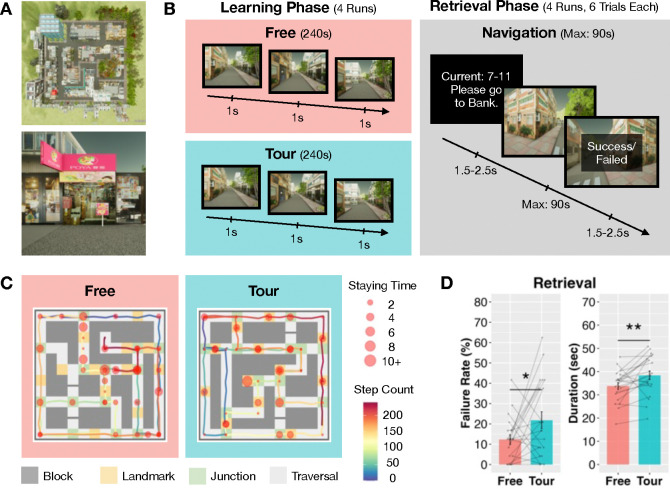 Figure 1
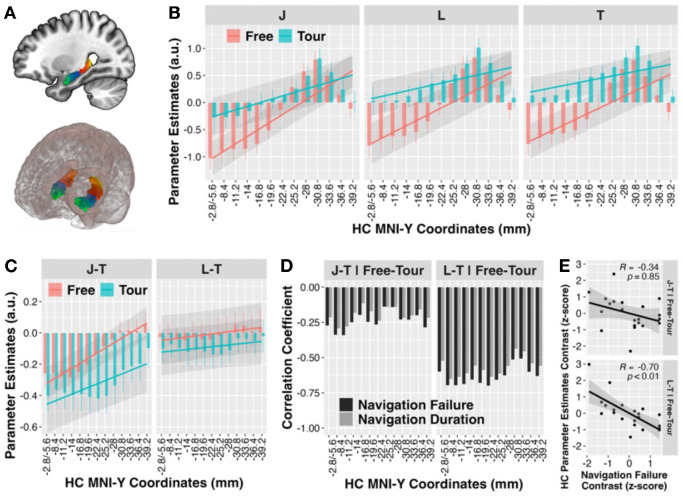 Figure 2
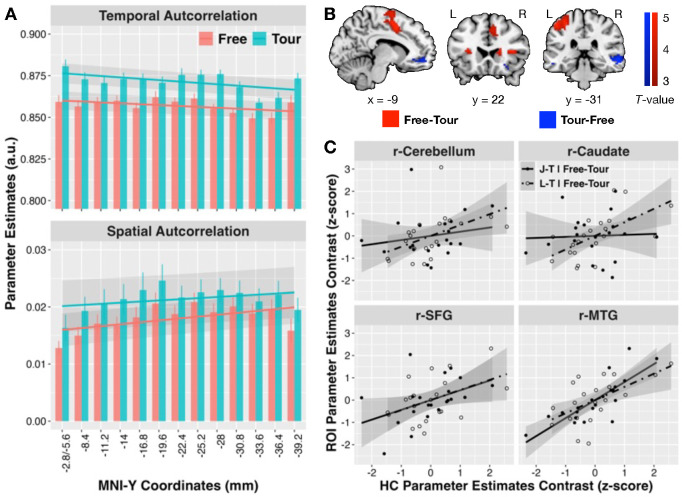 Figure 3
Peer Reviews
No public reviews on file for this paper yet. If you reviewed it on a platform where reviews are public (OpenReview, ICLR, NeurIPS, ICML), you can paste yours below so the community can read it here.
Videos
No videos yet. Explain this paper in a talk, walkthrough, or lecture? Add one.
Taxonomy
TopicsMemory and Neural Mechanisms