Phosphorylation State Dictates Bacterial Stressosome Assembly and Function
Elizabeth A. Martinez-Bond, Ivanna Lopez-Ayala, Mariya Lobanovska, Lisa Qiu, Virginia Garda, Zanlin Yu, Daniel A. Portnoy, Allison H. Williams

TL;DR
This paper shows how phosphorylation controls the assembly and function of bacterial stressosomes, which are crucial for stress response and virulence in Listeria monocytogenes.
Contribution
The study reveals specific phosphorylation sites that regulate stressosome structure and function, linking structural dynamics to bacterial adaptation and pathogenesis.
Findings
Phosphorylation at T175 primes the stressosome for activation, while S56 phosphorylation destabilizes the core and releases RsbT.
Phosphomimetic mutants resist oxidative stress but lose virulence, whereas phosphodeficient mutants are stress-sensitive but retain virulence.
Phosphorylation at T209 modulates stressosome composition and fine-tunes the intensity of the stress response.
Abstract
Bacterial pathogens rely on their ability to sense and respond to environmental stressors to survive and maintain virulence. The stressosome, a 1.8-megadalton nanomachine, serves as a critical sensor and regulator of the general stress response. It is composed of multiple copies of three proteins RsbR, RsbS, and the kinase RsbT which together orchestrate activation of downstream stress adaptation pathways. Using cryo-electron microscopy, we solved the atomic structure of five Listeria monocytogenes stressosomes, capturing structural mimics of the transition between inactive and activated states using phosphomimetic and phosphodeficient mutants. Our findings reveal that phosphorylation at specific residues T175 and T209 on RsbR, and S56 on RsbS dictates stressosome assembly, stoichiometry, and activation. Specifically, phosphorylation at T175 primes the stressosome for activation, while…
Genes, proteins, chemicals, diseases, species, mutations and cell lines named across the full text — each resolved to its canonical identifier and authoritative record.
Click any figure to enlarge with its caption.
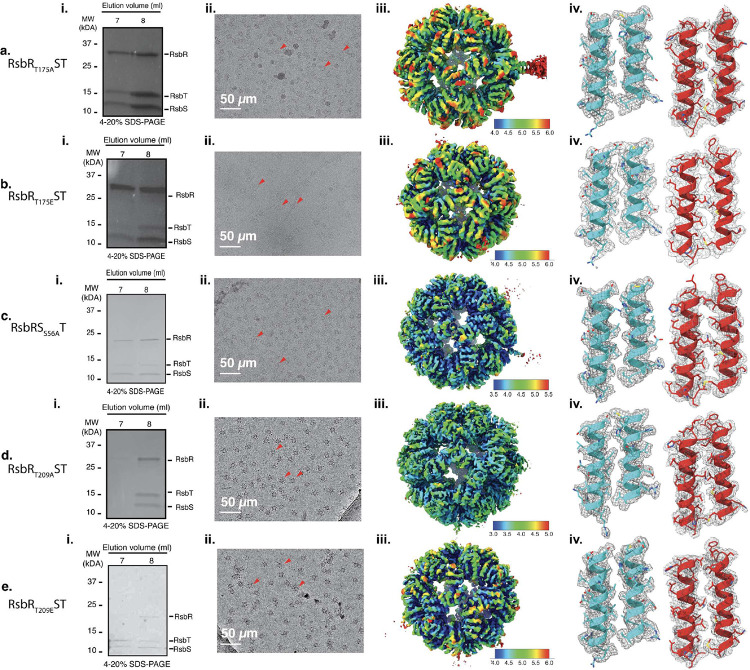 Figure 1
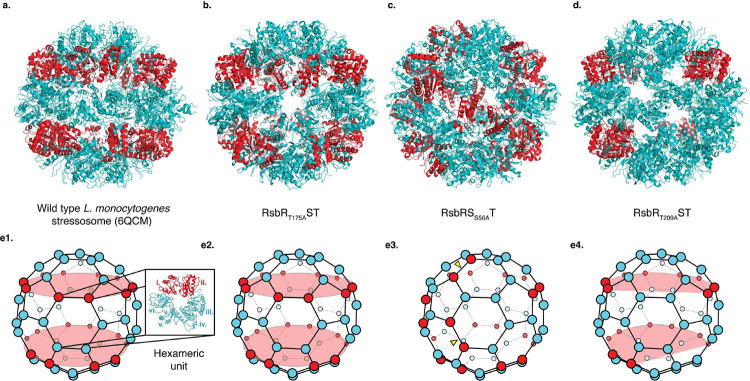 Figure 2
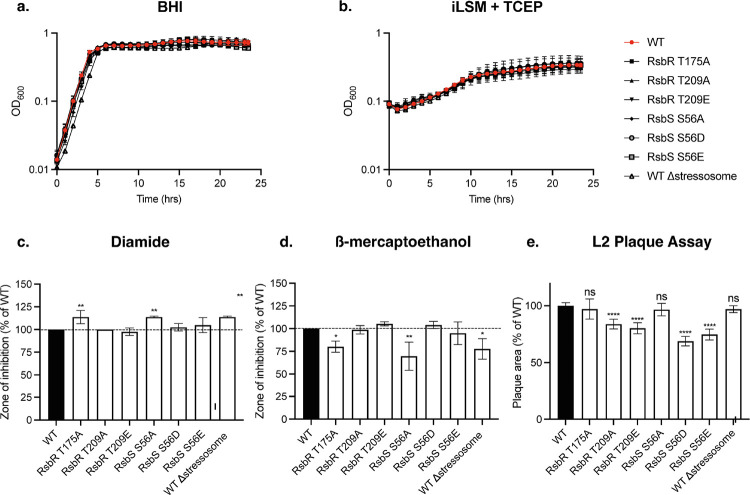 Figure 3
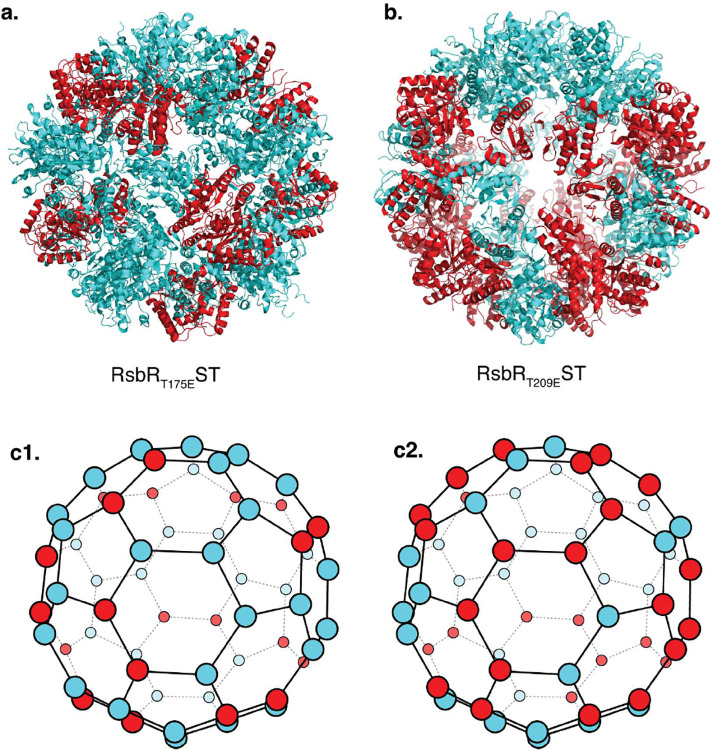 Figure 4
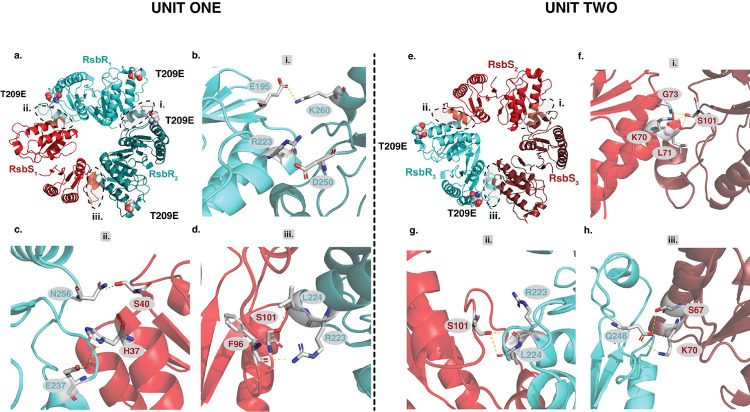 Figure 5
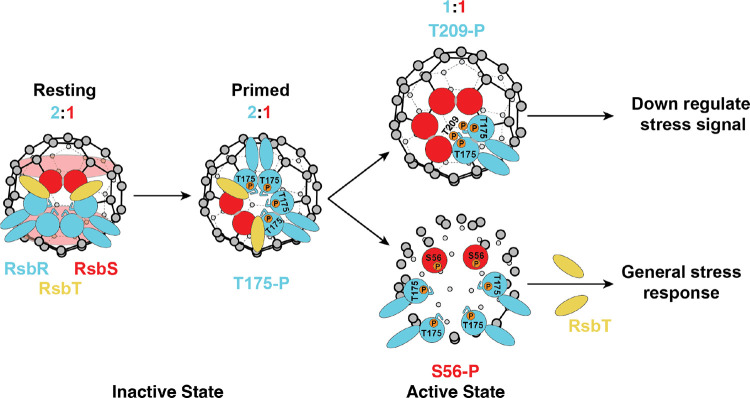 Figure 6
Peer Reviews
No public reviews on file for this paper yet. If you reviewed it on a platform where reviews are public (OpenReview, ICLR, NeurIPS, ICML), you can paste yours below so the community can read it here.
Videos
No videos yet. Explain this paper in a talk, walkthrough, or lecture? Add one.
Taxonomy
TopicsMicrobial Community Ecology and Physiology · Bacteriophages and microbial interactions · Bacterial Genetics and Biotechnology