Effect of gait speed on post-stroke step length and anterior ground reaction force relative to individualized predicted values
Sarah A Kettlety, Maryana Bonilla Yanez, Christina K Holl, Jan Stenum, Ryan T Roemmich, Kristan A Leech

TL;DR
This study examines how walking faster affects step length and ground reaction force in stroke survivors compared to predicted values, finding that faster walking doesn't always improve these metrics.
Contribution
The study introduces a novel analysis of how gait speed affects post-stroke walking metrics relative to individualized predictions.
Findings
Faster walking did not reduce the difference between actual and predicted step lengths.
Faster walking increased the difference between paretic anterior ground reaction force and predicted values for those with longer paretic steps.
Fast walking alone may not improve paretic anterior ground reaction force to predicted levels.
Abstract
Training at faster gait speeds is recommended to improve activity limitations in adults with stroke. Walking faster can also increase step length and anterior ground reaction force (AGRF) relative to post-stroke habitual walking patterns. Recent work has developed a prediction equation that utilizes individual characteristics to predict a neurotypical or pre-stroke step length and AGRF value for an individual. However, it is unclear how the predicted individualized step length and AGRF values from this prediction equation relate to actual step length and AGRF values, and how the relationship between these values may change with gait speed. We aimed to understand the effect of gait speed on post-stroke step length and AGRF relative to a predicted individualized step length and AGRF value and to understand whether step length asymmetry direction (i.e., whether the paretic or non-paretic…
Genes, proteins, chemicals, diseases, species, mutations and cell lines named across the full text — each resolved to its canonical identifier and authoritative record.
Click any figure to enlarge with its caption.
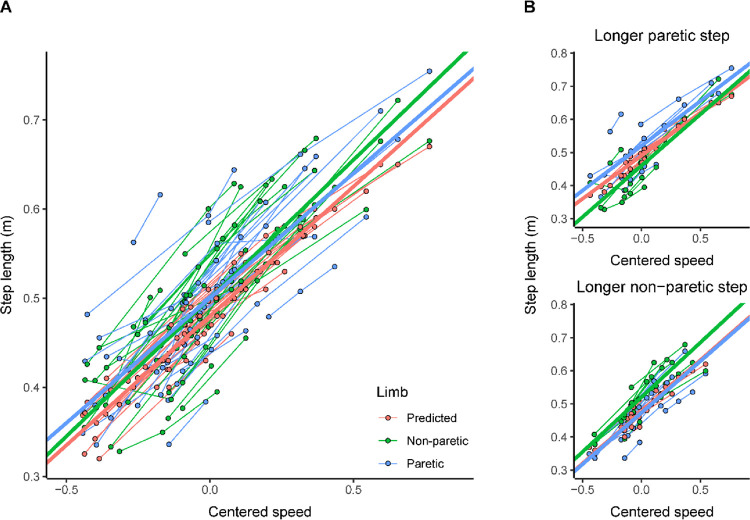 Figure 1
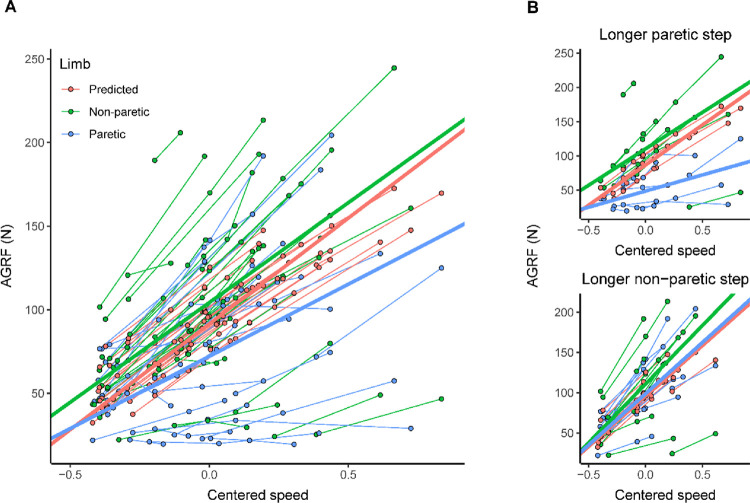 Figure 2
Peer Reviews
No public reviews on file for this paper yet. If you reviewed it on a platform where reviews are public (OpenReview, ICLR, NeurIPS, ICML), you can paste yours below so the community can read it here.
Videos
No videos yet. Explain this paper in a talk, walkthrough, or lecture? Add one.
Taxonomy
TopicsWinter Sports Injuries and Performance