Cannabinoid Receptor Type 1 Availability in Individuals with a History of Childhood Trauma: A Positron Emission Tomography Study
ANAHITA BASSIR NIA, Ardavan Mohammad Aghaei, Brian Pittman, Nachshon Korem, Deepak D’Souza, Marc Potenza, Ansel Hillmer, Mohini Ranganathan, Ilan Harpaz-Rotem

TL;DR
This study found that adults with a history of childhood trauma have lower levels of a brain receptor linked to the endocannabinoid system compared to healthy controls.
Contribution
The study is the first to show reduced CB1R availability in humans with childhood trauma using PET imaging.
Findings
CB1R availability was lower in trauma-affected individuals globally and in the amygdala and hippocampus.
No significant differences were found in frontal cortex CB1R availability between groups.
Psychiatric diagnoses and medication use did not affect the observed CB1R differences.
Abstract
Early life adversity has a lasting impact on the endocannabinoid (eCB) system based on animal models. However, the impact of early life adversity such as childhood trauma (CT) on the eCB system has not been thoroughly studied. We assessed the availability of cannabinoid receptor type 1 (CB1R) in individuals with CT compared to healthy controls without CT (HCs). Cannabinoid receptor type 1 (CB1R) availability was compared in adults with CT (N = 22) and age- and sex-matched HCs (n = 22), using positron emission tomography (PET) imaging with the CB1R-specific radiotracer [11C]OMAR. Using linear models, the effect of the group was assessed on global and trauma-relevant brain regions (amygdala, hippocampus, and frontal cortex). Compared to HCs, lower CB1R availability was observed in CT globally (difference= −11.36%, F(1,42) = 4.35, p = 0.04), in amygdala (−13.70%, F(1,84) = 6.66, p = 0.01),…
Genes, proteins, chemicals, diseases, species, mutations and cell lines named across the full text — each resolved to its canonical identifier and authoritative record.
Click any figure to enlarge with its caption.
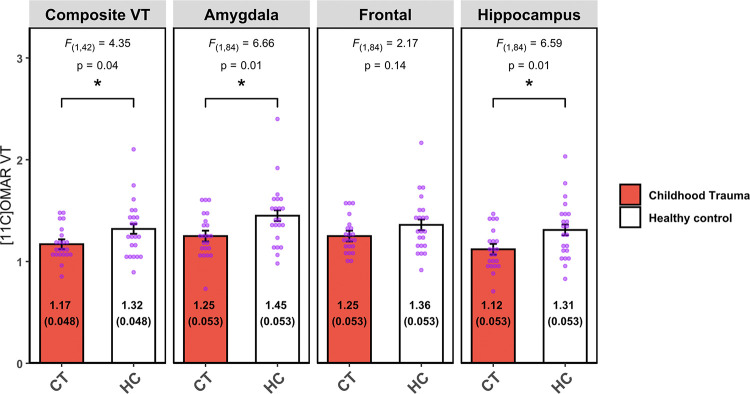 Figure 1
Peer Reviews
No public reviews on file for this paper yet. If you reviewed it on a platform where reviews are public (OpenReview, ICLR, NeurIPS, ICML), you can paste yours below so the community can read it here.
Videos
No videos yet. Explain this paper in a talk, walkthrough, or lecture? Add one.
Taxonomy
TopicsCannabis and Cannabinoid Research · Neuroscience of respiration and sleep · Forensic Toxicology and Drug Analysis