Gender Dysphoria Preceding Intersex Recognition Demonstrates a Biophysiological Basis for Sex Identity
Beverly Rice, Billy Troy Wooton, Joshua G. Burkhart, Kartik Saini, Alexander J. Stokes, Helen Turner

TL;DR
Intersex individuals are more likely to experience gender dysphoria, suggesting a biological link between sex variation and gender identity.
Contribution
The study reveals a biophysiological basis for sex identity through the elevated and earlier occurrence of gender dysphoria in intersex individuals.
Findings
Intersex individuals have nearly four times the rate of gender dysphoria compared to the general population.
Gender dysphoria preceded intersex recognition in 47% of cases, indicating delayed diagnosis.
Intersex individuals are diagnosed with gender dysphoria at older ages than non-intersex individuals.
Abstract
Intersex individuals—those born with congenital variations in sex characteristics (VSCs)—experience elevated and underrecognized clinical risks. In an analysis of 3.42 million electronic health records, we identified 2,207 intersex patients, of whom 2.95% were diagnosed with gender dysphoria (GD)—nearly four times the rate in the general population (OR = 3.84, p < 0.001). In temporally resolvable cases, GD preceded intersex recognition in 47% of patients. Intersex individuals also received GD diagnoses at significantly older ages than non-intersex peers (median 32 vs. 26 years), with a broader and more variable age distribution. These patterns suggest delayed recognition, elevated psychosocial burden, and systemic misalignment between clinical frameworks and patient realities. Despite clinical recognition of both intersex traits and GD via long-established ICD codes, recent policies…
Genes, proteins, chemicals, diseases, species, mutations and cell lines named across the full text — each resolved to its canonical identifier and authoritative record.
Click any figure to enlarge with its caption.
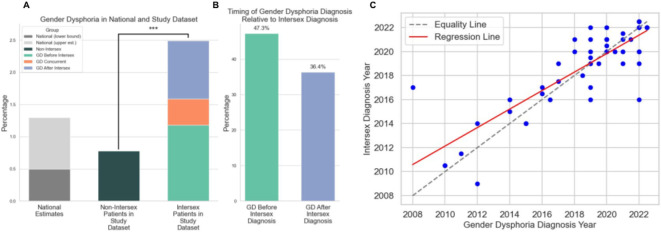 Figure 1
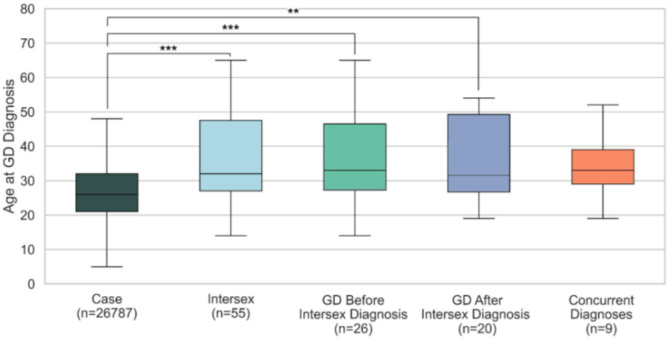 Figure 2
Peer Reviews
No public reviews on file for this paper yet. If you reviewed it on a platform where reviews are public (OpenReview, ICLR, NeurIPS, ICML), you can paste yours below so the community can read it here.
Videos
No videos yet. Explain this paper in a talk, walkthrough, or lecture? Add one.
Taxonomy
TopicsSexual Differentiation and Disorders · Genetic and Clinical Aspects of Sex Determination and Chromosomal Abnormalities · LGBTQ Health, Identity, and Policy