Speckle-Tracking Echocardiography in Dogs: Evaluating Imaging Parameters and Methodological Variability in Global Longitudinal Strain Assessment
Jonas E. Mogensen, Maiken B. T. Bach, Pernille G. Bay, Tuğba Varlik, Jakob L. Willesen, Caroline H. Gleerup, Jørgen Koch

TL;DR
This study examines how technical factors affect the accuracy of heart function measurements in dogs using 2D-STE and compares two analysis methods.
Contribution
The study identifies key factors influencing GLS measurements and evaluates the reliability of two 2D-STE methods in dogs.
Findings
Foreshortening and heart rate variability significantly affect GLS measurements in dogs.
2D strain and AFI methods show good correlation but cannot be used interchangeably due to systematic bias.
Observer variability is low, with coefficients of variation below 9% for both methods.
Abstract
Two-dimensional speckle-tracking echocardiography (2D-STE) is a valuable tool for assessing myocardial function by measuring myocardial deformation. This prospective cohort study investigates 2D-STE. The first part of this study evaluated the influence of heart rate, frame rate, foreshortening, zoom, and transducer frequency upon global longitudinal strain (GLS) in 16 healthy dogs. The second part of the study compared GLS values obtained with GE Healthcare’s two 2D-STE methods: quantitative analysis of the 2D strain (2D strain) and automated function imaging (AFI) in 10 dogs. Our findings demonstrate that foreshortening of the left ventricle (p < 0.01, Cohen’s d: 0.52, CI: −17.81 to −24.83) and heart rate variation (p = 0.02, Cohen’s d: 0.72, CI: −18.07 to −26.23) significantly affect the GLSA4C in dogs, which should be considered in clinical and research applications. There was a good…
Genes, proteins, chemicals, diseases, species, mutations and cell lines named across the full text — each resolved to its canonical identifier and authoritative record.
Click any figure to enlarge with its caption.
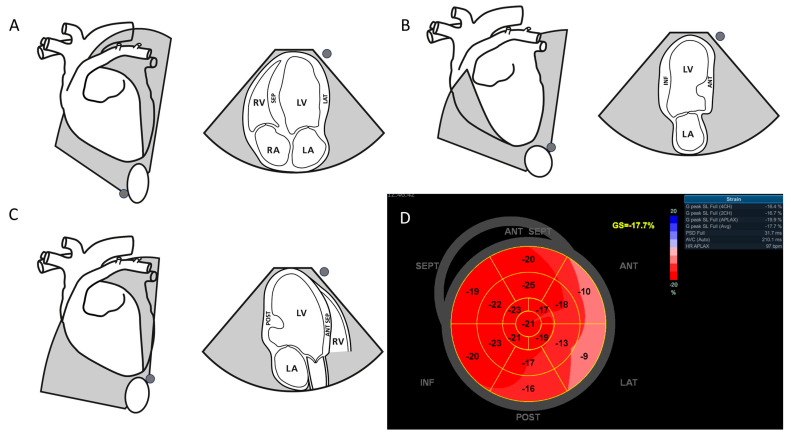 Figure 1
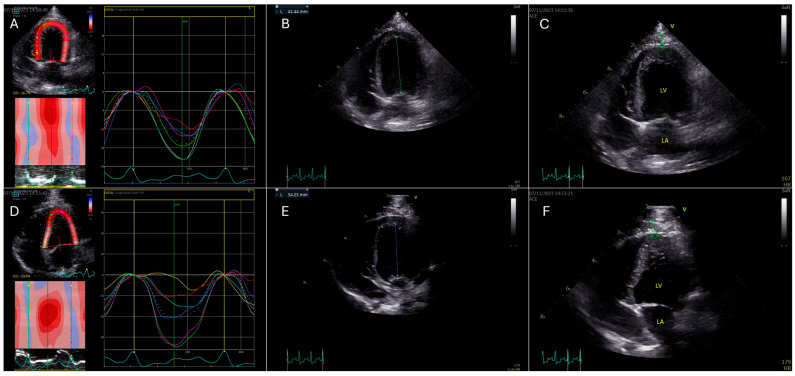 Figure 2
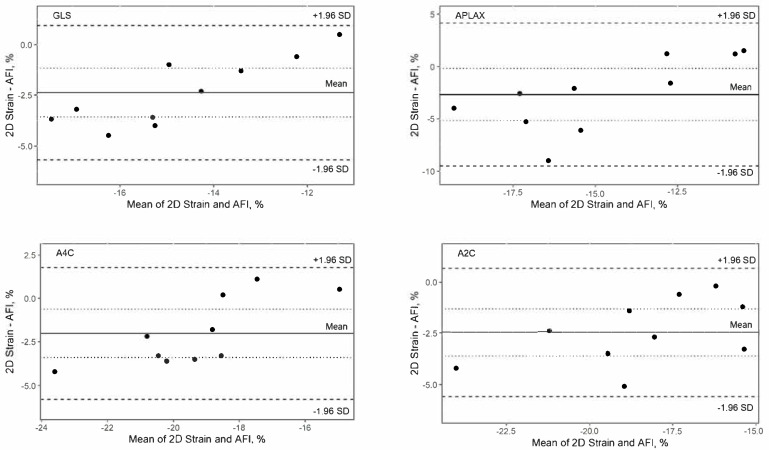 Figure 3
Peer Reviews
No public reviews on file for this paper yet. If you reviewed it on a platform where reviews are public (OpenReview, ICLR, NeurIPS, ICML), you can paste yours below so the community can read it here.
Videos
No videos yet. Explain this paper in a talk, walkthrough, or lecture? Add one.
Taxonomy
TopicsCardiovascular Function and Risk Factors · Ultrasound in Clinical Applications · Cardiovascular Conditions and Treatments