How Happy Do These Animals Look? Exploring Factors Influencing Children’s Perceptions of Animal Welfare at the Zoo
María Ignacia Vera-Concha, Manuel Rojas, Daniel Cartes, Maria Camila Ceballos, Mari Carmen Villarroel, Martín Pérez, Vladimir Venegas, Cristóbal Briceño, Javiera Calderón-Amor, Daniela Luna

TL;DR
This study explores how children and teens judge animal welfare at zoos, finding that emotions and perceptions strongly influence their assessments.
Contribution
The study reveals that children's animal welfare assessments are influenced by emotional state, phylogenetic closeness, and perceived enclosure quality.
Findings
Fish received the highest welfare and enclosure ratings despite being less evolutionarily close to humans.
Positive emotions in participants correlated with more favorable animal welfare assessments.
Children recognized the importance of natural behaviors and species-specific environments for animal welfare.
Abstract
Understanding how children and adolescents perceive animal welfare in zoos is important for improving both animal care and educational programs. This study examined how 254 children and adolescents aged 7 to 18 assessed six animals in their enclosures at a zoo: a monkey, a parrot, a caiman, a frog, a fish, and a tarantula. Participants were asked about the animals’ needs (n = 254) and how they felt emotionally, how they perceived each animal’s welfare, and how they rated the animals’ enclosures (n = 113). Participants understood animal welfare as more than just providing food or water; they also recognized the importance of natural behaviors and proper environments for each species. Participants’ ratings were influenced by their emotional state, their overall impression of each animal’s welfare, and the evolutionary closeness of the species observed. Interestingly, fish received the…
Genes, proteins, chemicals, diseases, species, mutations and cell lines named across the full text — each resolved to its canonical identifier and authoritative record.
Click any figure to enlarge with its caption.
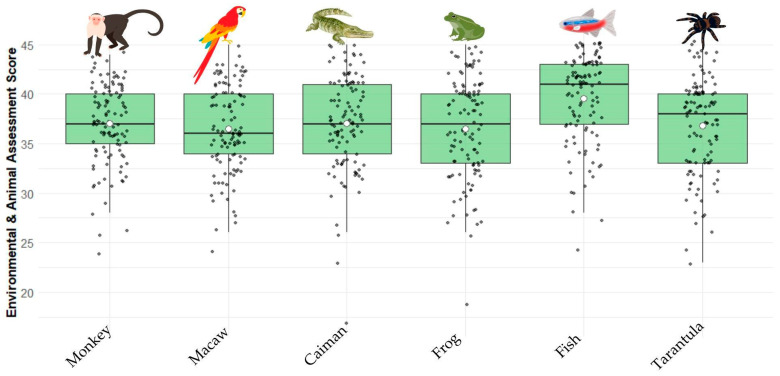 Figure 1
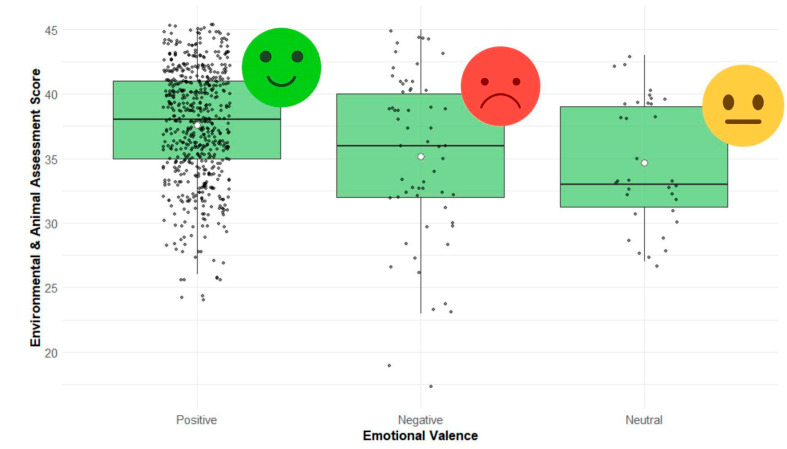 Figure 2
Peer Reviews
No public reviews on file for this paper yet. If you reviewed it on a platform where reviews are public (OpenReview, ICLR, NeurIPS, ICML), you can paste yours below so the community can read it here.
Videos
No videos yet. Explain this paper in a talk, walkthrough, or lecture? Add one.
Taxonomy
TopicsAnimal and Plant Science Education · Human-Animal Interaction Studies · Animal Behavior and Welfare Studies