Oncology Biomarkers, Clinical Characteristics, and Survival Outcomes in Colorectal Cancer Patients with Spinal Metastases Undergoing Spinal Surgery: Insights from a Retrospective Cohort Study
Abdel-Hameed Al-Mistarehi, Taha Khalilullah, Abdul Karim Ghaith, Mahnoor Shafi, Jawad M. Khalifeh, Yuanxuan Xia, Khaled J. Zaitoun, Ahmad A. Alnasser, Joseph Rajasekaran, Avi N. Albert, Siddharth Shah, Nicholas Theodore, Jeffrey Meyer, Kristin J. Redmond, Susan L. Gearhart

TL;DR
This study explores factors affecting survival in colorectal cancer patients with spinal metastases, finding that CK20 expression and tumor recurrence are linked to shorter survival, while surgery improves quality of life.
Contribution
The study identifies CK20 expression and spinal tumor recurrence as novel prognostic factors for survival in colorectal cancer patients with spinal metastases.
Findings
CK20 expression and spinal tumor recurrence are significantly associated with shorter post-metastasis survival.
Surgical treatment improves neurological function and quality of life in patients with spinal metastases.
The median post-metastasis survival is 3.0 years, with most patients having extraspinal metastases.
Abstract
Colorectal cancer can metastasize to the spine, leading to significant complications such as pain, neurological deficits, and impaired mobility. This study examines clinical factors and biological markers that influence survival in patients with spinal metastasis from colorectal cancer. Analysis of demographics, tumor markers, surgical outcomes, and survival revealed that CK20 expression and the recurrent spinal tumors may be linked to shorter post-metastasis survival. Additionally, surgical treatment was associated with improved neurological function, enhancing patients’ quality of life. These insights could help guide future treatment strategies and improve patient care. Further prospective research with larger patient cohorts is necessary to validate these results and refine approaches for managing spinal metastases from colorectal cancer. Objectives: This study aims to identify…
Genes, proteins, chemicals, diseases, species, mutations and cell lines named across the full text — each resolved to its canonical identifier and authoritative record.
Click any figure to enlarge with its caption.
 Figure 1
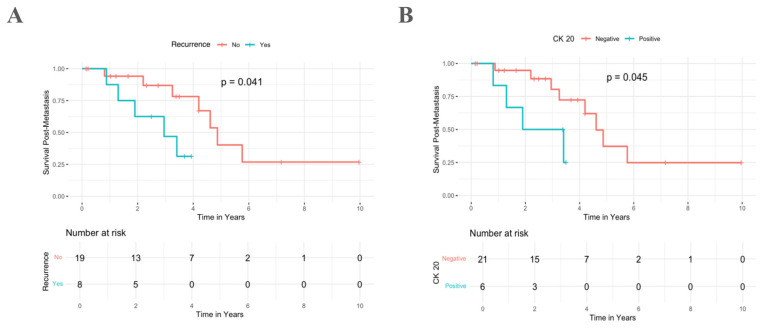 Figure 2
Peer Reviews
No public reviews on file for this paper yet. If you reviewed it on a platform where reviews are public (OpenReview, ICLR, NeurIPS, ICML), you can paste yours below so the community can read it here.
Videos
No videos yet. Explain this paper in a talk, walkthrough, or lecture? Add one.
Taxonomy
TopicsManagement of metastatic bone disease · Spine and Intervertebral Disc Pathology · Colorectal and Anal Carcinomas