Clinical and Morphological Features of ER-Positive HER2-Negative Breast Tumors with PIK3CA Mutations in Russian Patients
Tatyana N. Sokolova, Grigory A. Yanus, Svetlana N. Aleksakhina, Yana V. Belysheva, Aleksandra P. Chernyakova, Yulia S. Zharnakova, Alisa S. Nikitina, Tatyana M. Stebneva, Aleksandr S. Martianov, Alla Yu. Goryainova, Mark I. Gluzman, Rashida V. Orlova, Anastasiya I. Stukan’

TL;DR
This study examines the frequency and characteristics of PIK3CA mutations in Russian patients with a specific type of breast cancer and finds that testing should go beyond common mutation sites.
Contribution
The study emphasizes the need for comprehensive PIK3CA testing beyond hotspots in Russian HR+/HER2− breast cancer patients.
Findings
PIK3CA mutations were found in 37% of HR+/HER2− breast cancer cases.
Common commercial kits may miss up to 12% of PIK3CA mutations.
PIK3CA mutations were not linked to treatment resistance in a subgroup of patients.
Abstract
Mutations in PIK3CA occur in approximately one-third of hormone receptor-positive (HR+)/HER2-negative (HER2−) breast cancer (BC) and represent a target for specific inhibitors. The current study established the frequency and spectrum of PIK3CA alterations in HR+/HER2− BC from Russian patients. We conclude that the overall prevalence and characteristics of PIK3CA-positive cases are consistent with previously published data and do not depend on the patient’s ethnic background. We also show that PIK3CA testing should not be limited to hot-spot variants, as commercially available kits may miss up to 12% of PIK3CA-mutated cases. Background: Several targeted drugs have been recently approved for the treatment of PIK3CA-mutated hormone receptor-positive (HR+)/HER2-negative (HER2−) breast cancer (BC). This study aimed at a comprehensive evaluation of the spectrum of PIK3CA alterations in…
Genes, proteins, chemicals, diseases, species, mutations and cell lines named across the full text — each resolved to its canonical identifier and authoritative record.
Click any figure to enlarge with its caption.
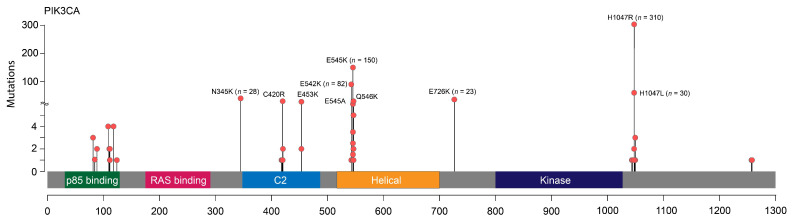 Figure 1
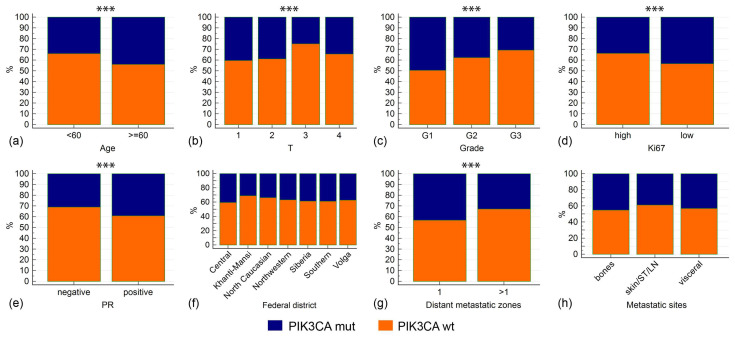 Figure 2
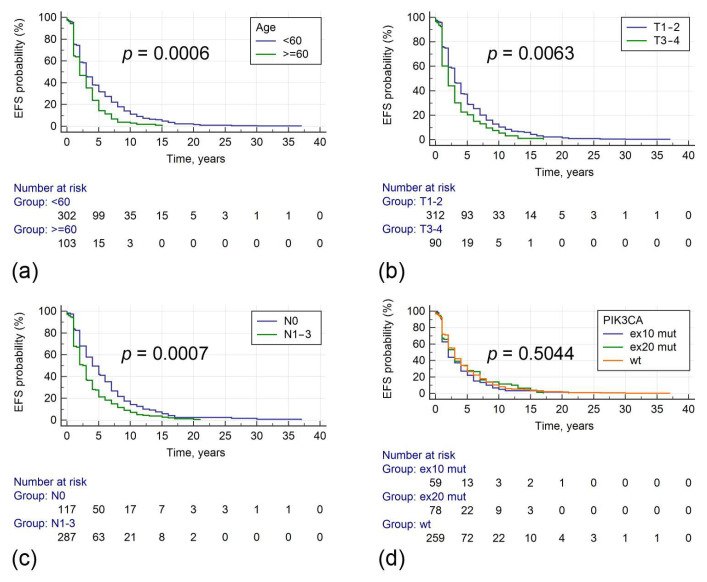 Figure 3
Peer Reviews
No public reviews on file for this paper yet. If you reviewed it on a platform where reviews are public (OpenReview, ICLR, NeurIPS, ICML), you can paste yours below so the community can read it here.
Videos
No videos yet. Explain this paper in a talk, walkthrough, or lecture? Add one.
Taxonomy
TopicsAdvanced Breast Cancer Therapies · Chronic Lymphocytic Leukemia Research · PI3K/AKT/mTOR signaling in cancer