The Prognostic Value of Tumor Fibrosis in Patients Undergoing Hepatic Metastasectomy for Colorectal Cancer: A Retrospective Pooled Analysis
Xavier Hernández-Yagüe, Santiago López-Ben, Joan Martínez-Sancho, Maria Rosa Ortíz-Durán, Margarida Casellas-Robert, Ana Aula-Olivar, Cristina Meléndez-Muñoz, Maria Buxó Pujolràs, Bernardo Queralt-Merino, Joan Figueras i Felip

TL;DR
This study shows that anti-EGFR therapy leads to more tumor fibrosis than anti-VEGF in colorectal cancer liver metastases, suggesting it may be a better prognostic indicator.
Contribution
The study compares anti-EGFR and anti-VEGF therapies in relation to tumor fibrosis and evaluates the Poultsides classification as a prognostic tool.
Findings
Anti-EGFR therapy resulted in significantly higher fibrosis (median 40.0%) compared to anti-VEGF (median 20.6%).
Overall survival was similar between the two treatment cohorts despite differences in fibrosis levels.
The Poultsides classification may offer better prognostic value than the Rubbia–Brandt classification.
Abstract
Surgical resection of liver metastases (M1) has shown a clear survival benefit in patients with metastatic colorectal cancer (mCRC). Several prognostic factors have been linked to differences in survival among these patients, including pathological tumor response. Tumor fibrosis in resected liver metastases has been associated with improved outcomes across different classifications, though no consistent cut-off for prognostic value has been established. This study aims to evaluate the likelihood of achieving ≥40% fibrosis following preoperative chemotherapy combined with either anti-epidermal growth factor receptor (anti-EGFR) or anti-vascular endothelial growth factor (anti-VEGF) therapy and its association with overall survival. Additionally, the study compares the prognostic value of two pathological response classifications: Poultsides vs. Rubbia–Brandt. Final outcomes aim to…
Genes, proteins, chemicals, diseases, species, mutations and cell lines named across the full text — each resolved to its canonical identifier and authoritative record.
Click any figure to enlarge with its caption.
 Figure 1
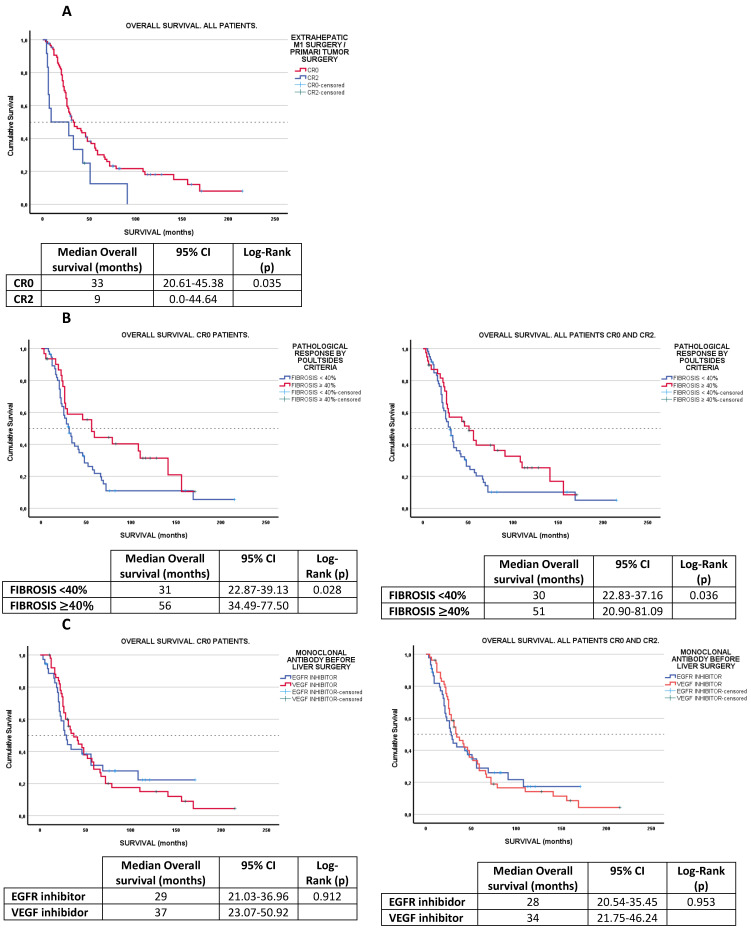 Figure 2
Peer Reviews
No public reviews on file for this paper yet. If you reviewed it on a platform where reviews are public (OpenReview, ICLR, NeurIPS, ICML), you can paste yours below so the community can read it here.
Videos
No videos yet. Explain this paper in a talk, walkthrough, or lecture? Add one.
Taxonomy
TopicsHepatocellular Carcinoma Treatment and Prognosis · Gastric Cancer Management and Outcomes · Colorectal Cancer Treatments and Studies