Culturally Adapted Manual‐Assisted Psychological Intervention (CaMaPI) for Adolescents/Young People With a History of Self‐Harm and Suicidal Ideation in Nigeria: A Randomised Controlled Feasibility Trial
Dung Ezekiel Jidong, Tarela Juliet Ike, Maigari Yusufu Taru, Juliet Y. Pwajok, Charles Nnaemeka Nwoga, John Ezekiel Jidong, Shadrack B. Mwankon, Christopher Francis, Nusrat Husain

TL;DR
A culturally adapted psychological intervention called CaMaPI was found to be feasible and acceptable for reducing self-harm and suicidal thoughts in Nigerian youth.
Contribution
The study introduces a culturally adapted manual-based intervention tailored for Nigerian adolescents and young people with self-harm and suicidal ideation.
Findings
CaMaPI showed higher satisfaction and greater reduction in self-harm and suicidal ideation compared to Treatment as Usual.
Qualitative feedback highlighted cultural appropriateness and positive participant experiences with CaMaPI.
Both groups showed no significant reduction in hopelessness, suggesting a need for further intervention refinement.
Abstract
Globally, suicide is the second leading cause of death for adolescents/young people aged 15–30‐years old. The mainstream care for these affected persons is mostly unsuccessful due to limited culturally appropriate care. This is a mixed‐methods randomised controlled feasibility trial design. A culturally adapted manual‐assisted psychological intervention (CaMaPI) was utilised to treat adolescents/young people with histories of self‐harm and suicidal ideation. CaMaPI is a manualised intervention consisting of 10 sessions, grounded in psychoeducation and cognitive behavioural therapy. Participants aged 18–29 were screened for self‐harm and suicidal ideation. N = 20 participants were randomised into CaMaPI (n = 10) or Treatment as Usual (TaU) (n = 10) groups. One focus group with n = 8 participants, and n = 3 individual interviews were conducted with the experimental group. Satisfaction…
Genes, proteins, chemicals, diseases, species, mutations and cell lines named across the full text — each resolved to its canonical identifier and authoritative record.
Click any figure to enlarge with its caption.
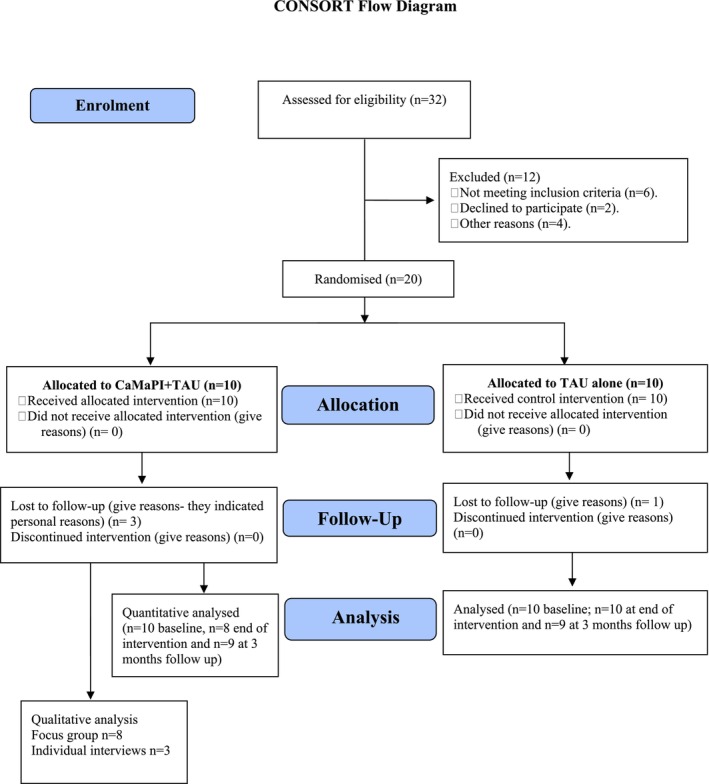 Figure 1
Peer Reviews
No public reviews on file for this paper yet. If you reviewed it on a platform where reviews are public (OpenReview, ICLR, NeurIPS, ICML), you can paste yours below so the community can read it here.
Videos
No videos yet. Explain this paper in a talk, walkthrough, or lecture? Add one.
Taxonomy
TopicsResilience and Mental Health · Religion, Spirituality, and Psychology · Childhood Cancer Survivors' Quality of Life