Configuration of adaptable template RNA architectures to unfold the editable space of a nuclease prime editor
Pingbo Chen, Xiangyang Li, Qian Zhou, Jingzhou Chen, Lijin Lu, Pei Wang, Guiquan Zhang, Dongxiao Sun, Xingxu Huang, Jianghuai Liu, Xiaolong Wang

TL;DR
Researchers improved the nuclease prime editor to enable editing in the target DNA strand, expanding its editing capabilities and accuracy.
Contribution
They developed new RNA configurations and a bifunctional pegRNA to enable upstream-directed editing in the target strand.
Findings
Dual-RNA and tsp-pegRNA systems enable accurate upstream-directed edits in previously refractory DNA locations.
uPEn3.1 and uPEn3.2 outperform standard uPEn and nickase PE in editing efficiency and purity.
Co-administering a DNA-dependent protein kinase inhibitor further improves editing accuracy.
Abstract
The nuclease prime editor (PEn) combines double-strand break (DSB) induction with reverse transcription for editing. Recently, high-activity PEn forms (e.g. uPEn) have been developed via the concomitant application of DNA repair regulator(s). While the standard uPEn introduces edits only downstream of the nuclease-induced DNA break, we seek innovative designs to enable upstream-directed editing by re-configuring guide/template RNAs to drive prime edits into the target strand (TS), instead of the conventional non-TS. We first devise a dual-RNA uPEn strategy by supplementing a cleavage-competent sgRNA with an accessory template RNA for modifying target strand (ActRNA:t). Characterization of the dual-RNA system allows us to next develop a bifunctional target strand-programming pegRNA (tsp-pegRNA). Both the dual- and single-RNA upstream-modifying uPEn forms (versions 3.1/3.2) successfully…
Genes, proteins, chemicals, diseases, species, mutations and cell lines named across the full text — each resolved to its canonical identifier and authoritative record.
Click any figure to enlarge with its caption.
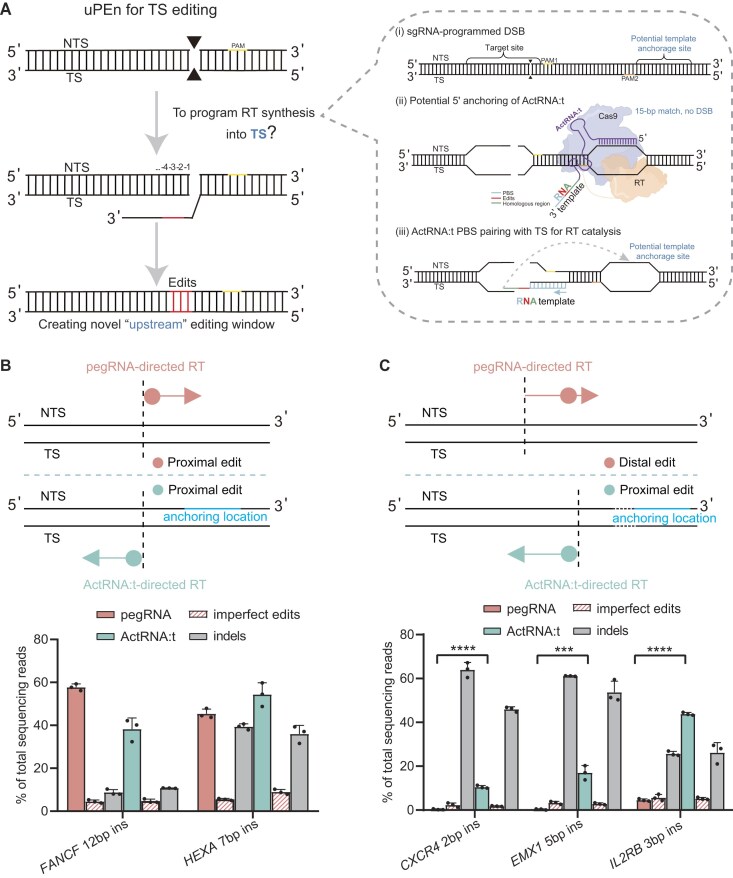 Figure 1
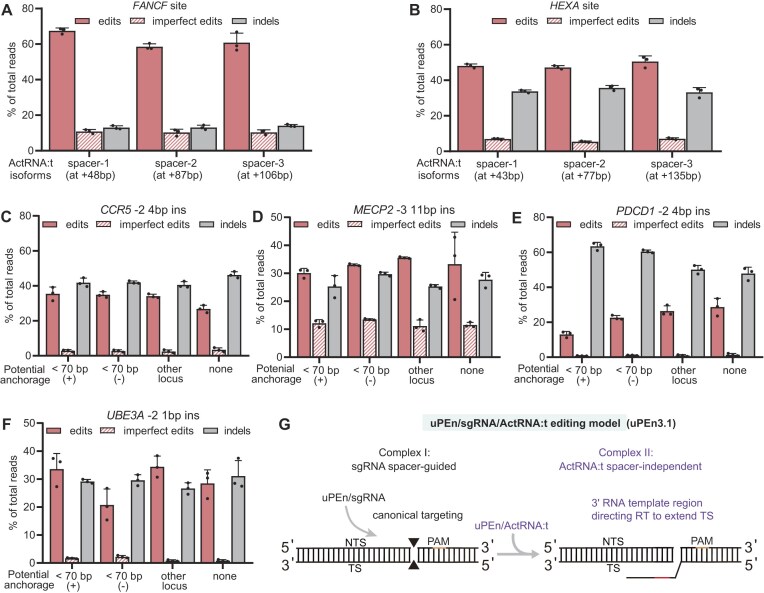 Figure 2
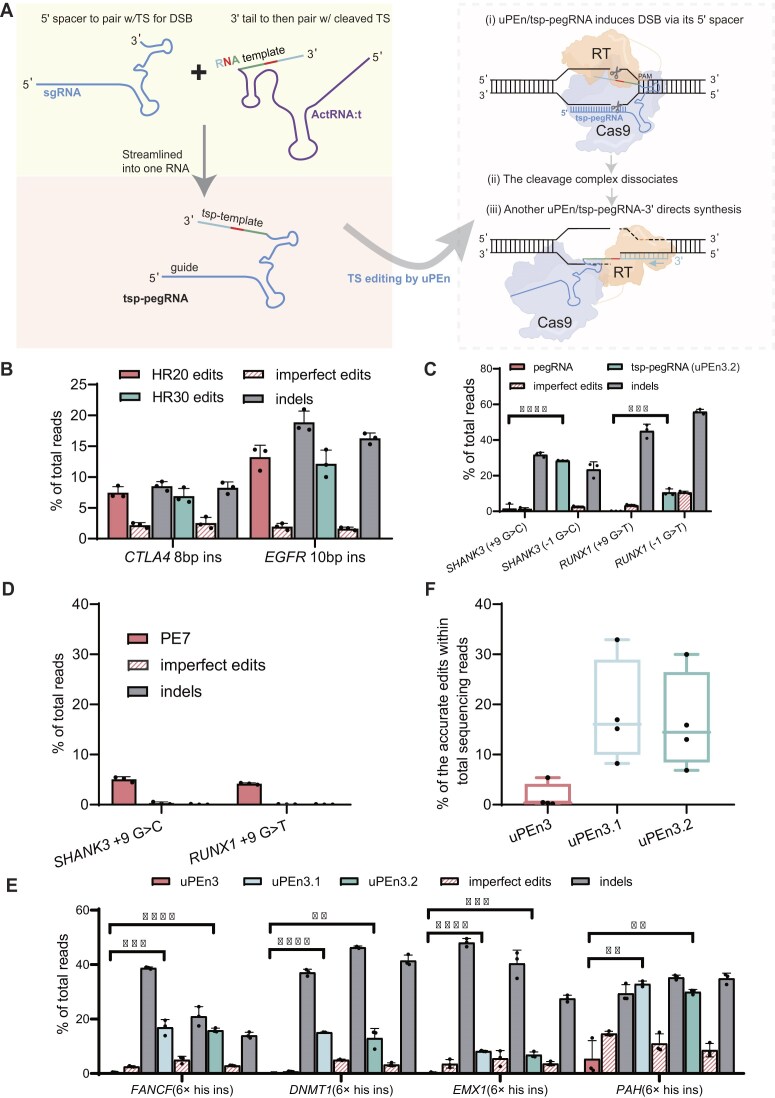 Figure 3
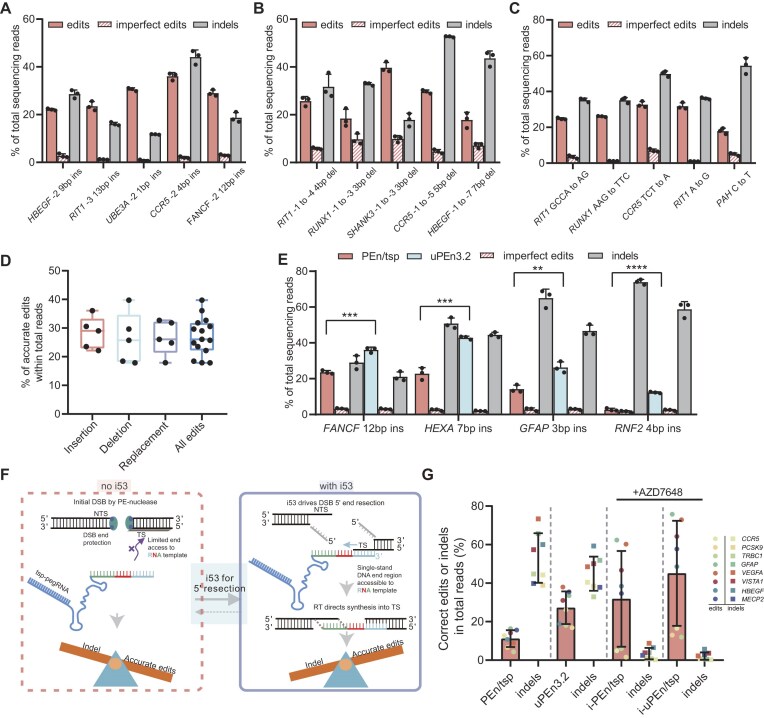 Figure 4
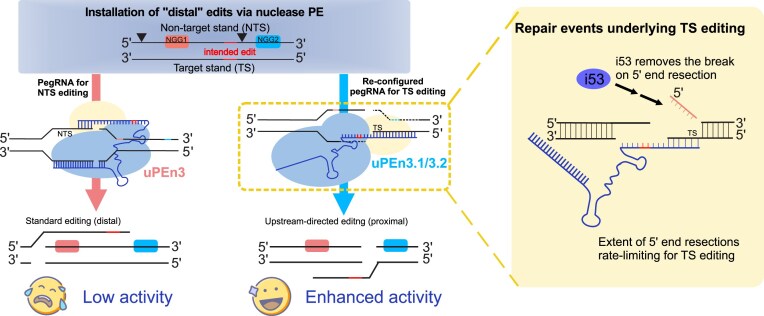 Figure 5
Peer Reviews
No public reviews on file for this paper yet. If you reviewed it on a platform where reviews are public (OpenReview, ICLR, NeurIPS, ICML), you can paste yours below so the community can read it here.
Videos
No videos yet. Explain this paper in a talk, walkthrough, or lecture? Add one.
Taxonomy
TopicsCRISPR and Genetic Engineering · RNA and protein synthesis mechanisms · Advanced biosensing and bioanalysis techniques