Comparison of two genetic strategies for diagnostic work-up of hypertrophic cardiomyopathy: impact on the diagnosis of Fabry disease or transthyretin amyloidosis
Aurélien Palmyre, Fairouz Koraichi, Flavie Ader, Erwan Donal, Céline Bordet, Pascal de Groote, Laurence Faivre, Patricia Reant, Annick Toutain, Karine Nguyen, Bertrand Isidor, Anne-Claire Brehin, Lise Legrand, Estelle Gandjbakhch, Julie Proukhnitzky, Richard Isnard

TL;DR
This study compares two genetic testing approaches for diagnosing heart conditions in patients with hypertrophic cardiomyopathy, finding that targeted testing based on clinical signs is faster, cheaper, and more effective.
Contribution
Demonstrates that targeted genetic testing outperforms broad panel testing in diagnosing specific inherited heart diseases in hypertrophic cardiomyopathy patients.
Findings
Targeted testing identified 28.6% of pathogenic variants in TTR/GLA genes, compared to 1.0% with multigene panels.
Targeted testing was 7.5 times faster and significantly cheaper than multigene panel analysis.
Clinical analysis guided by red flags improves diagnostic efficiency and reduces delays in treatment.
Abstract
Diagnostic work-up of patients with hypertrophic cardiomyopathy is crucial for appropriate management. However, the optimal genetic strategy remains debatable. We compared two strategies: targeted testing based on careful examination of clinical red flags versus large multigene panel analysis without gene prioritization. We applied the strategy to the diagnosis of Fabry disease or Hereditary Transthyretin Amyloidosis (GLA or TTR genes respectively). We studied 341 hypertrophic cardiomyopathy index patients. Patients of subgroup 1 (n = 42) had careful clinical analysis and high suspicion of Hereditary Transthyretin Amyloidosis or Fabry disease. They underwent targeted Sanger sequencing. Patients in subgroup 2 (n = 299) did not have clinical selection, and underwent next-generation sequencing analysis of 107 cardiac genes. The yield of genetic testing for pathogenic/likely pathogenic…
Genes, proteins, chemicals, diseases, species, mutations and cell lines named across the full text — each resolved to its canonical identifier and authoritative record.
Click any figure to enlarge with its caption.
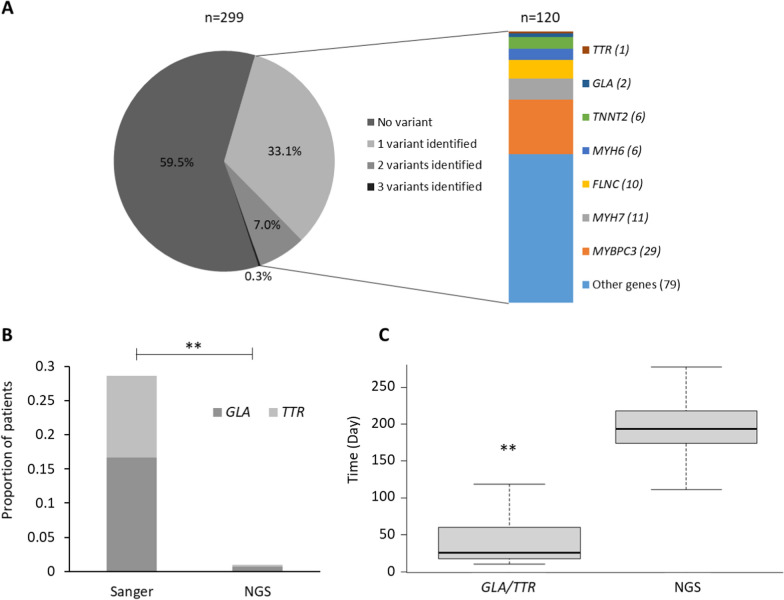 Figure 1
Peer Reviews
No public reviews on file for this paper yet. If you reviewed it on a platform where reviews are public (OpenReview, ICLR, NeurIPS, ICML), you can paste yours below so the community can read it here.
Videos
No videos yet. Explain this paper in a talk, walkthrough, or lecture? Add one.
Taxonomy
TopicsCardiomyopathy and Myosin Studies · Lysosomal Storage Disorders Research · Trypanosoma species research and implications