Refining Drug-Induced Cholestasis Prediction: An Explainable Consensus Model Integrating Chemical and Biological Fingerprints
Palle S. Helmke, Gerhard F. Ecker

TL;DR
This paper presents a new computational model to predict drug-induced cholestasis using chemical and biological data, aiming to reduce animal testing in drug development.
Contribution
The novel contribution is an explainable consensus model integrating chemical fingerprints and biological data to improve cholestasis prediction.
Findings
The baseline model achieved an MCC of 0.29 and sensitivity of 0.79 using PubChem and pathway data.
The refined model improved performance with an MCC of 0.38 and sensitivity of 0.80.
Albumin was identified as a potential target linked to cholestasis.
Abstract
Effective drug safety assessment, guided by the 3R principle (Replacement, Reduction, Refinement) to minimize animal testing, is critical in early drug development. Drug-induced liver injury (DILI), particularly drug-induced cholestasis (DIC), remains a major challenge. This study introduces a computational method for predicting DIC by integrating PubChem substructure fingerprints with biological data from liver-expressed targets and pathways, alongside nine hepatic transporter inhibition models. To address class imbalance in the public cholestasis data set, we employed undersampling, a technique that constructs a small and robust consensus model by evaluating distinct subsets. The most effective baseline model, which combined PubChem substructure fingerprints, pathway data and hepatic transporter inhibition predictions, achieved a Matthews correlation coefficient (MCC) of 0.29 and a…
Genes, proteins, chemicals, diseases, species, mutations and cell lines named across the full text — each resolved to its canonical identifier and authoritative record.
Click any figure to enlarge with its caption.
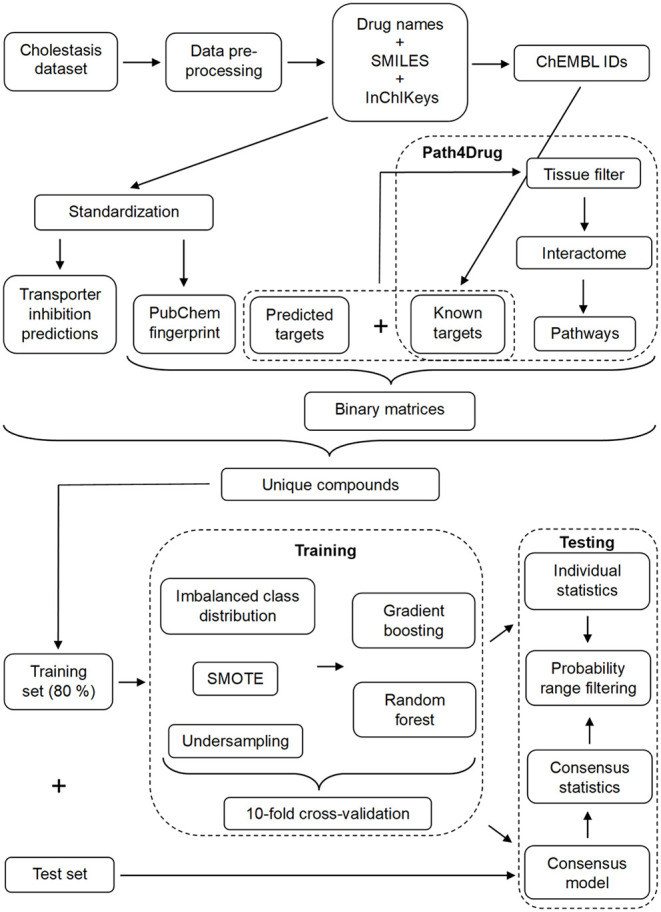 Figure 1
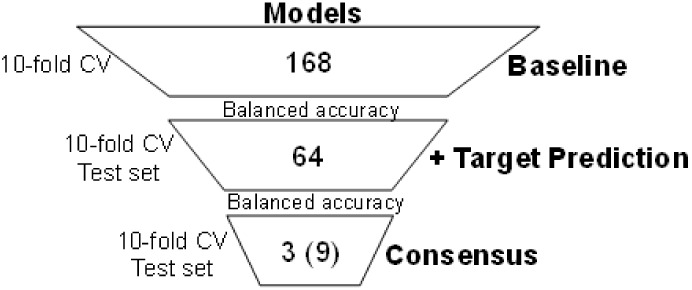 Figure 2
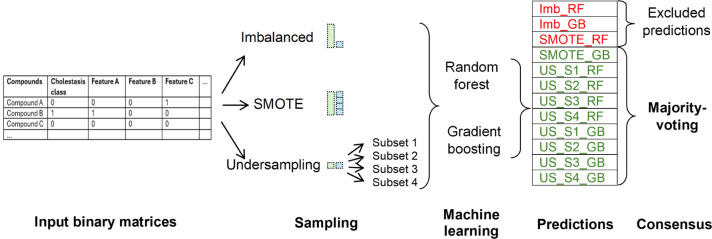 Figure 3
 Figure 4
 Figure 5
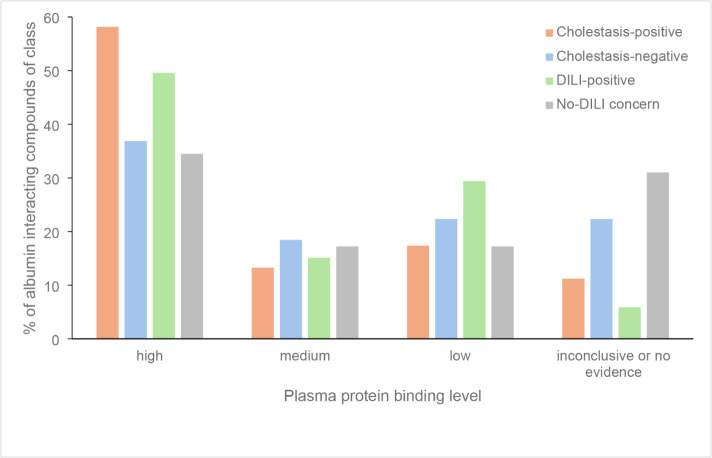 Figure 6
 Figure 7
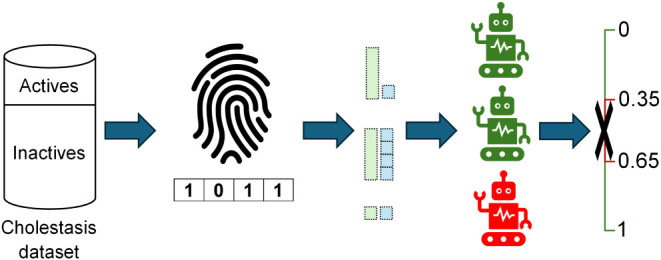 Figure 8
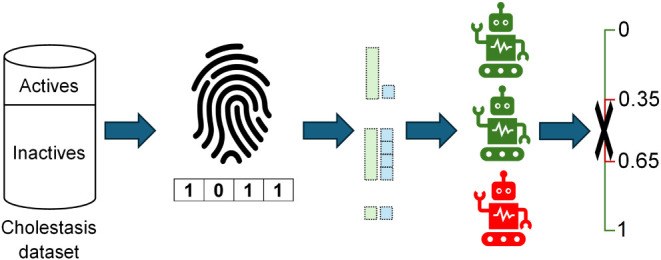 Figure 9
 Figure 10
 Figure 11
 Figure 12
 Figure 13
Peer Reviews
No public reviews on file for this paper yet. If you reviewed it on a platform where reviews are public (OpenReview, ICLR, NeurIPS, ICML), you can paste yours below so the community can read it here.
Videos
No videos yet. Explain this paper in a talk, walkthrough, or lecture? Add one.
Taxonomy
TopicsDrug Transport and Resistance Mechanisms · Computational Drug Discovery Methods · Hepatitis B Virus Studies