Predicting late renal toxicity using a two-component repair model among pediatric patients receiving total body irradiation for stem cell transplant
Eric D. Ehler, Grace H. Hutchinson, Jianling Yuan, Kathryn E. Dusenbery

TL;DR
This study develops a model to predict kidney damage in children undergoing stem cell transplants with total body irradiation, emphasizing the role of dose rate and fraction timing.
Contribution
A novel two-component repair model is introduced to predict late renal toxicity in pediatric stem cell transplant patients.
Findings
A two-component sublethal repair EQD2 model showed a statistically significant relationship with renal toxicity (p = 0.03).
Predicted probabilities of renal toxicity correlate with EQD2 values of 10.4, 11.1, and 13.2 Gy for 5%, 10%, and 50% toxicity rates.
Dose rate and time between fractions are identified as important factors in predicting renal toxicity.
Abstract
•Efforts have been made recently to reduce toxicities in myeloablative TBI.•We utilize a linear quadratic schema with two component dose rate repair mechanism.•We compare this kidney dose response model to others in the literature.•Dose rate is an important factor, along with total dose and dose per fraction. Efforts have been made recently to reduce toxicities in myeloablative TBI. We utilize a linear quadratic schema with two component dose rate repair mechanism. We compare this kidney dose response model to others in the literature. Dose rate is an important factor, along with total dose and dose per fraction. Late renal toxicity can be impactful for stem cell transplant (SCT) patients with total body irradiation (TBI) as part of the conditioning regimen. This work describes a two component repair model to predict renal toxicity among pediatric patients. Systematic literature…
Genes, proteins, chemicals, diseases, species, mutations and cell lines named across the full text — each resolved to its canonical identifier and authoritative record.
Click any figure to enlarge with its caption.
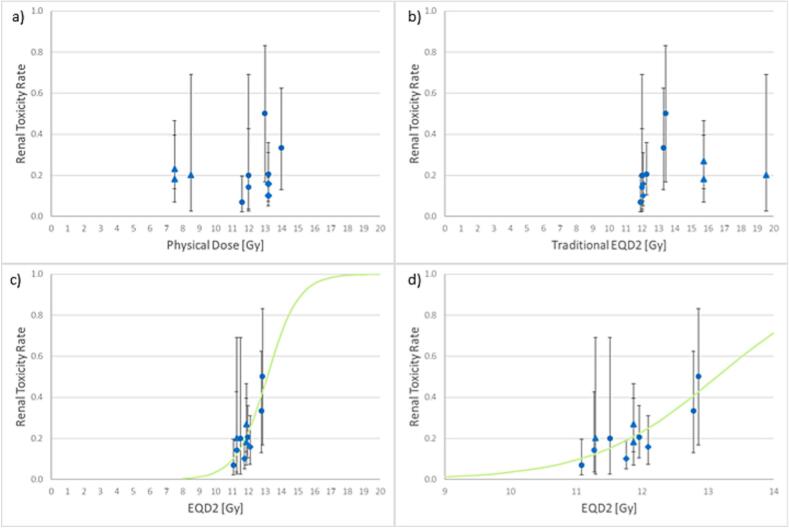 Figure 1
Peer Reviews
No public reviews on file for this paper yet. If you reviewed it on a platform where reviews are public (OpenReview, ICLR, NeurIPS, ICML), you can paste yours below so the community can read it here.
Videos
No videos yet. Explain this paper in a talk, walkthrough, or lecture? Add one.
Taxonomy
TopicsChildhood Cancer Survivors' Quality of Life · Organ Transplantation Techniques and Outcomes · Renal and related cancers