Olfactory cues elicit species-specific locomotive responses in poison frog tadpoles
Mina E. Phipps, Penelope R. Baker, Luise Bachmann, Soyeon Park, Malia J. Perez, Shay Nair Sharma, Yvette Soto-Hernandez, Malaya Gaerlan, Marco Carrillo, Sofia Ceva, Sowmya Chundi, Binta Diallo, Juliana N. Fong, Kelly Huang, Jennifer Jackson, Jasmine Padilla, Leslie Quintana

TL;DR
Poison frog tadpoles from different species react uniquely to smell cues, showing species-specific behaviors in response to environmental signals.
Contribution
The study reveals species-specific olfactory responses in poison frog tadpoles linked to their life history strategies.
Findings
A. femoralis tadpoles spent more time near an injury cue compared to control.
R. imitator tadpoles increased movement in response to high amino acid concentrations.
Abstract
Amphibian species rear their larvae in distinct environments that may influence how they respond to different sensory stimuli. Here, we investigated the olfactory-mediated locomotive responses of two poison frog species ( Allobates femoralis and Ranitomeya imitator ) that vary in life history strategies. We found that A. femoralis tadpoles spent more time near an injury cue compared to control, while R. imitator tadpoles increased their movement in response to high concentrations of amino acids. These experiments were done in an undergraduate laboratory course, demonstrating how simple behavior assays conducted in a classroom setting can provide practical research experiences and new insights into animal behavior.
Genes, proteins, chemicals, diseases, species, mutations and cell lines named across the full text — each resolved to its canonical identifier and authoritative record.
Click any figure to enlarge with its caption.
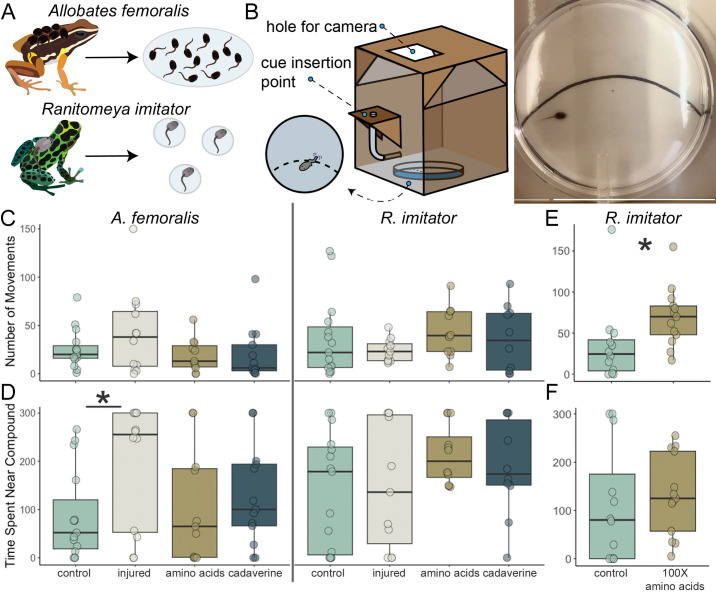 Figure 1
Peer Reviews
No public reviews on file for this paper yet. If you reviewed it on a platform where reviews are public (OpenReview, ICLR, NeurIPS, ICML), you can paste yours below so the community can read it here.
Videos
No videos yet. Explain this paper in a talk, walkthrough, or lecture? Add one.
Taxonomy
TopicsOlfactory and Sensory Function Studies · Neurobiology and Insect Physiology Research · Animal Behavior and Reproduction