Multidimensionality of hallucination-like experiences: A factor structure refinement of the Launay-Slade Hallucination Scale
H. Honcamp, L.K. Goller, M. Amorim, S.X. Duggirala, J.F. Johnson, M. Schwartze, A.P. Pinheiro, S.A. Kotz

TL;DR
This study improves the understanding of hallucination-like experiences by refining the structure of a widely used psychological scale.
Contribution
The study introduces a new factor, 'Personified HLEs,' related to perceiving the presence of another person or voice.
Findings
A four-factor structure of hallucination-like experiences was identified, including 'Multisensory HLEs' and 'Personified HLEs'.
The new 'Personified HLEs' factor aligns with theories about self-monitoring and external attribution bias in hallucination proneness.
Refined factors may better represent individual differences in hallucination-like experiences.
Abstract
Previous research on the multidimensionality of hallucination-like experiences (HLEs) across the psychosis continuum highlights methodological disparities, emphasizing the need for a cautious interpretation of findings and transparent reporting of parameters used in the analysis. This study aimed to refine the factorial structure of the 16-item Launay-Slade Hallucination Scale (LSHS), enhance methodological clarity, and improve the robustness of LSHS factor solutions. To this end, an Exploratory Factor Analysis (EFA) was performed on a heterogeneous sample (N = 278) with specified parameters (e.g., estimation procedure) that remain true to data characteristics and assumptions underlying EFA. The results revealed a four-factor structure including “Multisensory HLEs”, “Auditory daydreaming”, “Vivid thoughts and inner speech”, and “Personified HLEs”. Our investigation introduces a new…
Genes, proteins, chemicals, diseases, species, mutations and cell lines named across the full text — each resolved to its canonical identifier and authoritative record.
Click any figure to enlarge with its caption.
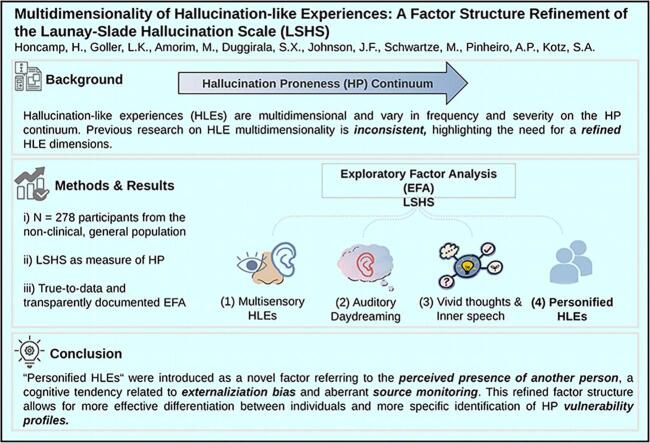 Figure 1
Peer Reviews
No public reviews on file for this paper yet. If you reviewed it on a platform where reviews are public (OpenReview, ICLR, NeurIPS, ICML), you can paste yours below so the community can read it here.
Videos
No videos yet. Explain this paper in a talk, walkthrough, or lecture? Add one.
Taxonomy
TopicsPsychosomatic Disorders and Their Treatments · Hallucinations in medical conditions · Mental Health and Psychiatry