Artificial intelligence and endoanal ultrasound: pioneering automated differentiation of benign anal and sphincter lesions
M. Mascarenhas, M. J. Almeida, M. Martins, F. Mendes, J. Mota, P. Cardoso, B. Mendes, J. Ferreira, G. Macedo, C. Poças

TL;DR
This paper introduces an AI tool that can accurately distinguish between different types of benign anal injuries using ultrasound images, potentially improving diagnosis and reducing reliance on expert interpretation.
Contribution
The paper presents the first AI model for automated differentiation of benign anal and sphincter lesions using endoanal ultrasound.
Findings
The CNN achieved 100% sensitivity, specificity, and accuracy for anal fissures.
For external lacerations, the model achieved 82.5% sensitivity, 93.5% specificity, and 88.2% accuracy.
The model demonstrated 91.7% sensitivity and 85.9% specificity for internal lacerations.
Abstract
Anal injuries, such as lacerations and fissures, are challenging to diagnose because of their anatomical complexity. Endoanal ultrasound (EAUS) has proven to be a reliable tool for detailed visualization of anal structures but relies on expert interpretation. Artificial intelligence (AI) may offer a solution for more accurate and consistent diagnoses. This study aims to develop and test a convolutional neural network (CNN)-based algorithm for automatic classification of fissures and anal lacerations (internal and external) on EUAS. A single-center retrospective study analyzed 238 EUAS radial probe exams (April 2022–January 2024), categorizing 4528 frames into fissures (516), external lacerations (2174), and internal lacerations (1838), following validation by three experts. Data was split 80% for training and 20% for testing. Performance metrics included sensitivity, specificity, and…
Genes, proteins, chemicals, diseases, species, mutations and cell lines named across the full text — each resolved to its canonical identifier and authoritative record.
Click any figure to enlarge with its caption.
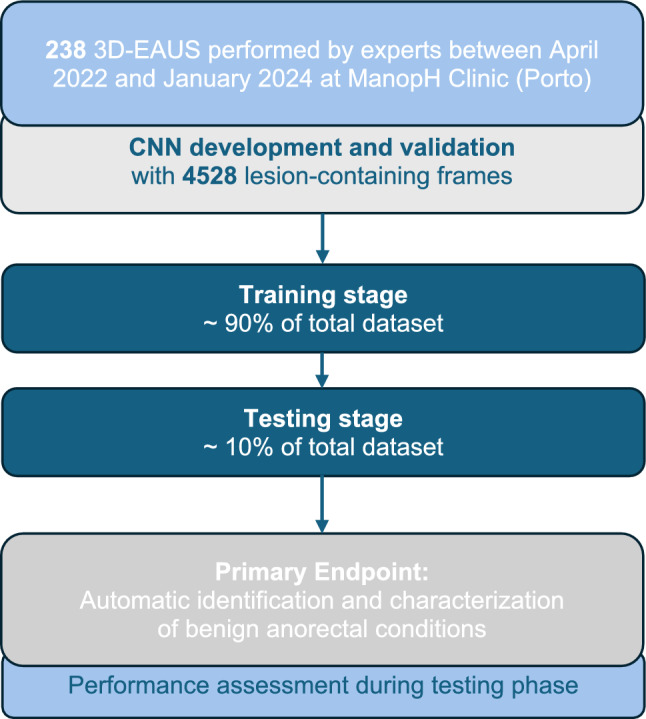 Figure 1
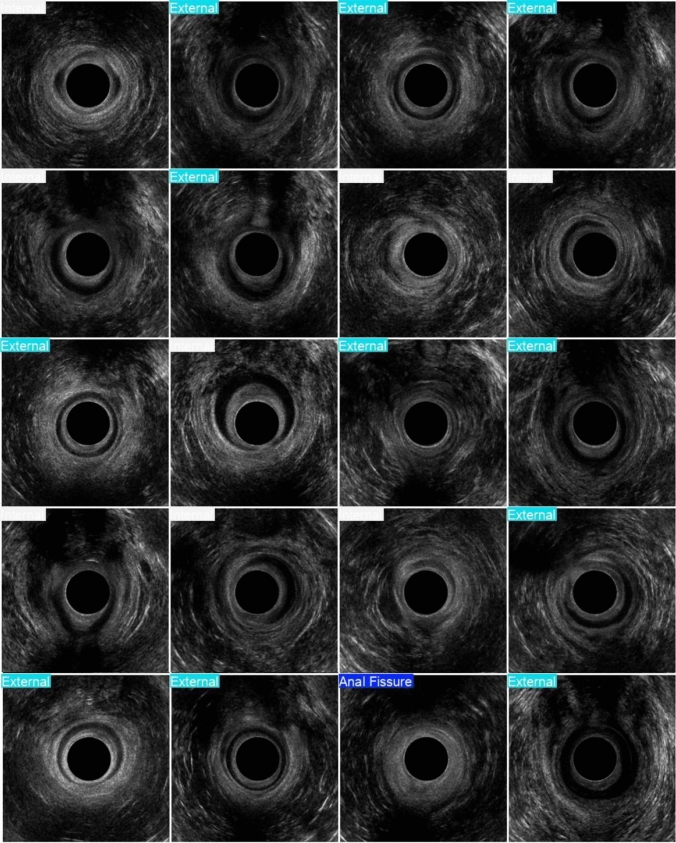 Figure 2
Peer Reviews
No public reviews on file for this paper yet. If you reviewed it on a platform where reviews are public (OpenReview, ICLR, NeurIPS, ICML), you can paste yours below so the community can read it here.
Videos
No videos yet. Explain this paper in a talk, walkthrough, or lecture? Add one.
Taxonomy
TopicsAnorectal Disease Treatments and Outcomes · Pelvic floor disorders treatments · Diverticular Disease and Complications