Electroconvulsive therapy for depression and oral dyskinesia in a patient who developed parkinsonism induced by valbenazine
Yuhei Mori, Yuhei Suzuki, Akiko Sato, Risa Shishido, Yuri Kobayashi, Yuta Fukuchi, Shota Inada, Yuka Iwasaki, Riko Sato, Keitaro Takada, Naoki Morita, Itaru Miura

TL;DR
A 65-year-old woman with depression and oral dyskinesia improved after ECT when valbenazine caused parkinsonism.
Contribution
Demonstrates ECT as a potential treatment for depression and TD in patients intolerant to VMAT2 inhibitors.
Findings
ECT improved depressive symptoms and oral dyskinesia in a patient who developed DIP from valbenazine.
Valbenazine discontinuation was necessary due to DIP, but ECT provided an alternative therapeutic benefit.
This case highlights ECT's potential role in managing TD and depression when VMAT2 inhibitors are ineffective.
Abstract
Tardive dyskinesia (TD) is a movement disorder related to long‐term antipsychotic use and characterized by involuntary repetitive movements that often affect the oral and facial muscles. Although valbenazine, a vesicular monoamine transporter 2 (VMAT2) inhibitor, is an effective treatment of TD, it may induce drug‐induced parkinsonism (DIP) in some patients. Electroconvulsive therapy (ECT) improves depressive symptoms and certain movement disorders; however, its role in managing TD, particularly in patients intolerant to VMAT2 inhibitors because of DIP, remains elusive. Herein, we describe a 65‐year‐old Japanese woman with a history of major depressive episodes and oral dyskinesia. The patient was treated with valbenazine for oral dyskinesia; however, she developed DIP, requiring valbenazine discontinuation. After the worsening of depression, the patient was hospitalized and underwent…
Genes, proteins, chemicals, diseases, species, mutations and cell lines named across the full text — each resolved to its canonical identifier and authoritative record.
Click any figure to enlarge with its caption.
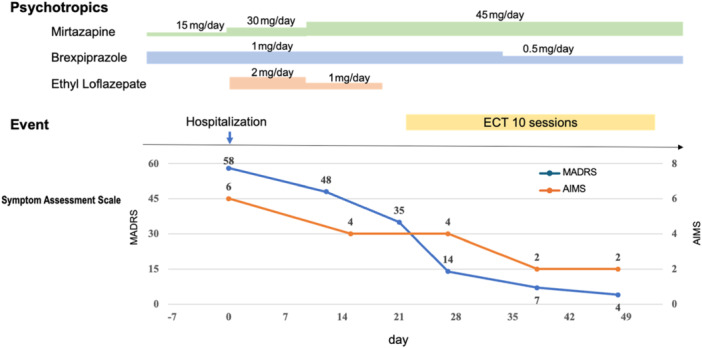 Figure 1
Peer Reviews
No public reviews on file for this paper yet. If you reviewed it on a platform where reviews are public (OpenReview, ICLR, NeurIPS, ICML), you can paste yours below so the community can read it here.
Videos
No videos yet. Explain this paper in a talk, walkthrough, or lecture? Add one.
Taxonomy
TopicsElectroconvulsive Therapy Studies · Bipolar Disorder and Treatment · Parkinson's Disease and Spinal Disorders