The association between objectively measured physical activity and home blood pressure: a population-based real-world data analysis
Minako Kinuta, Takashi Hisamatsu, Kaori Taniguchi, Mari Fukuda, Noriko Nakahata, Hideyuki Kanda

TL;DR
This study finds that more vigorous physical activity and fewer sedentary hours are linked to lower home blood pressure, especially in younger people and men.
Contribution
The study uses real-world data to show how objectively measured physical activity and sedentary behavior affect home blood pressure.
Findings
One hour of vigorous physical activity is associated with a 1.69 mmHg lower systolic and 1.09 mmHg lower diastolic blood pressure.
A 1000-step increase is linked to a small but measurable decrease in both systolic and diastolic blood pressure.
Sedentary time is positively associated with blood pressure in younger and male participants but inversely in older and female participants.
Abstract
Few studies have examined the association of objectively measured habitual physical activity (PA) and sedentary behavior with out-of-office blood pressure (BP). We investigated the associations of objectively measured PA intensity time, sedentary time, and step count with at-home BP. Using accelerometer-recorded PA indices and self-measured BP in 368 participants (mean age, 53.8 years; 58.7% women), we analyzed 115,575 records of each parameter between May 2019 and April 2024. PA intensities were categorized as light (2.0–2.9 metabolic equivalents [METs]); moderate (3.0–5.9 METs); vigorous (≥6.0 METs), or sedentary (<2.0 METs): the median [interquartile ranges] for these variables was 188 [146–232], 83 [59–114], 1 [0–2], 501 [428–579] minutes, respectively, and for step count, was 6040 [4164–8457]. Means [standard deviations] for systolic and diastolic BP were 116.4 [14.2] and 75.2…
Genes, proteins, chemicals, diseases, species, mutations and cell lines named across the full text — each resolved to its canonical identifier and authoritative record.
Click any figure to enlarge with its caption.
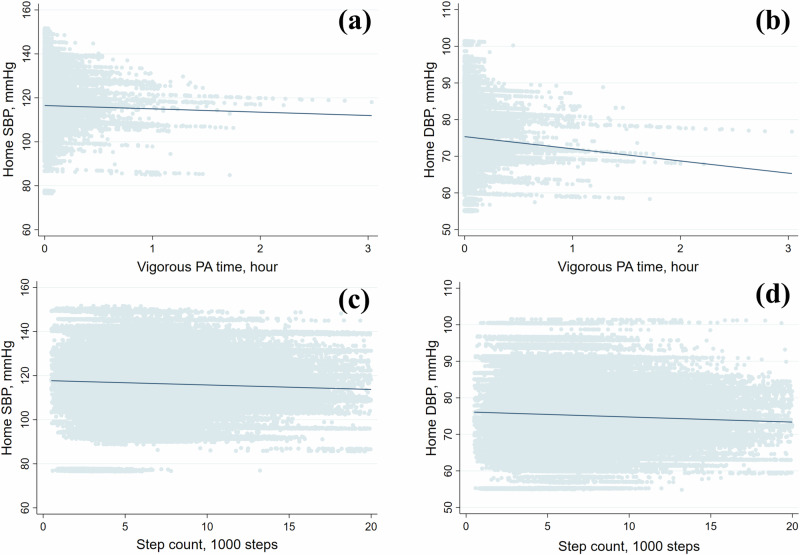 Figure 1
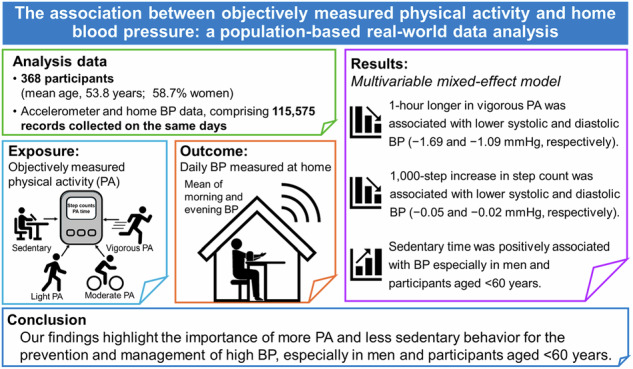 Figure 2
Peer Reviews
No public reviews on file for this paper yet. If you reviewed it on a platform where reviews are public (OpenReview, ICLR, NeurIPS, ICML), you can paste yours below so the community can read it here.
Videos
No videos yet. Explain this paper in a talk, walkthrough, or lecture? Add one.
Taxonomy
TopicsBlood Pressure and Hypertension Studies · Physical Activity and Health · Heart Rate Variability and Autonomic Control