Factors Affecting Clinical Course of Postoperative Bile Leakage and Efficacy of Endoscopic Biliary Drainage: A Multi‐Center Retrospective Cohort Study
Kota Shimojo, Takuji Iwashita, Keisuke Iwata, Yuki Utakata, Kaori Koide, Takuya Koizumi, Yuki Ito, Yosuke Ohashi, Shota Iwata, Akihiko Senju, Ryuichi Tezuka, Hironao Ichikawa, Yuhei Iwasa, Naoki Mita, Mitsuru Okuno, Kensaku Yoshida, Akinori Maruta, Shinya Uemura, Masahiko Kawai

TL;DR
This study identifies factors that influence the severity of bile leakage after liver and bile surgery and shows that endoscopic drainage is effective in treating it.
Contribution
The study identifies age and time to leak as novel predictors of bile leakage severity and confirms the efficacy of endoscopic drainage.
Findings
Older age and longer time from surgery to bile leak are independent predictors of severe bile leakage.
Endoscopic biliary drainage successfully treated all severe bile leakage cases, with a median drainage period of 18 days.
Most patients with severe bile leakage also required intra-abdominal abscess drainage.
Abstract
Bile leakage is one of the complications after hepatobiliary surgery, causing intra‐abdominal infections, and is sometimes difficult to treat. The purpose of our study was to investigate the factors related to severity and to evaluate the efficacy of endoscopic treatment. This was a retrospective multicenter cohort study conducted at three tertiary care medical centers. The severity of bile leakage was classified per the International Study Group of Liver Surgery, and Grades B and C (requiring some intervention or reoperation) were considered as severe. The subjects were 59 patients. The surgical procedures were 31 cholecystectomies, 23 hepatectomies, and five pancreaticoduodenectomies. The severity was Grade A/B/C: 17/40/2. Multivariate logistic regression analysis found that age (unit odds ratio [UOR], 1.09; 95% confidence interval [CI], 1.0–1.19; p = 0.049) and days from surgery to…
Genes, proteins, chemicals, diseases, species, mutations and cell lines named across the full text — each resolved to its canonical identifier and authoritative record.
Click any figure to enlarge with its caption.
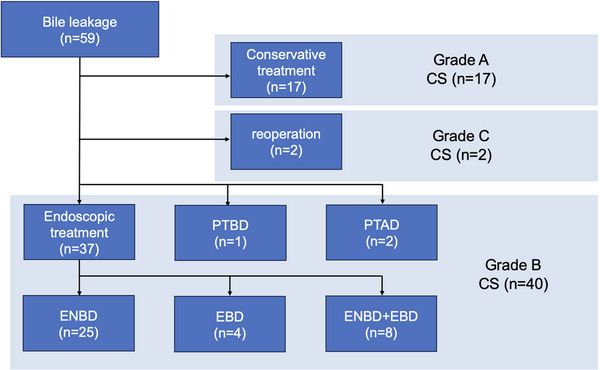 Figure 1
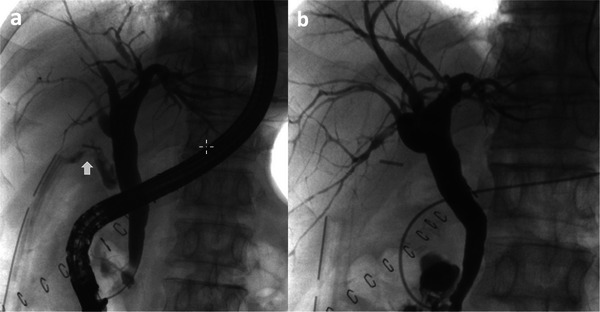 Figure 2
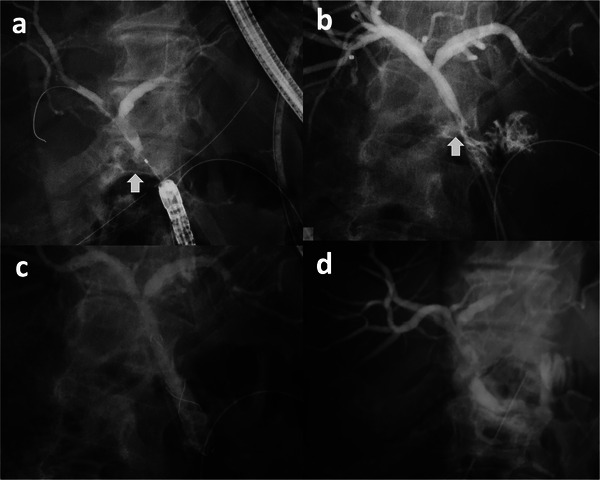 Figure 3
Peer Reviews
No public reviews on file for this paper yet. If you reviewed it on a platform where reviews are public (OpenReview, ICLR, NeurIPS, ICML), you can paste yours below so the community can read it here.
Videos
No videos yet. Explain this paper in a talk, walkthrough, or lecture? Add one.
Taxonomy
TopicsGallbladder and Bile Duct Disorders · Pancreatic and Hepatic Oncology Research · Pediatric Hepatobiliary Diseases and Treatments