Organ Donation in Marfan Syndrome: Is It a Case to Stretch Boundaries?
Sandeep A Jayasekera, Suchintha B Tillakaratne, Gayana Mahendra, Rohan C Siriwardana

TL;DR
This paper discusses the challenges of organ donation in a patient with Marfan syndrome, highlighting vascular risks and the need for careful intra-operative assessment.
Contribution
The paper presents a case study and histopathological findings on organ donation in Marfan syndrome, emphasizing clinical challenges and safety considerations.
Findings
Intra-operative findings showed a deformed liver and thin, friable vasculature in a Marfan syndrome donor.
Histology revealed mild liver fibrosis and cystic medionecrosis in the iliac artery, typical of Marfan syndrome.
The case reinforces the difficulty of safely retrieving organs from Marfan syndrome donors due to vascular fragility.
Abstract
Marfan syndrome is an autosomal dominant connective tissue disorder caused by mutations in the FBN1 gene. It primarily affects the cardiovascular, ocular, and skeletal systems. Despite improved survival outcomes, organ donation from these patients remains rare due to concerns of vascular fragility. A 44-year-old male with Marfan syndrome was considered for organ donation following brain stem death due to a massive intracerebral hemorrhage caused by a ruptured arteriovenous malformation. He had a history of mitral valve replacement and kyphoscoliosis. His liver and renal function tests were within normal limits. Consent for donation was subsequently obtained. Intra-operative findings revealed a grossly deformed liver and thin, friable vasculature, prompting the retrieval team to abandon the procedure. Biopsies from the liver and iliac artery were obtained for histopathological…
Genes, proteins, chemicals, diseases, species, mutations and cell lines named across the full text — each resolved to its canonical identifier and authoritative record.
Click any figure to enlarge with its caption.
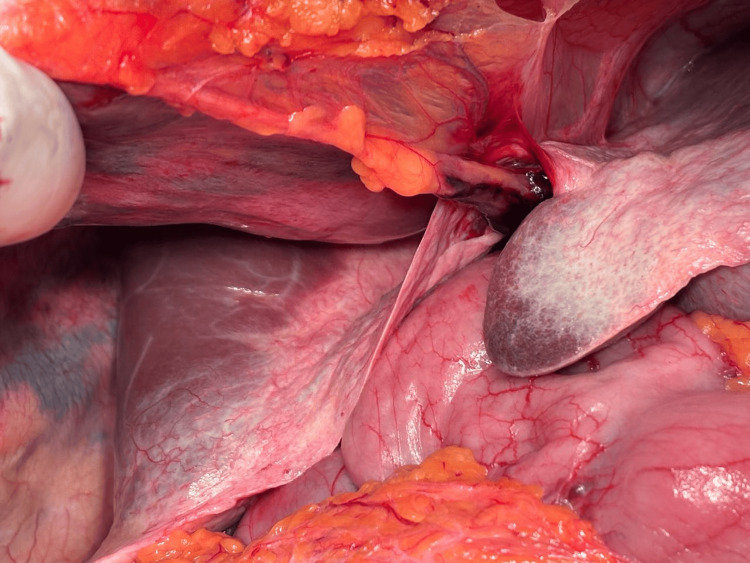 Figure 1
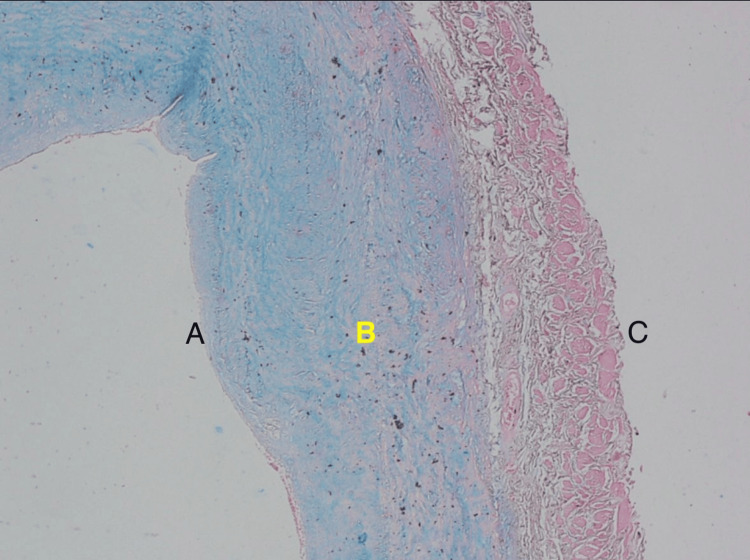 Figure 2
Peer Reviews
No public reviews on file for this paper yet. If you reviewed it on a platform where reviews are public (OpenReview, ICLR, NeurIPS, ICML), you can paste yours below so the community can read it here.
Videos
No videos yet. Explain this paper in a talk, walkthrough, or lecture? Add one.
Taxonomy
TopicsOrgan Donation and Transplantation · Renal and Vascular Pathologies · Organ Transplantation Techniques and Outcomes
Introduction
Marfan syndrome is an autosomal dominant connective tissue disorder, characterized by involvement of the cardiovascular, ocular, and skeletal systems. Mutations in the FBN1 gene encoding fibrillin-1 are responsible for the disease [1]. Although modern medicine has improved the survival of these patients, implications for organ donation remain marginal due to the multi-systemic nature of the condition. The feasibility of solid organ transplantation, especially the liver, remains poorly understood [2]. This is one of the few documented intra-operative assessments of liver suitability in a deceased donor with Marfan syndrome.
Case presentation
A 44-year-old male with Marfan syndrome and a BMI of 18 kg/m^2^, who had a history of mitral valve replacement for mitral valve prolapse, had a sudden onset of loss of consciousness and collapse. A CT scan of his brain showed a massive left-sided intracerebral hemorrhage. The cause was suspected to be a ruptured cerebral arteriovenous malformation. The patient never regained consciousness, and it was concluded that he had brain stem death two days after the index event. He was considered for organ donation due to his young age and absence of any other significant medical comorbidities.
His family consented to the donation, and he was subsequently worked up for it. His liver function tests were normal, as were his renal functions. However, marked distortion of the body was noted, caused by deformities due to significant kyphoscoliosis. A multidisciplinary meeting was conducted amongst the organ retrieval team, and the decision was made to retrieve his organs.
Upon opening of the abdomen, it was noted that the macroscopic morphology of the liver was grossly deformed due to kyphoscoliosis (Figure 1). However, there was no macroscopic evidence of cirrhosis. The kidneys appeared structurally normal but exhibited thin, friable vasculature. After an intra-operative discussion between the two consultant surgeons performing the retrieval, it was decided not to go ahead, and instead, a liver biopsy and iliac artery biopsies were taken to better understand the underlying pathology.
Intra-operative view of the liver of the donor with Marfan syndrome showing abnormal macroscopic morphology.
The liver biopsy demonstrated mild fibrosis (grade I-II) without significant steatosis or cholestasis. Occasional collections of lymphoid cells were seen. Lobular inflammation and interface hepatitis were minimal, without any evidence of malignancy.
The iliac artery biopsy showed a muscular artery with largely disrupted internal and external elastic laminae. Prominent myxoid degeneration and cystic medionecrosis of the wall were noted, with Alcian blue-positive mucin deposition. Vessel wall inflammation was minimal, and dissections or aneurysms were not seen. These histological changes were typical of those commonly seen in the vasculature of Marfan syndrome patients (Figure 2).
Histological section of an iliac artery from the potential donor with suspected Marfan syndrome, stained with Masson's trichrome (original magnification, x100). The tunica media demonstrates features consistent with cystic medionecrosis.A: Tunica intima. B: Tunica media demonstrating cystic medionecrosis. C: Tunica adventitia.
Discussion
The majority of donors available for deceased donor liver transplant (DDLT) are not ideal, especially in the current day and age with the ever-increasing incidence of metabolic syndrome [3]. All donors should be considered, including those with congenital disorders that may theoretically impair organ integrity. In the case of Marfan syndrome, the relatively high incidence of vascular complications compared to the normal population poses a challenge when it comes to a successful donation [4].
There is a clear paucity of data on organ retrieval from Marfan syndrome patients, especially concerning the liver. Only a few successful cases have been documented. A Japanese group reported a DDLT done from a Marfan syndrome donor, having a one-year survival without complications [5]. In that case, macroscopically, the liver looked healthy with iliac arteries having normal elasticity on intraoperative palpation. In the very limited literature available, there are no reports of recipient complications following liver transplant (LT) where the donor had Marfan syndrome.
The documented incidence of visceral artery changes in Marfan syndrome is 0.4-2% [6]. Two hepatic artery complications have been documented previously by Santiago-Delpin et al. [7] in a non-transplant setting. In this patient, the donor at the age of 44 years showed significant microscopic changes involving the elastic lamina. The healing process and the endurance of the anastomosis and the graft vessels to the flow turbulence with these microscopic changes are highly unpredictable. Hence, accepting a graft with a Marfan syndrome background needs reconsideration.
In the case described in this report, the liver was grossly abnormal, with the iliac arteries feeling brittle and unhealthy on intraoperative palpation as well. Concerns regarding vascular fragility prevented the safe retrieval of the organs for transplantation.
Conclusions
The ever-increasing need for organ donation in the current clinical context of the world demands consideration of donors previously disregarded due to congenital anomalies. However, retrieval teams should maintain a low threshold for abandonment in donors with Marfan syndrome due to the unpredictability of microscopic vascular changes.
The reference list from the paper itself. Each links out to its DOI / PubMed record.
- 1Marfan syndrome Stat Pearls Salik I Rawla P Treasure Island, FL Stat Pearls Publishing 2025 https://www.ncbi.nlm.nih.gov/books/NBK 537339/30726024 · pubmed ↗
- 2Successful kidney transplantation from donor with Marfan's syndrome Am J Transplant Farese S Vogt B Frey FJ Huynh-Do U 19721974620061688955210.1111/j.1600-6143.2006.01389.x · doi ↗ · pubmed ↗
- 3The global epidemic of the metabolic syndrome Curr Hypertens Rep Saklayen MG 122020182948036810.1007/s 11906-018-0812-z PMC 5866840 · doi ↗ · pubmed ↗
- 4Cardiovascular manifestations in Marfan syndrome Med Pharm Rep Lazea C Bucerzan S Crisan M 07942021 https://pubmed.ncbi.nlm.nih.gov/34527904/10.15386/mpr-2223 PMC 841182434527904 · doi ↗ · pubmed ↗
- 5A successful case of deceased-donor liver transplantation from a donor with Marfan syndrome: a case report Surg Case Rep Ishikawa T Itoh S Toshima T 141020243819807110.1186/s 40792-024-01807-y PMC 10781653 · doi ↗ · pubmed ↗
- 6Ruptured hepatic artery aneurysm: case report and review of literature Ann Vasc Surg Arneson MA Smith RS 5405451920051596849110.1007/s 10016-005-5043-5 · doi ↗ · pubmed ↗
- 7Perforated hepatic artery aneurysm and multiple aneurysms in incomplete Marfan syndrome Ann Surg Santiago-Delpin EA Marquez E Rodriguez OL Oliveras FE Baldizon C Martínez-Cabruja R 7727761761972 https://pubmed.ncbi.nlm.nih.gov/4540102/454010210.1097/00000658-197212000-00019 PMC 1355483 · doi ↗ · pubmed ↗