Protective Group-Dependent Iridium-Catalyzed CH Borylations of Levodopa
Cliff Yang, Jinda Fan, Robert E. Maleczka

TL;DR
This paper reports a new method to selectively borylate levodopa using iridium catalysts by managing steric hindrance with protecting groups.
Contribution
The study introduces a protective group strategy enabling selective C5 CH borylation of levodopa with iridium catalysts.
Findings
Selective C5 CH borylation of levodopa is achieved using boronic ester protecting groups.
In situ deprotection of the boronic ester group yields the free catechol.
Protecting groups reduce steric hindrance, enabling iridium-catalyzed borylation.
Abstract
Despite being an important aromatic amino acid, iridium-catalyzed borylation (CHB) of levodopa has not been reported. Via the application of carefully chosen protecting groups for the catechol moiety, the steric hindrance around the arene can be reduced, enabling selective C5 CHB of levodopa. Methylene and boronic ester protecting groups were explored, the latter of which is deprotected in situ to yield the free catechol.
Genes, proteins, chemicals, diseases, species, mutations and cell lines named across the full text — each resolved to its canonical identifier and authoritative record.
Click any figure to enlarge with its caption.
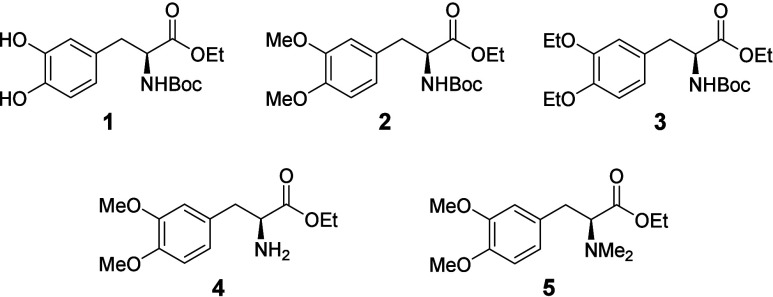 Figure 1
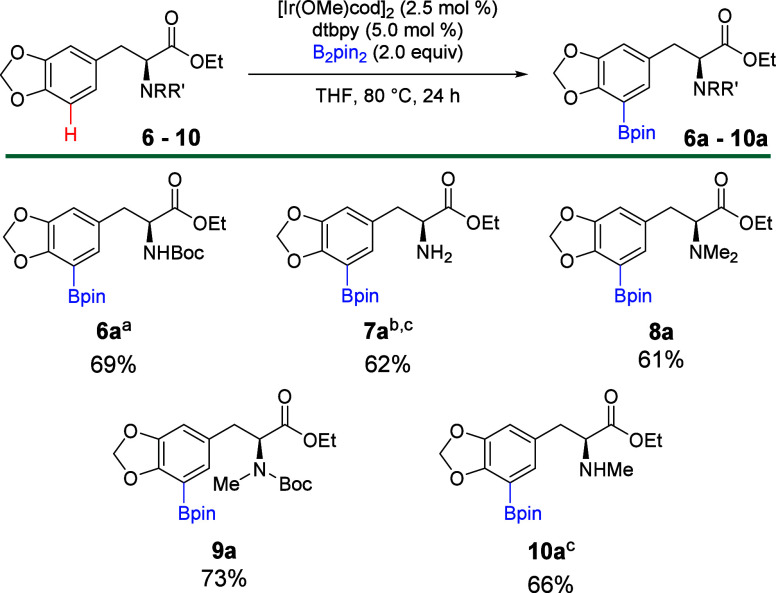 Figure 2
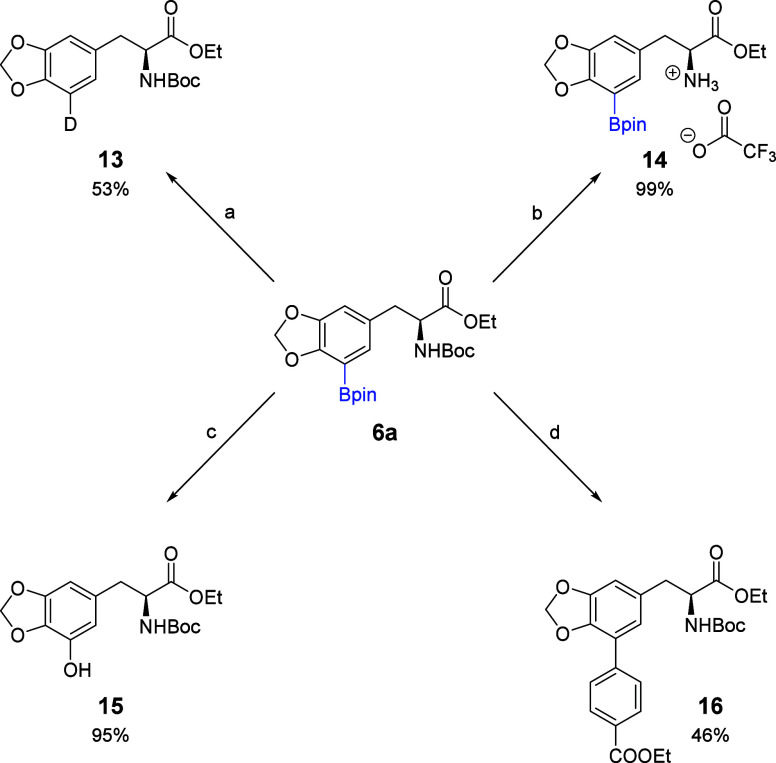 Figure 3
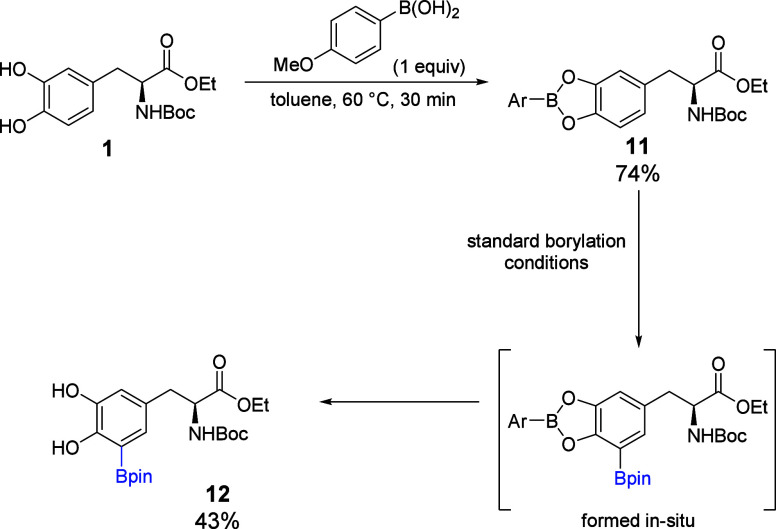 Figure 4
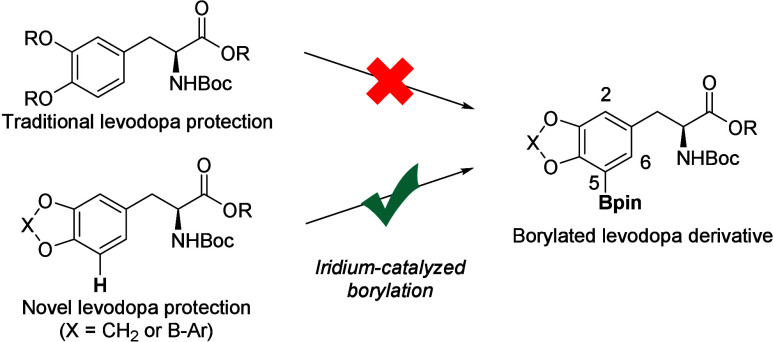 Figure 5
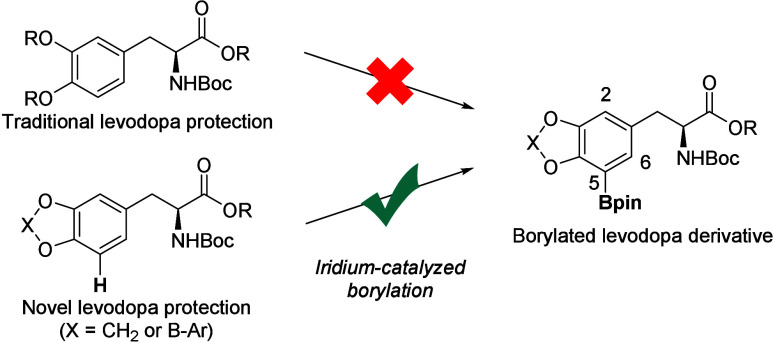 Figure 6
- —College of Natural Science, Michigan State University10.13039/100015893
- —Michigan State University Research Foundation10.13039/100016254
Peer Reviews
No public reviews on file for this paper yet. If you reviewed it on a platform where reviews are public (OpenReview, ICLR, NeurIPS, ICML), you can paste yours below so the community can read it here.
Videos
No videos yet. Explain this paper in a talk, walkthrough, or lecture? Add one.
Taxonomy
TopicsCatalytic C–H Functionalization Methods · Organoboron and organosilicon chemistry · Asymmetric Hydrogenation and Catalysis
Levodopa is an important aromatic amino acid and a precursor to both dopamine and fluorodopa. ?,? Previous routes to fluorodopa have used a three-step process in which levodopa is halogenated at C6, followed by a Miyaura borylation and finally a Bpin/^18^F exchange. ?,? Iridium-catalyzed CH borylation (CHB) has also been found to be similarly useful in the radiofluorination of some protected amino acid derivatives. However, CHB of levodopa has not been reported.? This is perhaps not surprising owing to the regiochemical outcomes of CHB being primarily driven by sterics and the steric hindrance about the levodopa arene (C2, C5, and C6 being ortho to the alkyl chain and/or the catechol hydroxyls).
To test and unequivocally document the impact of levodopa’s steric environment on CHBs, levodopa derivative 1 (Figure), in which the catechol was left unprotected, failed to borylate when subjected to [Ir(OMe)cod]2, B_2_pin_2_, and common ligands such as dtbpy and tmphen. Several dialkyl ether analogues (2–5) were then synthesized. They also proved to be resistant to standard CHB conditions. Even when borylations utilizing aniline? or dimethyl amine? directing effects were employed for 4 and 5, no borylation was observed. These unsuccessful borylations confirmed that protecting the arene ring of levodopa with simple ethers hinders CHB.
While the hydroxyls of catechol can be protected individually, they can also be protected via a bridging methylene. This change in protection can cause drastic changes in the selectivity of borylation. Previous work in our lab demonstrated that while borylation of veratrole yielded the meta product, borylation of benzodioxole gave only the ortho product.? This effect, if applied to levodopa, could reduce the steric hindrance of the arene and allow CHB to form via iridium catalysis.
Since benzodioxole is known to undergo CHB,? we synthesized derivatives (6–10) of levodopa, in which the catechol was protected with a methylene bridge, emulating the structure of benzodioxole. In contrast to the unsuccessful borylations of 1–5, these derivatives of levodopa underwent successful CHB (Scheme). For derivatives 6–10, the protecting group on the α-amine did not negatively affect the borylation, as N-Boc, N-methyl, and N,N-dimethyl groups were all tolerated during CHB. Borylation occurred selectively ortho to the benzodioxole moiety, since the methylene bridge tied back the catechol, reducing the steric hindrance at C5.? No borylation was observed ortho to the alkyl chain of the amino acid (C2 or C6) for any derivative tested.
The failure to borylate at C2 and C6 was not entirely surprising, as CHB of amino acids ortho to their alkyl chain has not been reported. ?−? ? However, we question if C6 could be borylated by utilizing directing effects previously employed in the ortho selective CHB of anilines? and dimethylamines.? In those cases, coordination between the active iridium catalyst and the substrate nitrogen atoms directs borylation ortho to the nitrogen-containing functional group. We hypothesized that the same Ir–N coordination combined with the flexibility of the alkyl chain might direct borylation at C6 of levodopa. In practice, neither derivative 7 nor 8 was amenable to this approach as only the starting derivatives were observed after exposure to ortho directing CHB conditions, even when using less hindered diboron glycolates such as those derived from ethylene glycol? or 1,2-butanediol.
Our focus returned to C5-borylated 6a and its post-CHB modification. Once CHB occurs at C5, the boronic ester can be converted into different functional groups via mild reactions. Borylated levodopa derivative 6a underwent deuterodeborylation,? oxidation,? and Suzuki coupling? (Scheme). These reactions demonstrate the utility of iridium-catalyzed CHB in the late-stage functionalization of sterically hindered catechols.
N-Boc deprotection was nearly quantitative and occurred without a loss of the Bpin (Scheme). In contrast, attempts to deprotect the catechol were unsuccessful due to the stability of the methylene bridge. A structurally similar protecting group for diols is a boronic ester derived from condensation of the diol with a boronic acid. Previous reports have shown that these boronic ester protecting groups can be installed on silsesquioxanes and carbohydrates and easily removed after they are no longer required. ?,?
Thus, we reacted 1 with 4-methoxyphenyl boronic acid to form capped boronic ester derivative 11 (Scheme). This derivative underwent CHB at C5 like the other derivatives. During CHB, however, the boronic ester cap was lost in situ, allowing direct access to 12. Here, CHB likely occurs before the loss of the boronic ester, as unprotected derivative 1 was resistant to borylation under similar conditions. Though the unoptimized yield of 12 was a modest 43%, the use of a boronic ester as the catechol protecting group has the advantage of enabling selective C5 CHB and obviating the need for a separate deprotection step.
In summary, the choice of protecting group for the catechol moiety of levodopa plays a significant role in CHB success or failure. CHB is not feasible when levodopa is protected via simple ethers. However, bridging the catechol hydroxyls with a methylene group reduces the steric hindrance about the arene and allows selective CHB at C5. Moreover, employing a boronic ester bridge offers the additional advantage of in situ deprotection to afford the free catechol. These observations provide insights into the positive and negative effects that different protecting groups have on the CHB of sterically hindered catechols, which is valuable for both late-stage functionalization strategies and the application of machine learning to organic synthesis.
Supplementary Material
The reference list from the paper itself. Each links out to its DOI / PubMed record.
- 1Pretze M.Wängler C.Wängler B.6-[18F]Fluoro-L-DOPA: A Well-Established Neurotracer with Expanding Application Spectrum and Strongly Improved Radiosyntheses Bio Med. Res. Int.20142014 e 67406310.1155/2014/674063 PMC 405852024987698 · doi ↗ · pubmed ↗
- 2Hornykiewicz O.L-DOPA: From a Biologically Inactive Amino Acid to a Successful Therapeutic Agent: Historical Review Article Amino Acids 200223657010.1007/s 00726-001-0111-912373520 · doi ↗ · pubmed ↗
- 3Zischler J.Kolks N.Modemann D.Neumaier B.Zlatopolskiy B. D.Alcohol-Enhanced Cu-Mediated Radiofluorination Chem. - Eur. J.201723143251325610.1002/chem.20160463327943464 · doi ↗ · pubmed ↗
- 4Mossine A. V.Tanzey S. S.Brooks A. F.Makaravage K. J.Ichiishi N.Miller J. M.Henderson B. D.Erhard T.Bruetting C.Skaddan M. B.Sanford M. S.Scott P. J. H.Synthesis of High-Molar-Activity [18F]6-Fluoro-l-DOPA Suitable for Human Use via Cu-Mediated Fluorination of a B Pin Precursor Nat. Protoc.20201551742175910.1038/s 41596-020-0305-932269382 PMC 7333241 · doi ↗ · pubmed ↗
- 5Wright J. S.Sharninghausen L. S.Preshlock S.Brooks A. F.Sanford M. S.Scott P. J. H.Sequential Ir/Cu-Mediated Method for the Meta-Selective C-H Radiofluorination of (Hetero)Arenes J. Am. Chem. Soc.2021143186915692110.1021/jacs.1c 0052333914521 PMC 8832069 · doi ↗ · pubmed ↗
- 6Smith M. R.III Bisht R.Haldar C.Pandey G.Dannatt J. E.Ghaffari B.Maleczka R. E.Jr.Chattopadhyay B.Achieving High Ortho Selectivity in Aniline C-H Borylations by Modifying Boron Substituents ACS Catal.2018876216622310.1021/acscatal.8b 0064130147990 PMC 6105271 · doi ↗ · pubmed ↗
- 7Roering A. J.Hale L. V. A.Squier P. A.Ringgold M. A.Wiederspan E. R.Clark T. B.Iridium-Catalyzed, Substrate-Directed C-H Borylation Reactions of Benzylic Amines Org. Lett.201214133558356110.1021/ol 301635 x 22731752 · doi ↗ · pubmed ↗
- 8Vanchura B. A.II Preshlock S. M.Roosen P. C.Kallepalli V. A.Staples R. J.Maleczka R. E.Jr.Singleton D. A.Smith M. R.III Electronic Effects in Iridium C-H Borylations: Insights from Unencumbered Substrates and Variation of Boryl Ligand Substituents Chem. Commun.201046417724772610.1039/c 0cc 02041 a PMC 357352620852803 · doi ↗ · pubmed ↗