Recombinant Escherichia coli-driven whole-cell bioconversion for selective 5-Aminopentanol production as a novel bioplastic monomer
Byung Wook Lee, Hee Taek Kim, Hyun Gi Koh, Kyungjae Yu, Gaeul Kim, Yoon Jung Jung, Haeng-Geun Cha, Yunhee Jeong, Yung-Hun Yang, See-Hyoung Park, Kyungmoon Park

TL;DR
Scientists engineered E. coli to produce 5-aminopentanol, a bioplastic monomer, from lysine using a sustainable, non-petroleum method.
Contribution
This is the first report of selective microbial 5-AP production using a recombinant E. coli system with optimized pathway engineering.
Findings
A biosynthetic pathway in E. coli produced 78.5 ± 1.2 mM of 5-AP using optimized cofactor regeneration and gene expression.
PatA gene dosage and T7-based dual-plasmid system significantly increased 5-AP yield while reducing byproduct accumulation.
The process converts lysine into high-value amino alcohols, offering a sustainable alternative to petroleum-based methods.
Abstract
5-Aminopentanol (5-AP) is a valuable amino alcohol with potential applications in polymer synthesis and bioplastics. Conventional production methods rely on petroleum-based feedstocks and metal catalysts, which raise environmental and sustainability concerns. In this study, a de novo biosynthetic pathway for 5-AP production from l-lysine was developed in Escherichia coli. The engineered pathway consisted of lysine decarboxylase 2 (LdcC), putrescine aminotransferase (PatA), and tested aldehyde reductase (YahK, YihU, YqhD). Among the tested reductases, aldehyde reductase exhibited the highest catalytic efficiency, producing 44.5 ± 2.6 mM of 5-AP (0.44 ± 0.03 mol5 − AP/moll−lysine). The replacement of the expression system with a T7-based dual-plasmid platform, pET24ma::ldcC, and pCDFDuet-1::yqhD::patA co-transformed into E. coli, increased the production to 60.7 ± 5.8 mM, accompanied by…
Genes, proteins, chemicals, diseases, species, mutations and cell lines named across the full text — each resolved to its canonical identifier and authoritative record.
Click any figure to enlarge with its caption.
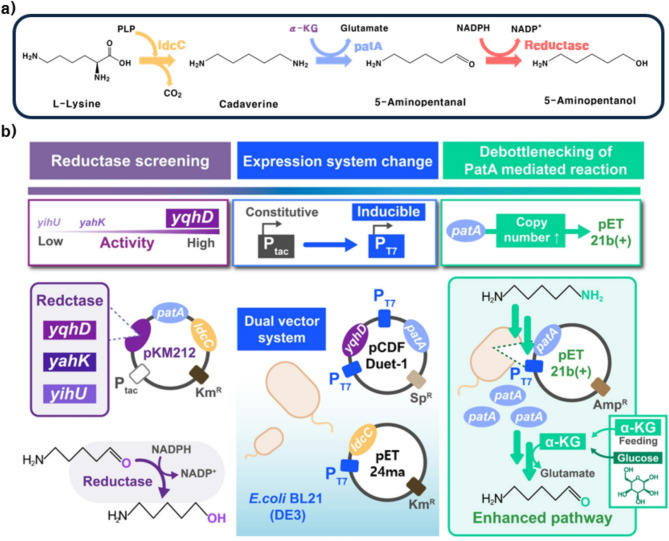 Figure 1
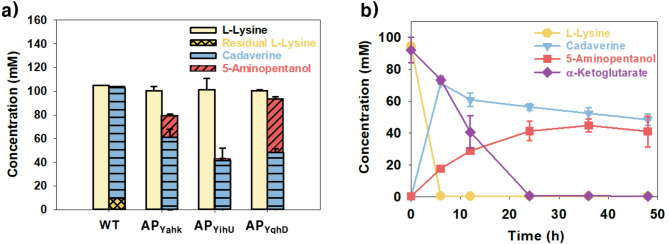 Figure 2
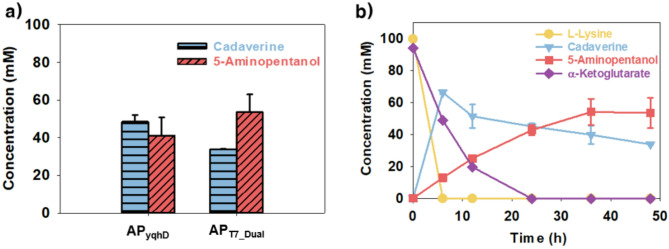 Figure 3
 Figure 4
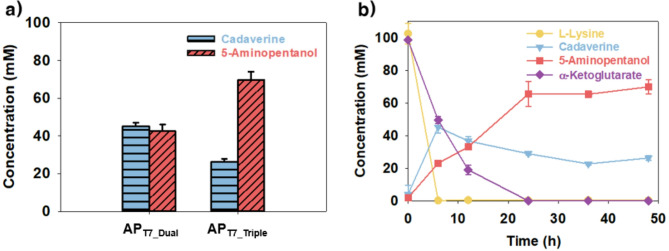 Figure 5
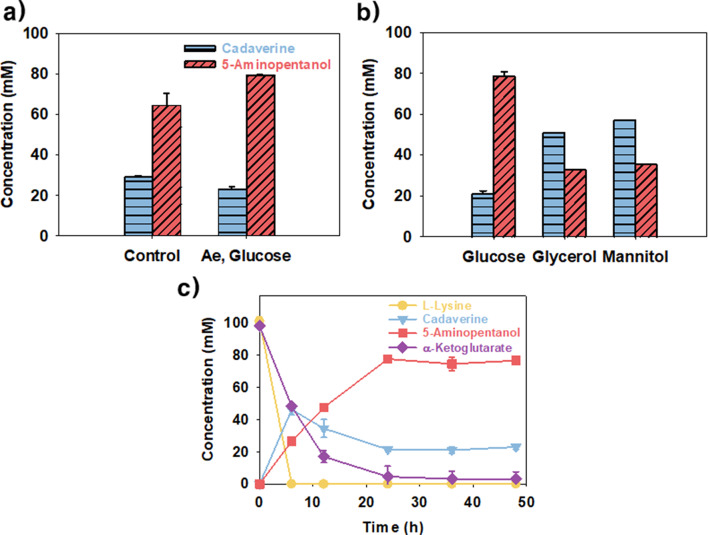 Figure 6
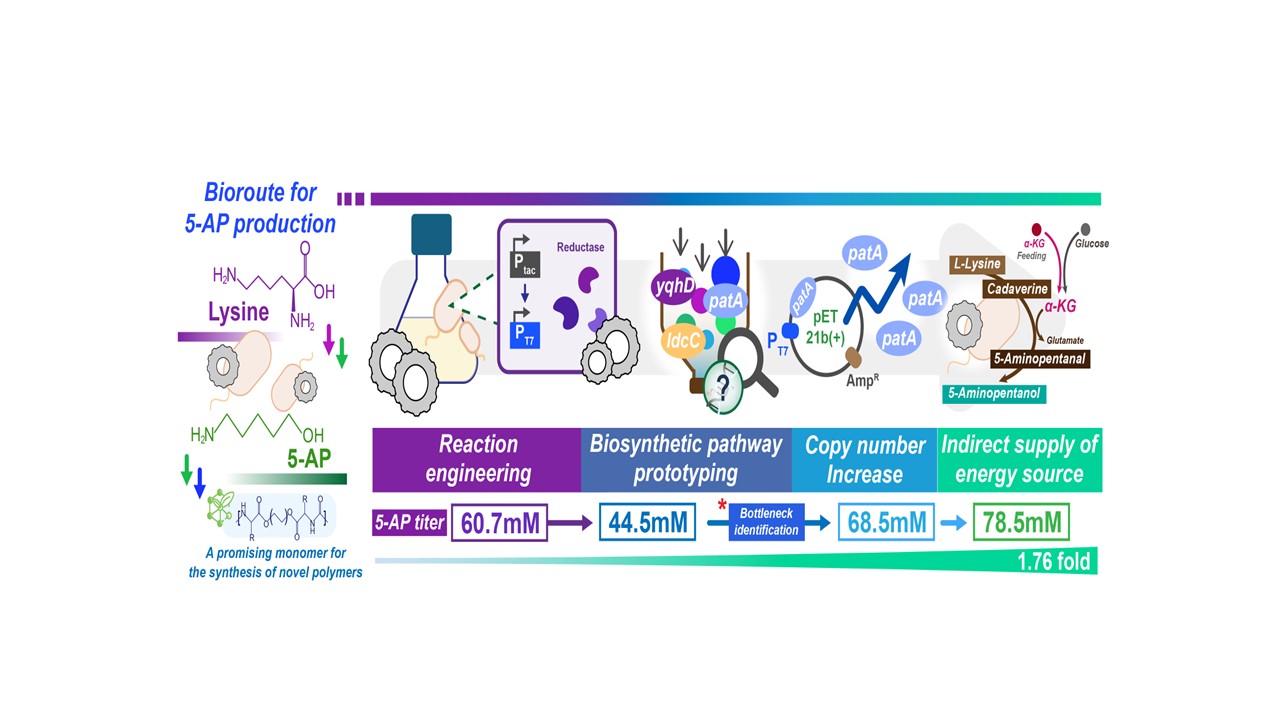 Figure 7
Peer Reviews
No public reviews on file for this paper yet. If you reviewed it on a platform where reviews are public (OpenReview, ICLR, NeurIPS, ICML), you can paste yours below so the community can read it here.
Videos
No videos yet. Explain this paper in a talk, walkthrough, or lecture? Add one.
Taxonomy
Topicsbiodegradable polymer synthesis and properties · Microbial Metabolic Engineering and Bioproduction · Enzyme Catalysis and Immobilization