Longitudinal and transverse muscle stiffness change differently with knee osteoarthritis and do not align with stiffness sensation
Angela V. Dieterich, Katrin Skerl, Filip Paskali, Leonardo Gizzi, Mehrin Azan, Gabriela F. Carvalho, Matthias Kohl, Andreas Haueise

TL;DR
This study found that knee osteoarthritis affects muscle stiffness differently in two directions, and that these changes don't match people's perception of stiffness.
Contribution
The study is the first to show that longitudinal and transverse muscle stiffness changes differently in knee OA and is not aligned with perceived stiffness.
Findings
Longitudinal stiffness of the gastrocnemius medialis was significantly lower in OA patients during double- and single-leg stances.
Transverse stiffness of the vastus lateralis was significantly higher in OA patients at baseline.
Measured muscle stiffness was not correlated with perceived stiffness in knee OA patients.
Abstract
Knee osteoarthritis (OA) is a prevalent joint condition associated with disability, pain, and stiffness in the muscles surrounding the knee. Myofascial and massage techniques are employed to alleviate these symptoms. Unclear is whether muscle stiffness is measurably increased in the painful muscles, and how measured muscle stiffness relates to perceived stiffness, pain, and functional impairment. Given muscle anisotropy, stiffness changes may occur in the longitudinal plane parallel to muscle fibers or perpendicularly in the transverse plane. Shear wave velocity (SWV) was measured in both scanning planes in 21 individuals with diagnosed knee OA, 21 sex- and age-matched controls, and 20 young controls, focusing on the gastrocnemius medialis and vastus lateralis muscles under four conditions: (a) resting state, (b) holding the shank against gravity, (c) double-leg stance, and (d)…
Genes, proteins, chemicals, diseases, species, mutations and cell lines named across the full text — each resolved to its canonical identifier and authoritative record.
Click any figure to enlarge with its caption.
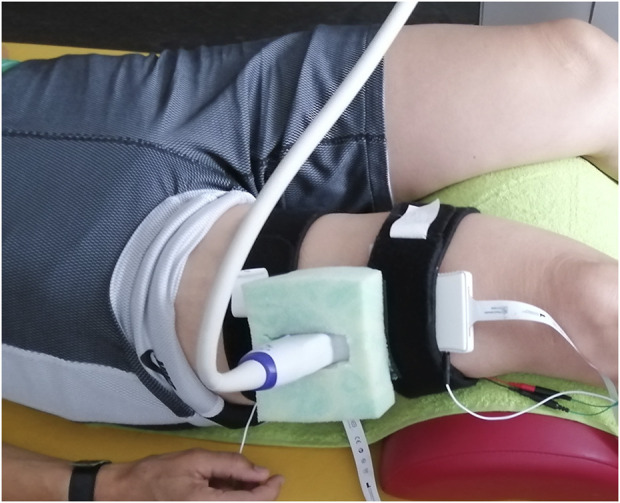 Figure 1
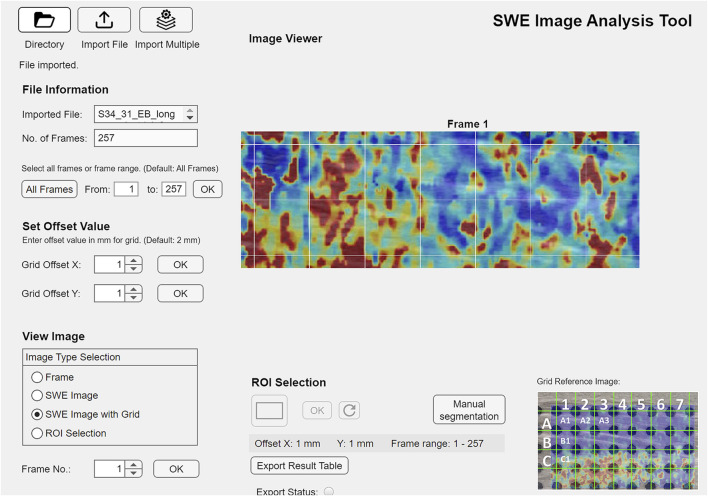 Figure 2
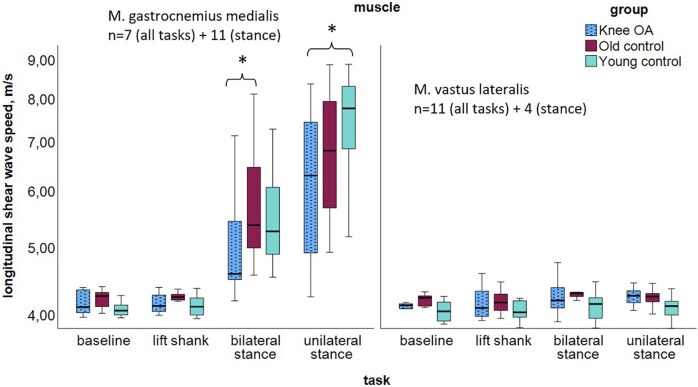 Figure 3
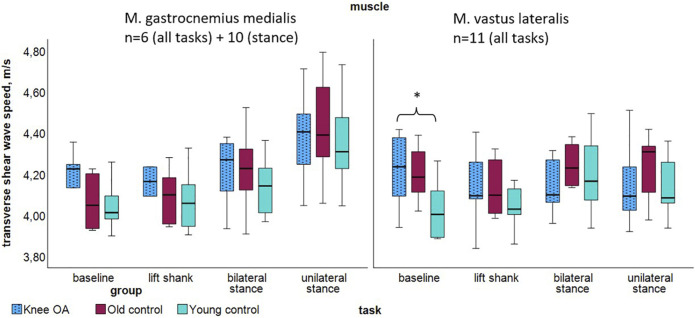 Figure 4
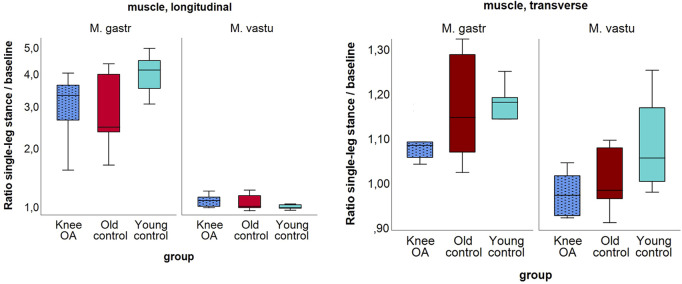 Figure 5
Peer Reviews
No public reviews on file for this paper yet. If you reviewed it on a platform where reviews are public (OpenReview, ICLR, NeurIPS, ICML), you can paste yours below so the community can read it here.
Videos
No videos yet. Explain this paper in a talk, walkthrough, or lecture? Add one.
Taxonomy
TopicsMuscle activation and electromyography studies · Lower Extremity Biomechanics and Pathologies · Osteoarthritis Treatment and Mechanisms