Prospective longitudinal cohort of Argentinean patients with progressive supranuclear palsy and corticobasal syndrome: A platform for epidemiological and translational research
Maria Jose Angel, Gabril F. Mizraji, Gonzalo Gomez-Arevalo, Garcia Silvia, Maria Eugenia Gonzalez-Toledo, Avale Elena, Paez-Paz Indiana, Falzone Tomas, Holubiec Mariana, C. Peralta Maria, Castano Federico, Sevlever Gustavo, Mezmezian Monica, Marras Connie, Gershanik Oscar

TL;DR
This paper describes a new research initiative in Argentina to study rare brain disorders called PSP and CBS, aiming to improve understanding and treatment in underrepresented populations.
Contribution
The paper introduces a prospective cohort study in Argentina for PSP and CBS, highlighting feasibility in a developing country.
Findings
33 patients with PSP and CBS have been enrolled, with over 60% completing initial assessments and biosample collection.
Environmental exposures and clinical data are being systematically collected to support translational research.
One patient donated their brain for pathological confirmation of PSP, supporting clinical diagnosis accuracy.
Abstract
Progressive supranuclear palsy (PSP) and corticobasal syndrome (CBS) are neurodegenerative disorders with disabling postural instability, falls and cognitive impairment associated with 4-repeat tau protein neuropathology. The low prevalence (6/100,000 inhabitants) is estimated with data only from North American, European countries or Japan. A multicenter initiative for studying the epidemiology and tau biology of Argentinean patients with PSP and CBS and their ovelaps, Consorcio Argentino de Investigación Traslacional en Tauopatias Primarias (CAITauP). A prospective observational cohort of people with PSP (PwPSP), CBS and PSP/CBS overlaps will be longitudinally studied aiming at recruitment of 75 patients in 3 years. Deep clinical phenotyping, neurocognitive testing every 12 months, and biosamples collection at baseline are planned. Disease severity will be assessed every 6 months and…
Genes, proteins, chemicals, diseases, species, mutations and cell lines named across the full text — each resolved to its canonical identifier and authoritative record.
Click any figure to enlarge with its caption.
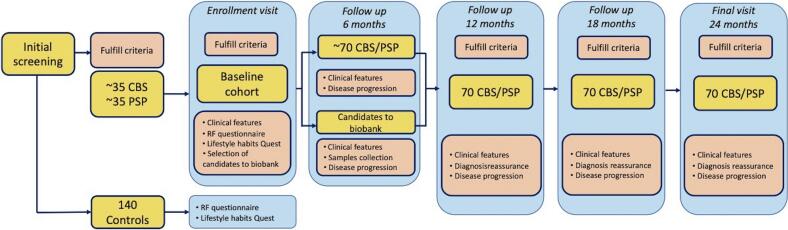 Figure 1
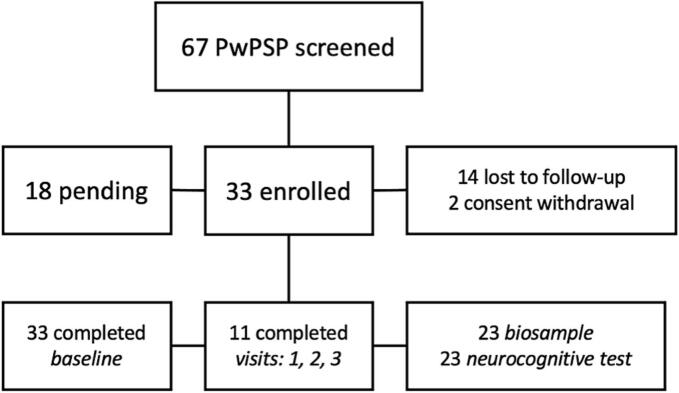 Figure 2
Peer Reviews
No public reviews on file for this paper yet. If you reviewed it on a platform where reviews are public (OpenReview, ICLR, NeurIPS, ICML), you can paste yours below so the community can read it here.
Videos
No videos yet. Explain this paper in a talk, walkthrough, or lecture? Add one.
Taxonomy
TopicsParkinson's Disease Mechanisms and Treatments · Neurological and metabolic disorders · Advanced Neuroimaging Techniques and Applications