A Dutch nationwide pediatric cardiac arrest registry with long-term follow-up – towards an international prognostication guideline
Marijn Albrecht, Maayke Hunfeld, Annemieke Arkesteijn-Muit, Karolijn Dulfer, Matthijs de Hoog, Gabry de Jong, Rogier de Jonge, Aldert Lamoré, Vinay Nadkarni, Corinne Buysse, Nikki Schoenmaker, Nikki Schoenmaker, Annelies van Zwol, Geanne Krabben-de Vlaam, Nicole de la Haye

TL;DR
This paper introduces a Dutch nationwide registry for pediatric cardiac arrest to improve prognostication and long-term care through standardized data collection and follow-up.
Contribution
The PROGNOSE registry is the first Dutch nationwide initiative to standardize pediatric cardiac arrest data collection and follow-up protocols.
Findings
The registry captures comprehensive data on pre-hospital factors, resuscitation, and post-return of circulation care.
Structured follow-up protocols are implemented to assess neurodevelopmental and psychosocial outcomes through age 17.
The registry aims to address knowledge gaps in pediatric cardiac arrest prognostication and clinical decision-making.
Abstract
Pediatric cardiac arrest is associated with high mortality and significant morbidity among survivors. International guidelines for prognostication remain limited due to small heterogeneous patient populations, variable post-return of circulation diagnostics, and insufficient long-term follow-up. Pediatric Resuscitation Prognostication and Outcomes Registry (PROGNOSE) is a Dutch nationwide, multicenter registry aiming to standardize data collection, establish uniform neuromonitoring reporting, and implement structured follow-up protocols. The Pediatric Resuscitation Prognostication and Outcomes Registry (ClinicalTrials.gov ID: NCT06938009) collects data on pediatric cardiac arrest across Dutch pediatric intensive care units, extending the pediRES-Q collaborative. It includes patients <18 years with out-of-hospital cardiac arrest requiring emergency services and in-hospital cardiac…
Genes, proteins, chemicals, diseases, species, mutations and cell lines named across the full text — each resolved to its canonical identifier and authoritative record.
Click any figure to enlarge with its caption.
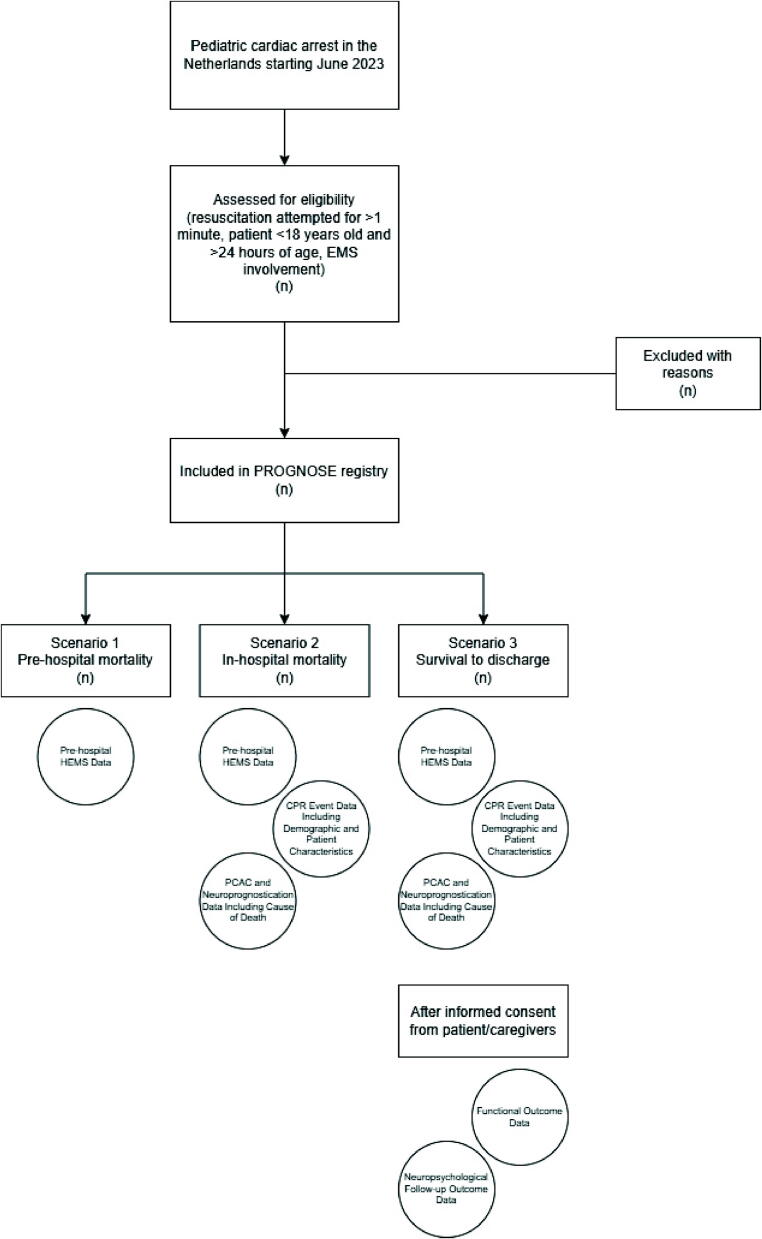 Figure 1
Peer Reviews
No public reviews on file for this paper yet. If you reviewed it on a platform where reviews are public (OpenReview, ICLR, NeurIPS, ICML), you can paste yours below so the community can read it here.
Videos
No videos yet. Explain this paper in a talk, walkthrough, or lecture? Add one.
Taxonomy
TopicsCardiac Arrest and Resuscitation · Emergency and Acute Care Studies · Ultrasound in Clinical Applications