Isolated Lunate Fracture in a Child: A Case Report
Lydian Aliene Huisman, Mike Rüttermann

TL;DR
A 6-year-old girl recovered fully after treatment for a rare lunate fracture, which may help prevent a condition called Kienböck’s disease.
Contribution
This case report presents a rare pediatric lunate fracture successfully treated with semi-open reduction and K-wires.
Findings
A 6-year-old girl had a displaced lunate fracture treated with semi-open reduction and K-wires.
The treatment resulted in complete functional recovery without complications.
This approach may reduce the risk of avascular necrosis of the lunate.
Abstract
Isolated lunate fractures in children are exceptionally uncommon. We present a case of a 6-year-old girl with an isolated, displaced lunate fracture after a fall who was treated with semi-open reduction with K-wires, resulting in complete functional recovery. This approach may reduce the risk of avascular necrosis (Kienböck’s disease) of the lunate.
Genes, proteins, chemicals, diseases, species, mutations and cell lines named across the full text — each resolved to its canonical identifier and authoritative record.
Click any figure to enlarge with its caption.
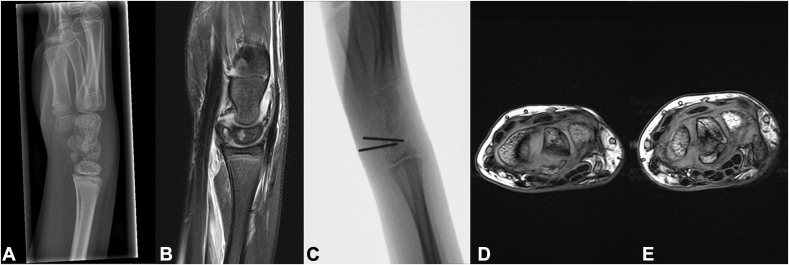 Figure 1
Peer Reviews
No public reviews on file for this paper yet. If you reviewed it on a platform where reviews are public (OpenReview, ICLR, NeurIPS, ICML), you can paste yours below so the community can read it here.
Videos
No videos yet. Explain this paper in a talk, walkthrough, or lecture? Add one.
Taxonomy
TopicsOrthopedic Surgery and Rehabilitation · Elbow and Forearm Trauma Treatment · Traumatic Ocular and Foreign Body Injuries