Links between self-monitoring data collected through smartphones and smartwatches and the individual disease trajectories of adult patients with depressive disorders: Study protocol of a one-year observational trial
Hanna Reich, Simon Schreynemackers, Rebeka Amin, Sascha Ludwig, Jil Zippelius, Johannes Leimhofer, Tobias Dunker, Elisabeth Schriewer, Angela Carell, Yvonne Weber, Ulrich Hegerl

TL;DR
This study explores how smartphone and smartwatch data can track depression severity and help personalize treatment for patients.
Contribution
It introduces a method to use self-monitoring data for predicting and tracking depression symptoms in individuals.
Findings
Biosensor data from smartphones and smartwatches may serve as objective markers for depression severity.
Machine learning models could predict self-reported depressive symptoms over time.
Personalized digital interventions may be tailored based on individual data patterns.
Abstract
Depression is highly recurrent and heterogenous in its individual course, requiring a personalized treatment approach. Patients today can collect large volumes of personal data via smartphones and smartwatches and may utilize them for their treatment and self-management. We aim to provide proof-of-concept that these data can (i) serve as an objective marker of and (ii) predict the daily and weekly self-reported depression severity within individuals with depressive disorders. In this exploratory study, 15 adult patients with depressive disorders will collect self-report and biosensor data over the course of one year. Participants will (a) attend three in-person appointments (at baseline, 6 months, and 12 months), (b) self-report daily and weekly depressive symptoms, (c) continuously collect sensor data via the “iTrackDepression” app on their Android smartphone (app usage, phone calls,…
Genes, proteins, chemicals, diseases, species, mutations and cell lines named across the full text — each resolved to its canonical identifier and authoritative record.
Click any figure to enlarge with its caption.
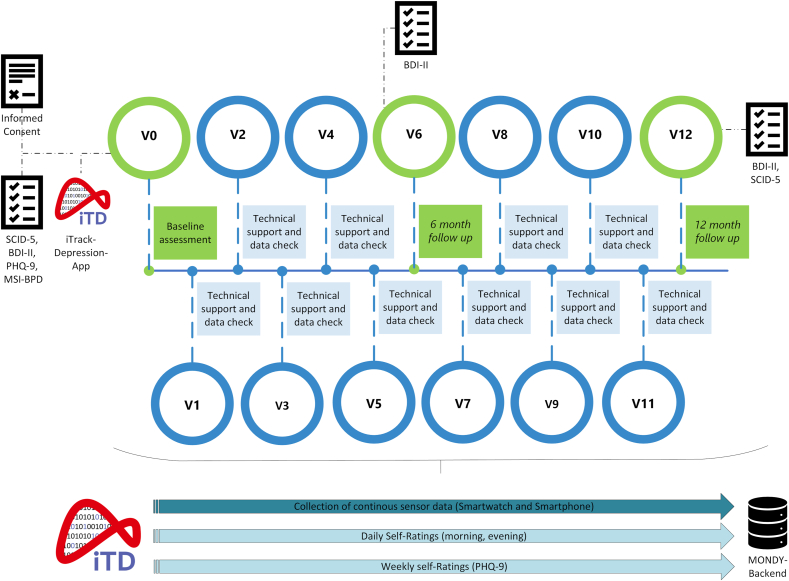 Figure 1
Peer Reviews
No public reviews on file for this paper yet. If you reviewed it on a platform where reviews are public (OpenReview, ICLR, NeurIPS, ICML), you can paste yours below so the community can read it here.
Videos
No videos yet. Explain this paper in a talk, walkthrough, or lecture? Add one.
Taxonomy
TopicsMental Health Research Topics · Digital Mental Health Interventions · Impact of Technology on Adolescents