Enhancing Antidiabetic Drug Selection Using Transformers: Machine-Learning Model Development
Hisashi Kurasawa, Kayo Waki, Tomohisa Seki, Eri Nakahara, Akinori Fujino, Nagisa Shiomi, Hiroshi Nakashima, Kazuhiko Ohe

TL;DR
This study developed a machine learning model using transformers to predict diabetes drug prescriptions, aiming to help nonspecialists make better treatment decisions.
Contribution
A transformer-based model that accurately predicts antidiabetic drug prescriptions with high ROC-AUC performance.
Findings
The model achieved a microaverage ROC-AUC of 0.993 and a macroaverage ROC-AUC of 0.988, surpassing the target of 0.95.
The model outperformed LightGBM and achieved high accuracy for 43 out of 44 drugs.
Training on 5-year data yielded better performance than 10-year data, suggesting recent patterns are more predictive.
Abstract
Diabetes affects millions worldwide. Primary care physicians provide a significant portion of care, and they often struggle with selecting appropriate medications. This study aimed to develop a model that accurately predicts what drug an endocrinologist would prescribe based on the current measurements. The goal was to create a system that would assist nonspecialists in choosing medications, thereby potentially improving diabetes treatment outcomes. Based on the performance of previous studies, we set a performance target of achieving a receiver operating characteristic area under the curve (ROC-AUC) above 0.95. A transformer-based encoder-decoder model predicts whether 44 types of diabetes drugs will be prescribed. The model uses sequences of age, sex, history for 12 laboratory tests, and prescribed drug history as inputs. We assessed the model using the electronic health records…
Genes, proteins, chemicals, diseases, species, mutations and cell lines named across the full text — each resolved to its canonical identifier and authoritative record.
Click any figure to enlarge with its caption.
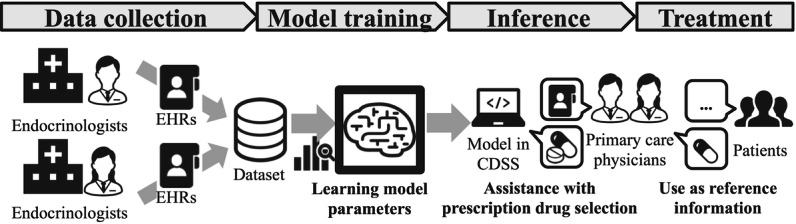 Figure 1
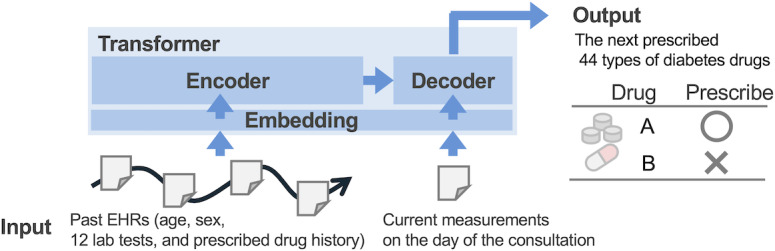 Figure 2
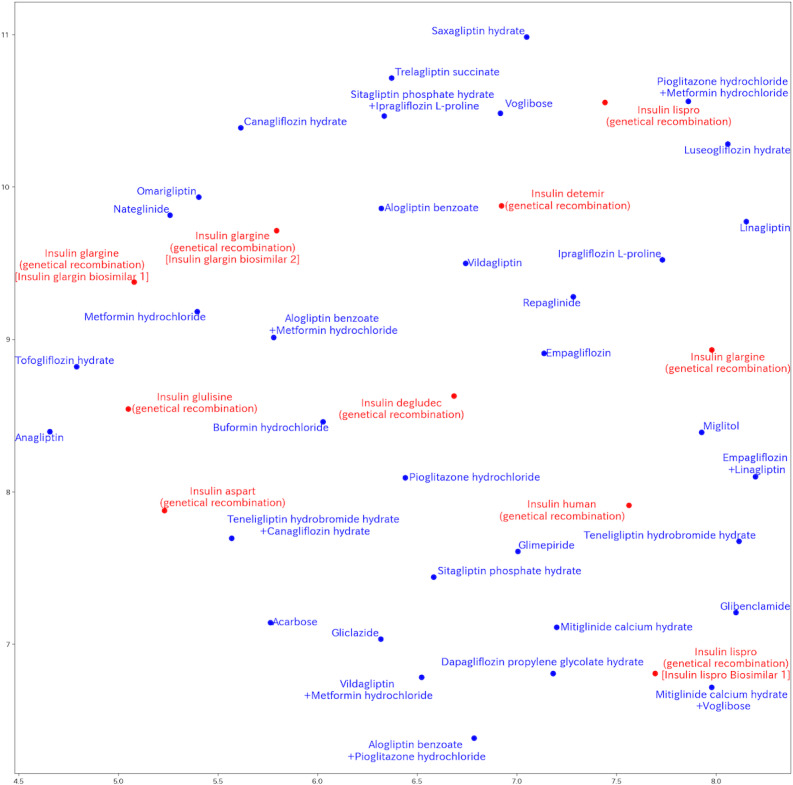 Figure 3
Peer Reviews
No public reviews on file for this paper yet. If you reviewed it on a platform where reviews are public (OpenReview, ICLR, NeurIPS, ICML), you can paste yours below so the community can read it here.
Videos
No videos yet. Explain this paper in a talk, walkthrough, or lecture? Add one.
Taxonomy
TopicsMachine Learning in Healthcare · Artificial Intelligence in Healthcare · Biomedical Text Mining and Ontologies