Comparison of sequence- and structure-based antibody clustering approaches on simulated repertoire sequencing data
Katharina Waury, Stefan Lelieveld, Sanne Abeln, Henk-Jan van den Ham, Claude Loverdo, Claude Loverdo, Claude Loverdo

TL;DR
This study compares traditional and new methods for grouping antibodies based on their sequence and structure to better understand immune responses.
Contribution
The paper provides the first comprehensive comparison of structure-based antibody clustering methods on realistic repertoire data.
Findings
Structure-based methods group more antibodies together than sequence-based clonotyping.
SPACE2 requires same-length CDR regions, limiting its applicability.
Structure-based clustering shows promise but still faces challenges like missing structure templates.
Abstract
Repertoire sequencing allows us to investigate the antibody-mediated immune response. The clustering of sequences is a crucial step in the data analysis pipeline, aiding in the identification of functionally related antibodies. The conventional clustering approach of clonotyping relies on sequence information, particularly CDRH3 sequence identity and V/J gene usage, to group sequences into clonotypes. It has been suggested that the limitations of sequence-based approaches to identify sequence-dissimilar but functionally converged antibodies can be overcome by using structure information to group antibodies. Recent advances have made structure-based methods feasible on a repertoire level. However, so far, their performance has only been evaluated on single-antigen sets of antibodies. A comprehensive comparison of the benefits and limitations of structure-based tools on realistic and…
Genes, proteins, chemicals, diseases, species, mutations and cell lines named across the full text — each resolved to its canonical identifier and authoritative record.
Click any figure to enlarge with its caption.
 Figure 1
 Figure 2
 Figure 3
 Figure 4
 Figure 5
 Figure 6
 Figure 7
 Figure 8
 Figure 9
 Figure 10
 Figure 11
 Figure 12
 Figure 13
 Figure 14
 Figure 15
 Figure 16
 Figure 17
 Figure 18
 Figure 19
 Figure 20
 Figure 21
 Figure 22
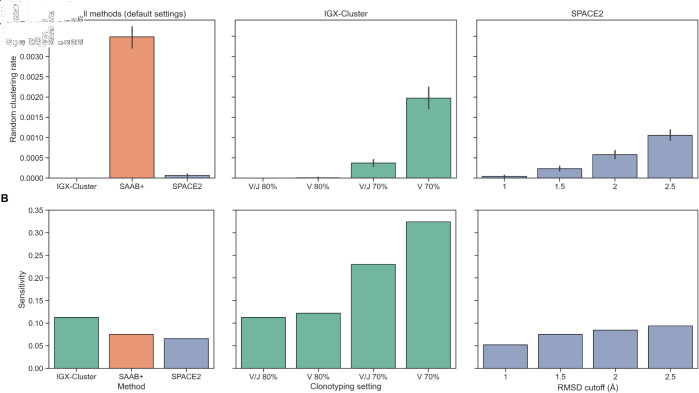 Figure 23
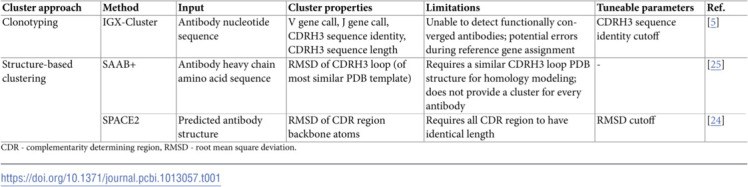 Figure 24
 Figure 25
Peer Reviews
No public reviews on file for this paper yet. If you reviewed it on a platform where reviews are public (OpenReview, ICLR, NeurIPS, ICML), you can paste yours below so the community can read it here.
Videos
No videos yet. Explain this paper in a talk, walkthrough, or lecture? Add one.
Taxonomy
TopicsMonoclonal and Polyclonal Antibodies Research · T-cell and B-cell Immunology · vaccines and immunoinformatics approaches